For cancer survivors whose neuropathy never went away
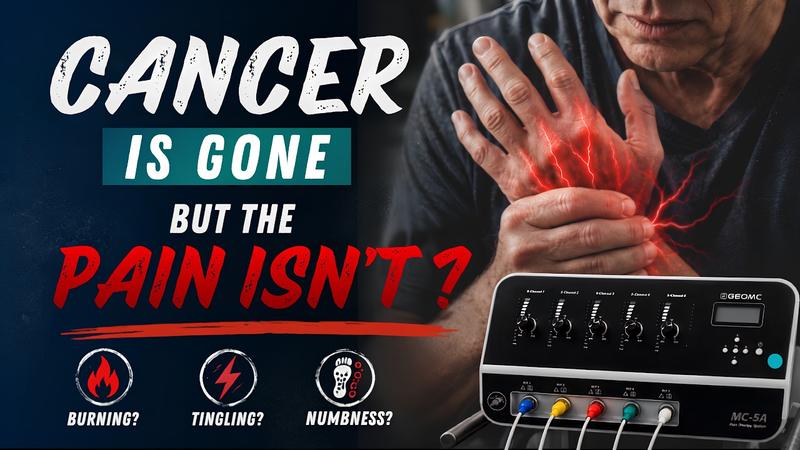
The cancer is gone. The pain isn't.Let's work on what the chemo left behind.
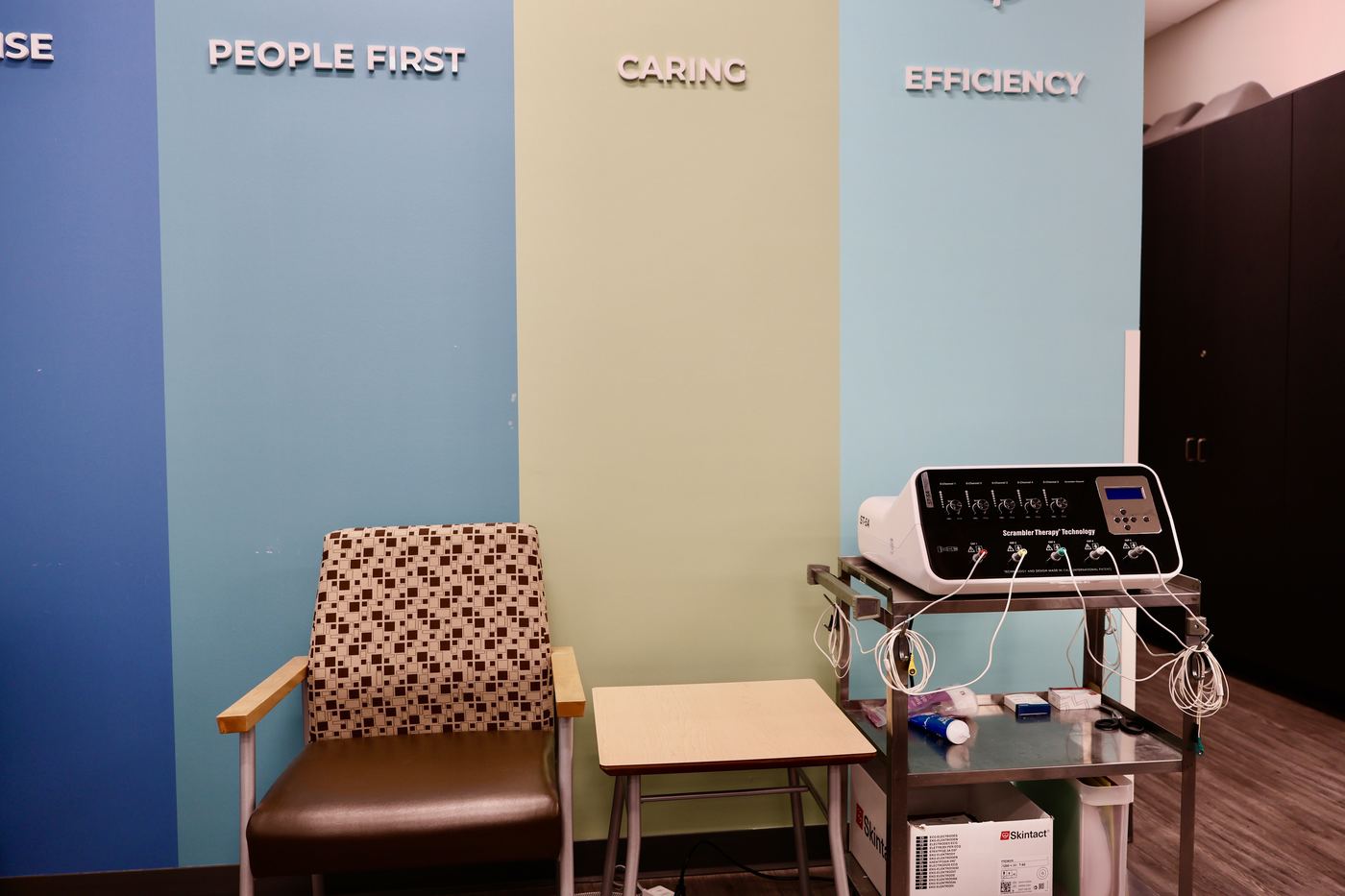
Scrambler therapy is an FDA-cleared, non-drug treatment for nerve pain — and chemo neuropathy is one of the conditions it was built for. Small pads go on healthy skin above the numb and burning areas, and the machine sends a calm, non-pain message up the same nerves. No pills to add. Nothing implanted. Nothing to recover from. A $19 consultation and a $99 first session tell you what your own nerves do with it.
You did everything they asked.
The infusions. The scans. The long days in the chair and the longer nights after. You got through it. Maybe you rang the bell. People hugged you and said the word survivor, and they meant it.
And then your feet never came back.
It started as tingling somewhere in the middle of treatment. Everyone said it would fade. Instead it settled in — the pins and needles, the burning soles, the feeling of walking on gravel in your own kitchen. For a lot of people the hands go too. Buttons are hard. Earrings are hard. You drop your keys, your phone, a coffee cup, and you don't feel it leave your fingers. Some people even notice it getting worse for a while after the last infusion.
Night is the worst of it. The sheet on your feet feels like sandpaper, so they go outside the covers. You get up in the dark and you're not sure where the floor is. You've started holding the rail on the stairs. Maybe you've stopped driving at night, because you can't quite feel the pedals.
You mentioned it. You were told to be patient — it will go away. You were handed gabapentin, and the fog that came with it. Maybe Lyrica, and the weight. Maybe Cymbalta. Some of it turned the volume down a little. None of it gave you your feet back.
Now you're a year out, or three, or ten. And the thought you don't say out loud is this: I survived cancer, and this is what I get to keep.
Here's the other side of that thought: the cancer part is done. The nerve pain is a separate problem — and it has its own treatment. Most people living with it have simply never been told about it: very few clinics own the machine, and insurance rarely covers it. The rest of this page is about that treatment.
The mechanism
How it works — in plain words
Start with what's actually wrong.
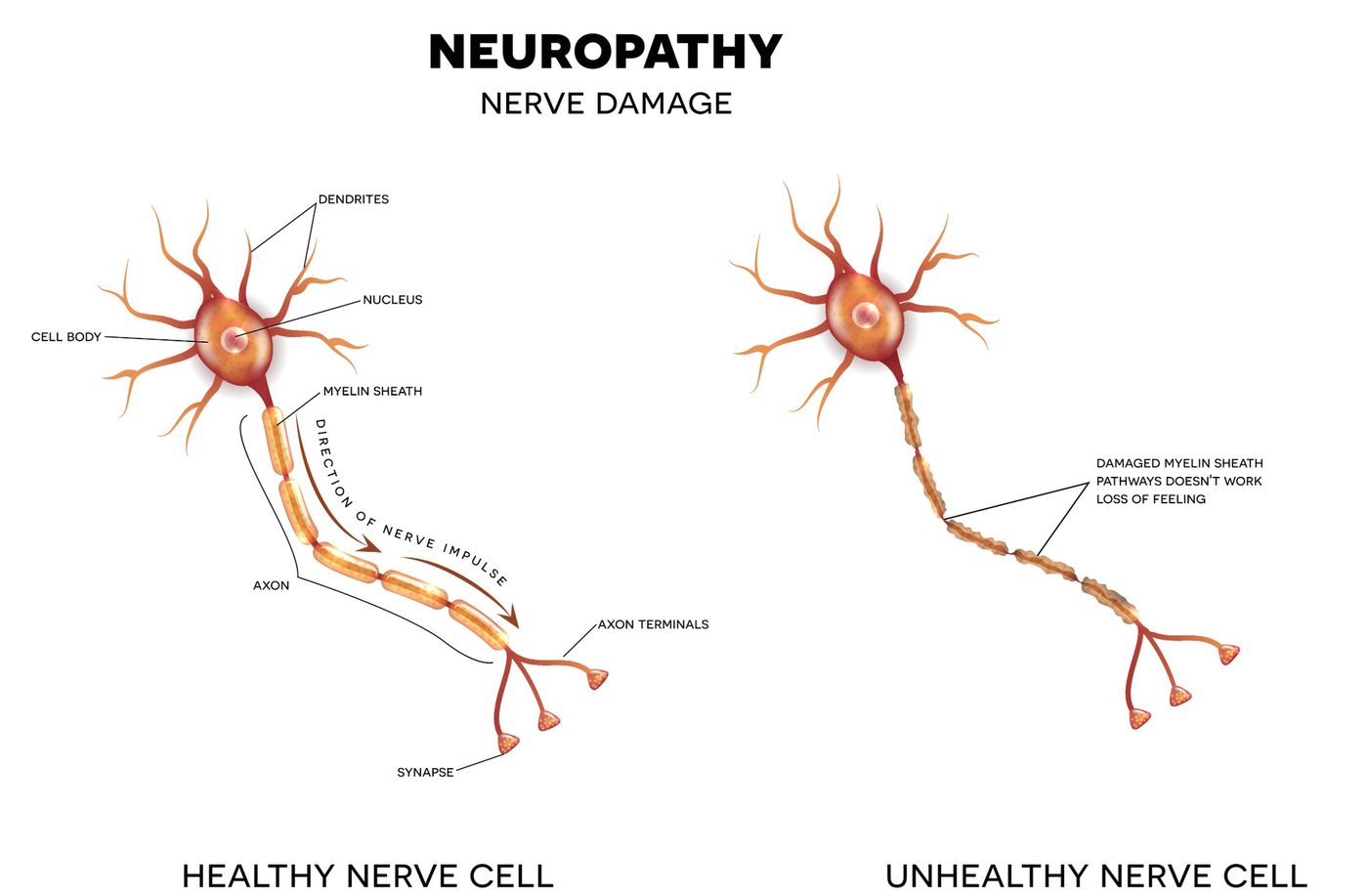
Chemotherapy is built to hit fast-growing cells hard. Some of those drugs also damage the long, thin nerves that reach your hands and feet: the nerve fibers themselves, and the myelin coating that protects them. That's the damage in the picture above. When treatment ends, the cancer drugs are gone — but the nerve pathway has learned a habit. It keeps firing, and your spinal cord and brain keep listening. The pain becomes the habit rather than the alarm.
That's why the usual tools underperform. A pill that lowers the volume doesn't change the message. Gabapentin quiets the signal but doesn't retrain it — which is why the dose tends to climb while the feet stay the same.
Scrambler therapy goes after the message.
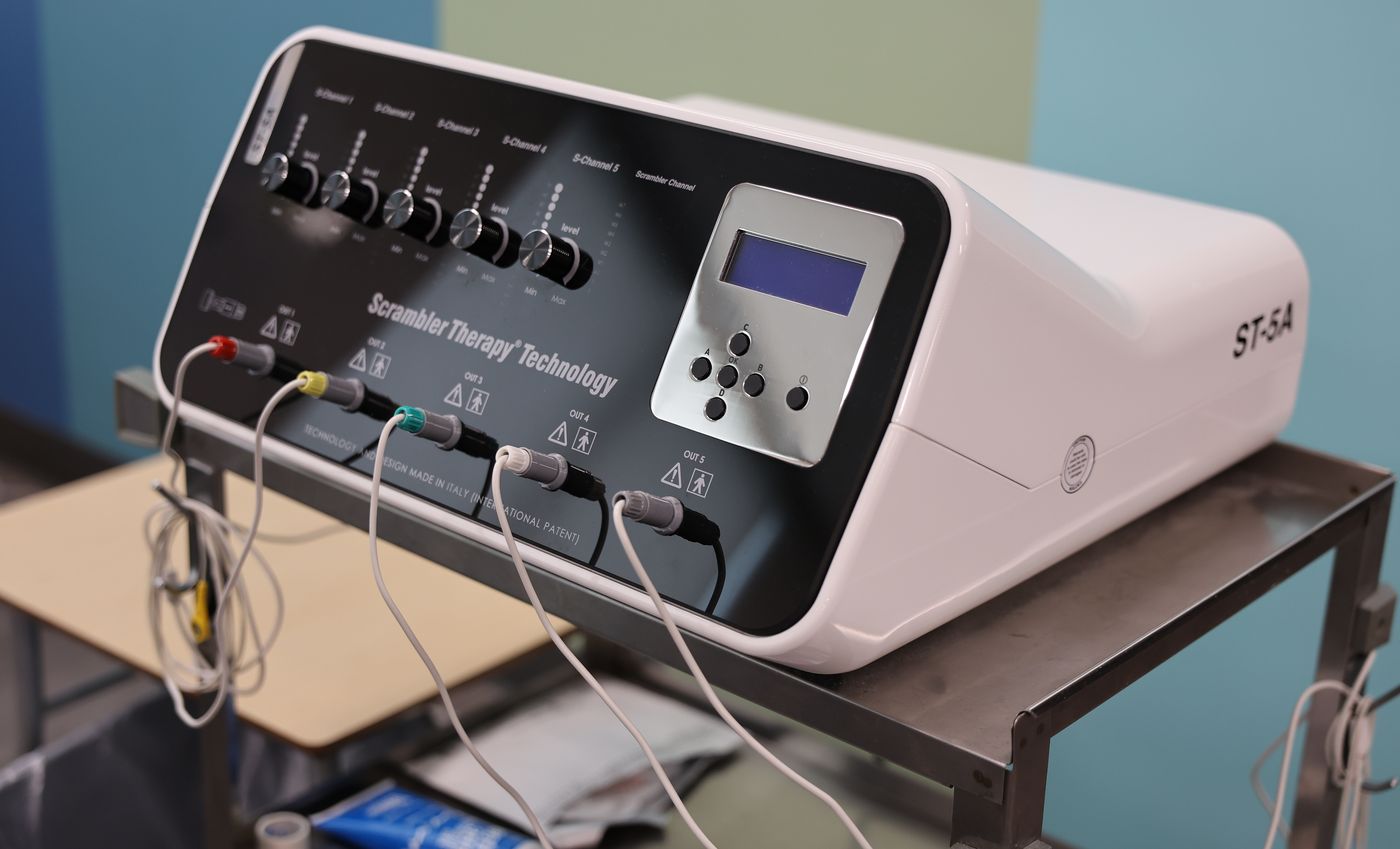
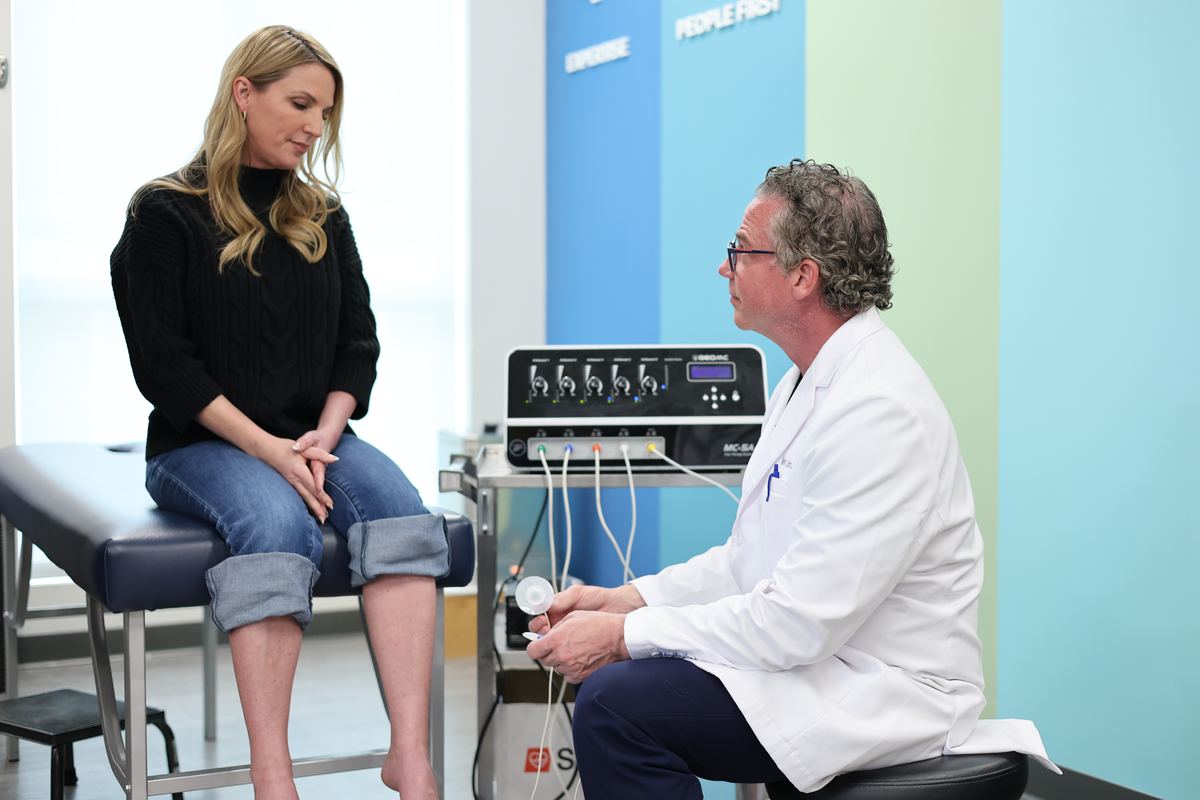
The details below follow a 2023 New England Journal of Medicine review of scrambler therapy, written by physicians at Johns Hopkins and the Mayo Clinic.1 Small adhesive pads — like the ones used for a heart tracing — go on healthy skin along the nerve pathway that feeds the painful area.2 For chemo neuropathy that means above the numb zone, never on it — higher up the leg for the feet, up the arm for the hands. The treatment needs nerves that still work well enough to carry a signal, so we place the pads where they do.3
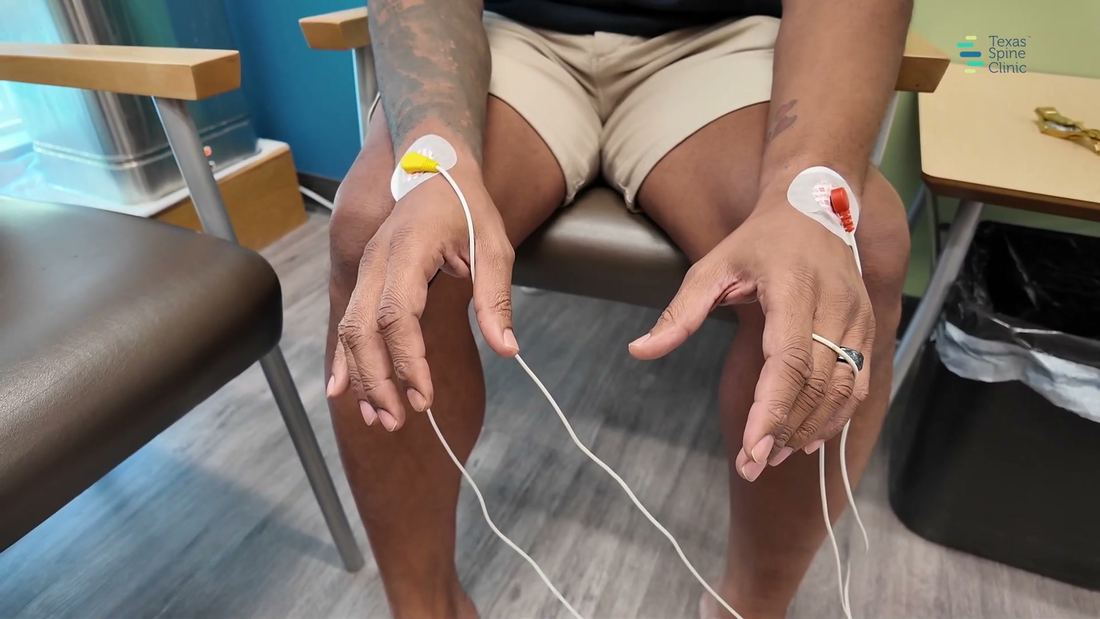
Then the machine sends its own signal up those nerves: constantly changing waveforms, shaped to imitate the traffic a healthy nerve sends when nothing is wrong.2 Your nervous system gets a non-pain message on the same line that has carried pain — over and over, for about forty minutes.
Most people feel the pain drop in the room. Then the question becomes how long it holds — which is what the course answers.
"Isn't this just a TENS unit?"
Fair question — the pads look the same. They're different treatments. The same NEJM review is clear that scrambler therapy is not a type of TENS.2 A TENS unit is set by you, at home, and its relief is meant to last while it's on. The scrambler's signal comes from the device's own program, it's run only by trained hands under a physician's supervision, and it's given as a course because it aims at relief that outlasts the session.
If a TENS unit did nothing for your feet, that tells you nothing about this.
"My feet are numb. How can pads work on feet I can't feel?"
That's exactly why they don't go on the numb part. The pads go higher up, on skin that still feels normally, along the same nerve route that serves the sole of your foot or the tips of your fingers. The signal travels from there. It's also why placement takes skill, and why it's worked out fresh at every visit.
"Does it hurt?"
No. A properly run session is a clear, comfortable tingle — some people say fizzing, some say tiny electrical ants.2
After cancer
What this treatment was built for
Scrambler therapy and cancer patients go back a long way. That same review lists chronic nerve pain and cancer pain as what the device was designed for — and the patient it uses to show how the treatment is done is a patient whose feet were hurt by chemotherapy.3 For a lot of the people who use this treatment, this is the field.
What it asks of you is small. After everything cancer treatment took out of you, that matters. No new medication, and nothing to wean off later. No needles. Nothing implanted, nothing that needs surgery. No downtime — you sit back for about forty minutes and drive yourself home. And nothing here closes a door: every other option you have today is still there afterward.
Chemo neuropathy can move. Some people find the numb and burning areas shift, especially in the first months after treatment. The device's own instructions call for placement to be worked out fresh for exactly that reason, and that's how we do it: every session, the setup matches where your pain is today.4
If your neuropathy is stubborn, we bring in more. Our CRPS protocol — graded desensitizing work started while the pain is down during a session, with the approach changed across the course until the pain answers — isn't only for CRPS. We use whatever part of it helps for any nerve pain that resists the scrambler sessions alone. It's part of the course, not billed on top.
What to expect
What a session is like — and the course
You keep your clothes on. You sit back in a treatment chair. Roll up your trousers or your sleeves, and that's it.
The pads go on by hand, along the nerve route above the painful area. If the first placement doesn't get the answer we want, they come off and go somewhere else. Feet and hands often each need their own setup.
You tell us what you feel. The level comes up in small steps. First, tell me when you feel something. Then, tell me when it's enough.2 The target is a clear tingle that's completely comfortable.
We don't put the pads on and walk away. Someone is with you the whole session, checking what the pain is doing and changing the setup on the spot. The goal every session is your pain at zero while you're in the chair.
About forty minutes, then you drive home.4 No drowsiness, no restrictions.
A full course is ten sessions on back-to-back weekdays — five days a week for two weeks.4 That's the protocol the device is built around. It's why we run scrambler sessions on Fridays, when the rest of the clinic is closed.
But you don't decide about ten days on day one.
- A $19 consultation. About an hour, Monday to Thursday: roughly thirty minutes of conversation and exam, then about thirty minutes of treatment.
- A $99 first session — credited toward the course. A full session, run properly, so you find out what your own nerves do with it.
- Then you decide — with your number in writing before you commit to anything.
What "working" tends to look like
For people who respond, relief builds across the course — each session's relief tends to last longer than the last.2 Some people come back later for a short round of booster sessions, usually a few days rather than another full course. In San Antonio, that's a drive, not a flight.
Why this works
Why this works — and what we stand behind
Scrambler therapy retrains the pain signal instead of masking it. Here's what makes it work here, and what you can hold us to.
It works on the signal. Your nerves are sending a pain message that isn't warning you about anything anymore. Scrambler therapy hands them a different message until they start holding on to it.
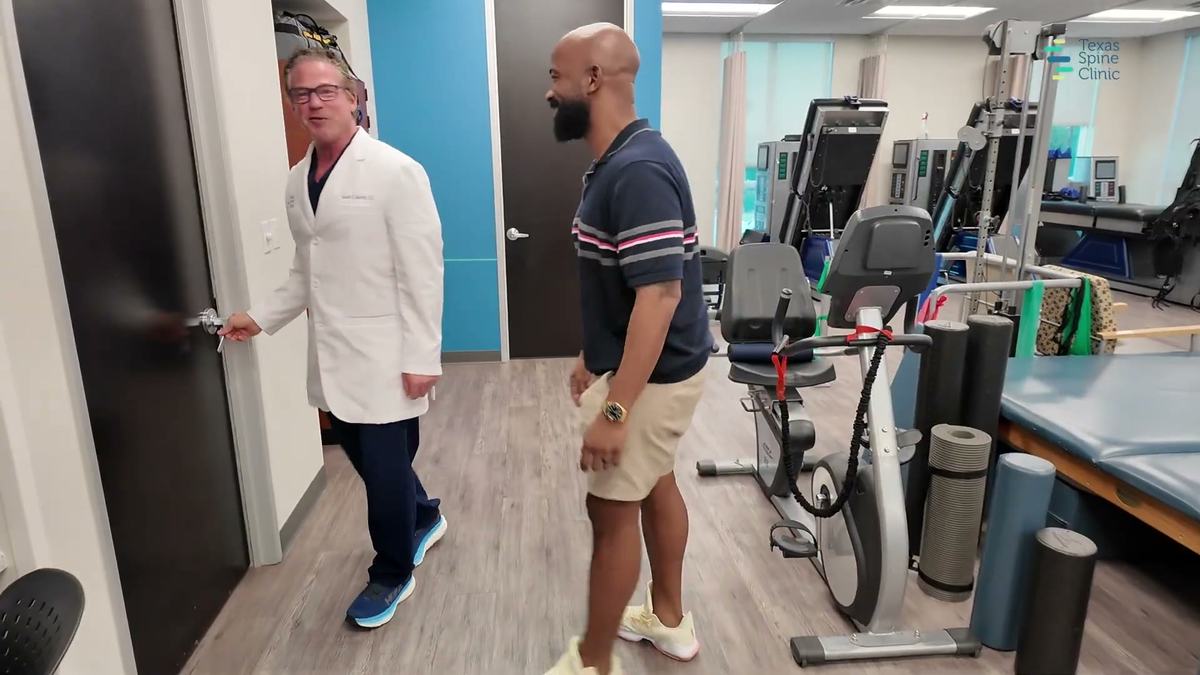
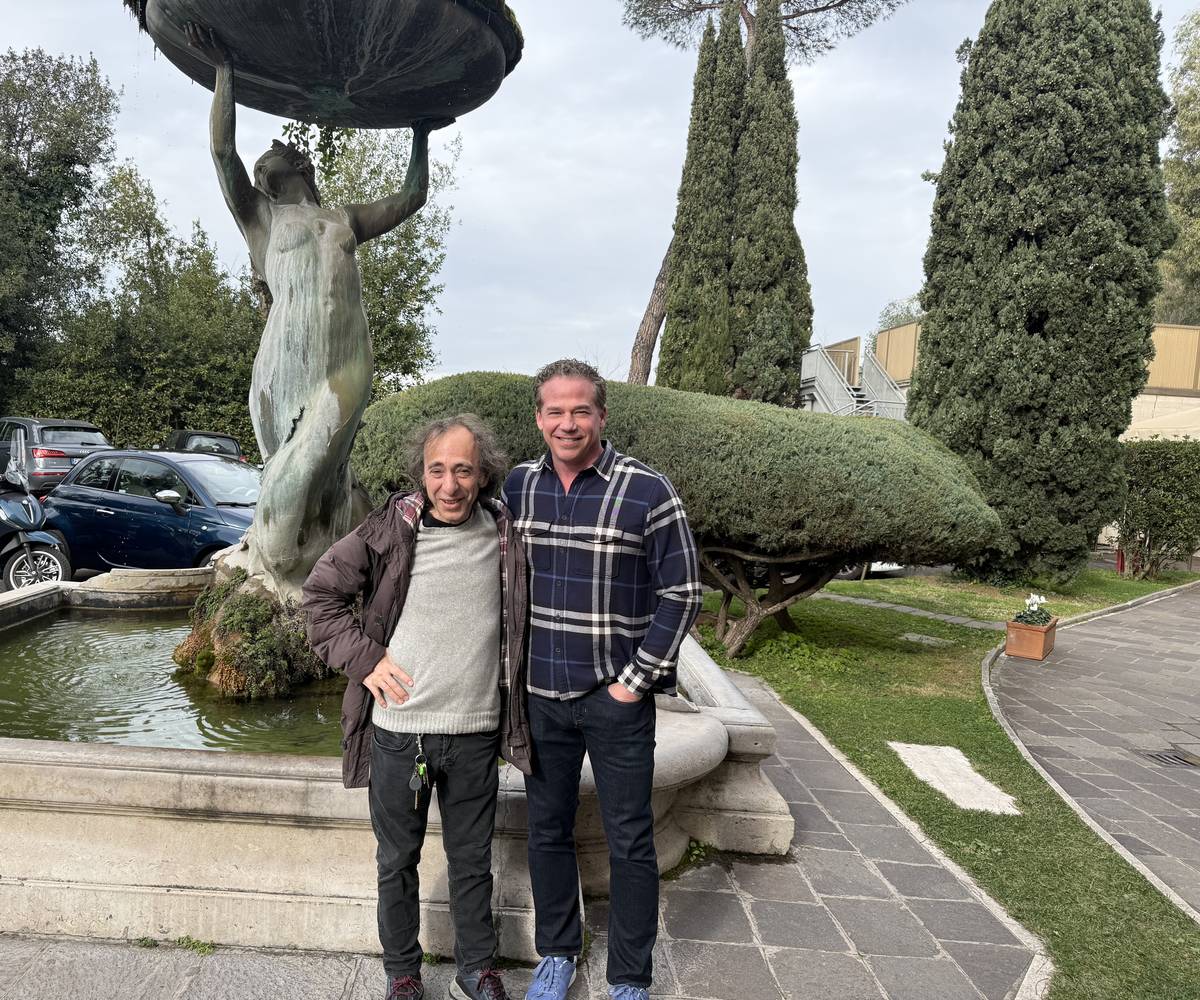
Who runs it matters. Everything depends on where the pads go and whether the level is set by someone paying attention to your answers. Dr. Barton trained in Rome with the inventor, Dr. Giuseppe Marineo — and every course here runs under the medical supervision of Lisa D. Persyn, M.D.
What we stand behind
- A full session before you invest in a course. That's what the $99 is for.
- We measure what matters to you. At your first visit and at follow-ups we use standard questionnaires and track three things: how bad the pain is, how often it comes, and what you can do — sleep with your feet under the covers, stand at the stove, walk to the mailbox, wear real shoes. We listen to what you tell us, and we never ignore it.
- If it isn't working, we tell you and we stop. Nobody runs you through ten sessions of something that isn't helping.
- Someone with you the whole session, every session.
Candidacy
Who this is for — and who it's not for
Who we see for chemo neuropathy
People whose hands, feet, or both have stayed painful, burning, tingling or numb after chemotherapy — whether treatment ended last season or years ago.
- Burning or pins-and-needles in the feet or hands — the "sock and glove" pattern
- Numbness that makes buttons, keys and small things hard to handle
- Pain that wrecks sleep — feet outside the covers, the sheet too much to bear
- Medicines that haven't held, or that cost too much in fog and weight
Who cannot have this treatment
These are absolute. They come from the device's own instructions, and no exam changes them:4
- An implanted pacemaker or defibrillator
- A spinal cord stimulator or peripheral nerve stimulator, implanted or in trial
- Aneurysm clips, vena cava clips, or skull plates
- A seizure disorder — epilepsy, or a tendency to seizures
- Pregnancy — the treatment hasn't been studied in pregnancy, so it isn't used
- Undiagnosed pain — pain nobody has worked up yet needs a diagnosis first, not a treatment. If that's where you are, we'll help you get to the right person.
Where we take extra care
Heart problems, diagnosed or suspected — we talk to you about it, and there are placements we don't use. Skin that has lost normal sensation, or is broken, infected or fragile where pads would go — with chemo neuropathy, that's the reason the pads go above the numb area. A tendency to bleed or bruise easily, or a recent fracture. Some anticonvulsant medications can change how the course is run — bring your full medication list to the consultation. And occasionally, skin irritation where the pads sit: it's the most common side effect there is, and moving the placement usually solves it. If you're still in cancer treatment, your oncologist is part of the plan before we begin.4
Your care team
Who does the treatment
With scrambler therapy, who is placing the pads matters as much as the machine. So here's our answer, before you ask.
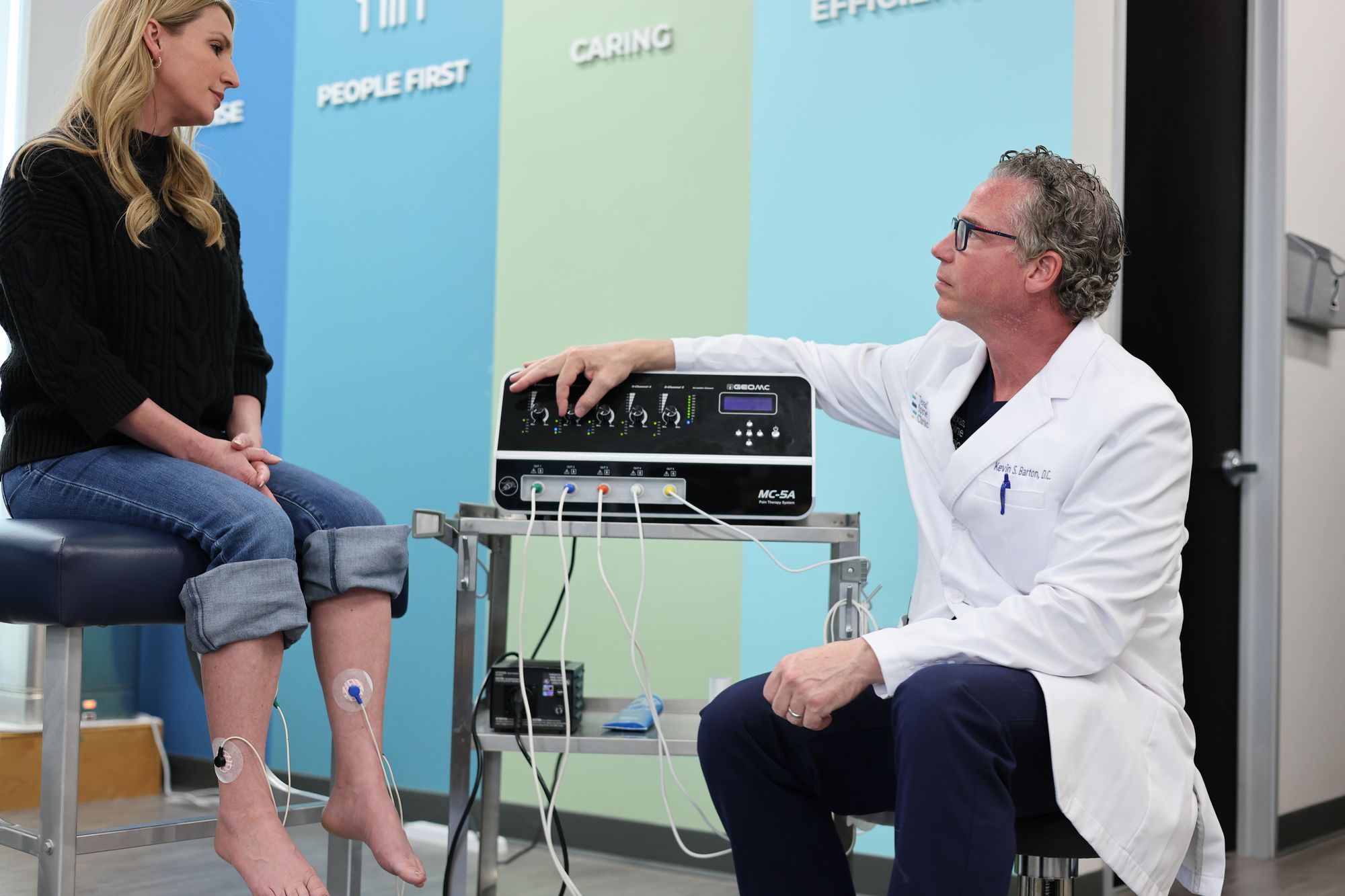
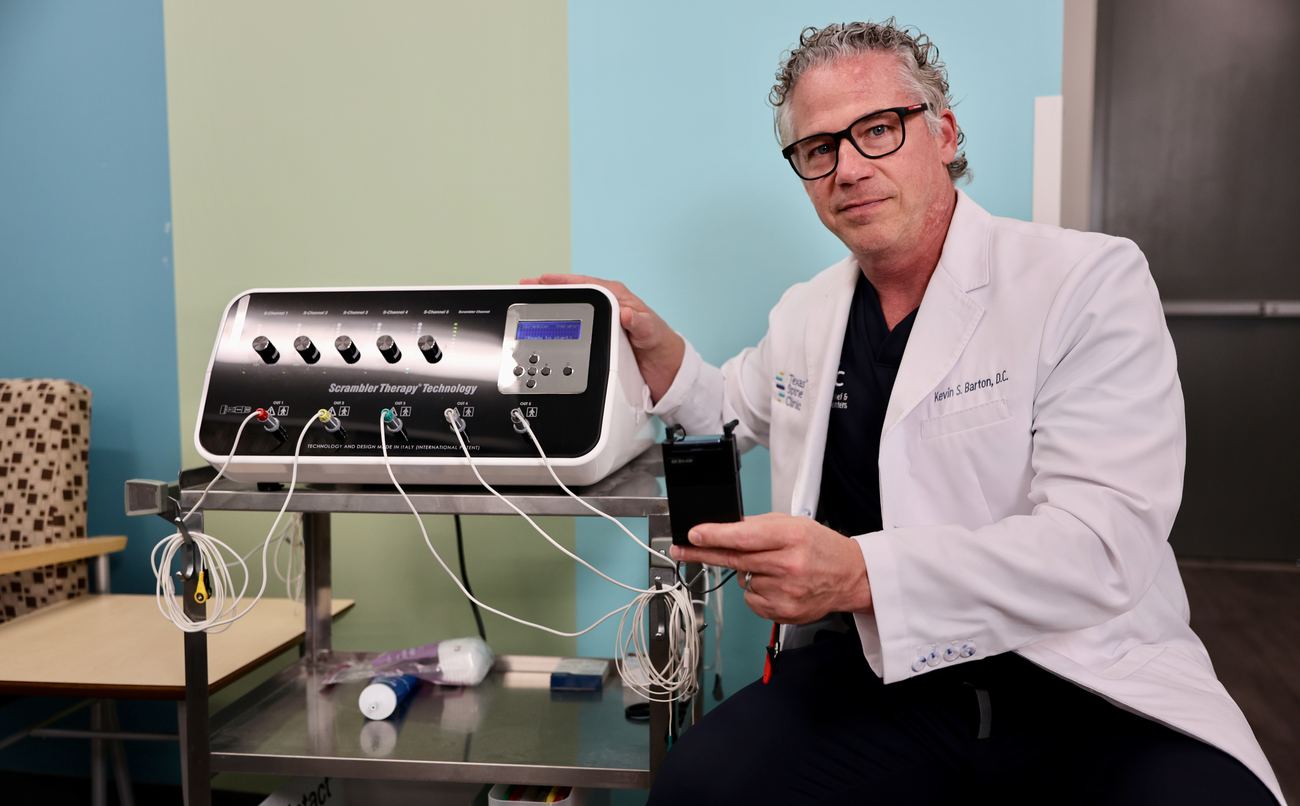
Kevin S. Barton, D.C. has practiced in San Antonio since 2003. He manages the scrambler program, and he does the treatments. He is advanced scrambler-trained: he trained in Rome, Italy, with Dr. Giuseppe Marineo — the biophysicist who invented this treatment.5
The program is medically supervised by Lisa D. Persyn, M.D., who is board certified in Physical Medicine and Rehabilitation — the specialty built around restoring function to people living with pain and nerve injury. That's how this device is meant to be used: by physicians, or by trained staff under a physician's supervision.1 And it means a physician is part of your care as well as the doctor running your sessions.
What that looks like in the room: pads placed fresh every visit, the level set with you saying where it stops, the setup changed on the spot when the pain isn't answering, and someone beside you the whole time.
Patients
Patient stories
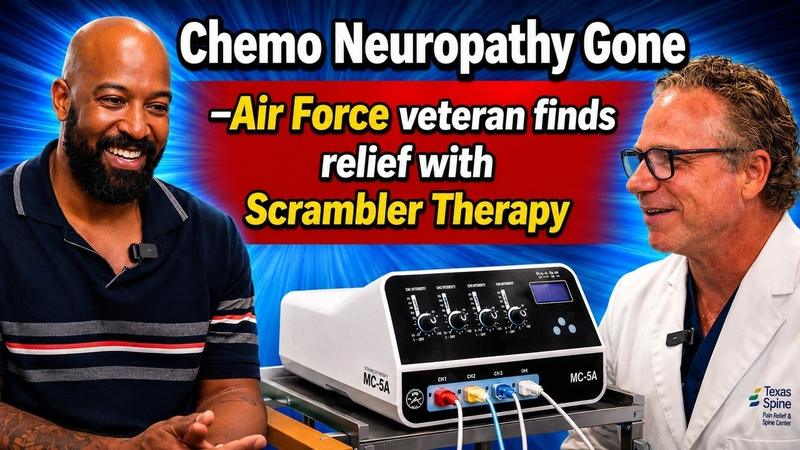
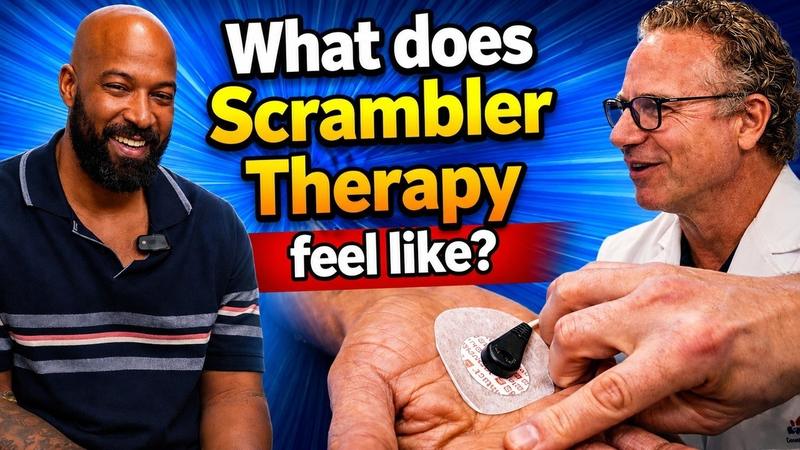
“Highly recommend using Texas Spine Clinic. I've been traveling to Dallas for the last three years and now I can go in San Antonio for scramble therapy.”
Every patient's story is their own. Results vary. These are real Texas Spine Clinic patients, sharing their experiences with their permission — watch them tell it in their own words.
Questions patients actually ask
Before you call
I finished chemo years ago. Is it too late?
Nerve pain that has been there for years is exactly the kind of stuck signal this treatment goes after. How long you've had it doesn't rule you out. The $99 first session is how you find out what your nerves do with it.
Can I do this while I'm still in cancer treatment?
Tell us where you are in treatment at the consultation. Your cancer care always comes first, and nothing we do here changes your cancer plan. If you're in active treatment or on a maintenance therapy, your oncologist is part of the decision before we start.
My feet are numb, not just painful. Can it help numbness?
The published description judges a session by whether pain, tingling or numbness eases,3 and we track all three with you. The pads go above the numb area, on skin that still feels normally, because that's where the signal can travel.
Does it hurt?
No. A properly run session feels like a comfortable tingle. If anything increases your pain, we stop and change the placement.
Can I keep taking gabapentin or my other medicines?
Keep taking them for now, and don't stop anything on your own. Gabapentin, Lyrica (pregabalin) and Cymbalta (duloxetine) can all interfere with the signal scrambler therapy sends, so we'll work with the doctor who prescribed them to wean you off safely. That has to be done gradually: gabapentin and Lyrica are anticonvulsants, and stopping them all at once can cause seizures. Cymbalta can cause withdrawal symptoms if it's stopped suddenly. Bring your full medication list to the consultation.
How many sessions will I need?
A full course is ten, on back-to-back weekdays over two weeks. Some people come back later for a short round of boosters.
What does it cost, and is it covered by insurance?
The consultation is $19, and the first full session is $99 — credited toward the course if you continue. Scrambler therapy isn't a covered insurance benefit, so the course itself is an out-of-pocket investment, and we go through it with you after your first session.
Who actually does the treatment?
Dr. Barton runs the sessions himself. He trained in Rome with Dr. Giuseppe Marineo, the inventor, and the program is medically supervised by Lisa D. Persyn, M.D. Nobody is left alone with a machine running.
What if it doesn't work for me?
You'll know early — that's the point of starting with one $99 session. You'll have invested $19 and $99 in a clear answer instead of more years of wondering. If it does work and you continue, the $99 comes off the course.
Footnotes
- Smith TJ, Wang EJ, Loprinzi CL. Cutaneous Electroanalgesia for Relief of Chronic and Neuropathic Pain. New England Journal of Medicine 2023;389:158–64. Review by physicians at Johns Hopkins and the Mayo Clinic. ↩
- Same review — mechanism and application: electrode placement on unaffected skin along the affected dermatomes; the continuously varied waveform sequences; the operator's step-by-step level-setting dialogue; session length; relief typically lengthening over a course; reported durability and retreatment; and the statement that scrambler therapy is distinct from TENS. ↩
- Same review — Table 1, which lists chronic neuropathic and cancer pain as what the device was designed for; Figure 2B, which shows scrambler therapy in a patient with chemotherapy-induced neuropathy of the feet, with electrodes placed above the area of diminished sensation; and the criterion that a session is successful when pain, tingling or numbness is relieved. ↩
- ST-5A device instruction manual (Delta International Services & Logistics, rev. 2020) — indications, warnings, contraindications, precautions and treatment protocol, including session length, the ten-treatment course structure, and the exclusions listed above. ↩
- Dr. Barton completed advanced scrambler therapy training in Rome, Italy, with Dr. Giuseppe Marineo, who developed scrambler therapy at the University of Rome Tor Vergata. ↩
Primary sources on file at the clinic.
The ask
You got through the hard part. Let's find out about this one.
Call (210) 741-9166. The consultation is $19.
- The $19 consultation. About an hour, Monday to Thursday. We take your history — the cancer, the treatment, and everything you've tried since — check you against the list of reasons someone can't have this treatment, and then treat for about thirty minutes.
- A $99 first session — credited toward the course. You see what your own nerves do with it before anyone talks to you about a program.
- You decide, with the number in front of you. If you responded, we walk you through the full course, and you decide with all of it in the open.
Texas Spine Clinic · 3212 Napier Park, San Antonio, TX 78231
Monday–Thursday, 8 a.m.–5 p.m. · Friday: scrambler therapy sessions only, by
appointment.
Book your $19 consultation
No referral needed. Same-day appointments available.
Calendar not showing? Open it in a new tab.
Rather book by phone? Call (210) 741-9166.
P.S. You've spent a long time being told to wait — for the chemo to finish, for the scans, for your feet to come back on their own. You don't have to wait to find out about this. A $19 consultation and a $99 session, and within a couple of weeks you could have a real answer. Call (210) 741-9166.