
Whiplash · Neck pain after a car accident · San Antonio
You walked away from the wreck.Now you can't turn your head.
A stiff neck that got worse overnight. A headache that starts at the base of your skull and climbs. Shoulders tight up to your ears. Maybe a tingle in your hand you can't explain. That's what whiplash usually feels like — and it very often shows up a day or two after the crash, not at the scene.
Here's the good part: whiplash is treatable, and the weeks right after a wreck are when care does the most good. Your first visit costs you nothing out of pocket. You can be seen the same day, and most people get their first treatment at that visit.
Same-day appointments, Monday–Thursday.
At the scene you were mostly annoyed. The other driver was apologizing, somebody asked if you wanted an ambulance, and you said no — you felt fine. You drove home, or got a ride, and went to bed.
The next morning, turning your head to check your blind spot felt like pulling a rope through a knot. By the second day the ache had spread into your shoulders, and a headache had set up camp at the back of your skull.
Maybe you went to urgent care or the ER. They took X-rays, told you nothing was broken, said "it's just whiplash," and sent you home with something for the pain and a sheet of paper that said rest.
That was a week ago. Or three. Or three months. And nobody has told you what's actually injured, how long it should take, or what to do about it.
That's what this page is for.
What whiplash actually is
Your head kept going after your body stopped.
Your head weighs about as much as a bowling ball, and it sits on top of seven small bones held together by muscle, ligament and small joints. In a crash — most often when you're hit from behind — the seat shoves your body forward and your head lags behind for an instant, then snaps forward to catch up. The whole thing happens faster than your muscles can brace.
In that instant, the tissues of your neck get stretched past where they're built to go:
- Muscles along the back and sides of your neck, which strain and then clamp down to protect the area.
- Ligaments — the tough straps that hold each vertebra to the next — which sprain.
- The small joints at the back of each level (facet joints), which get jammed and irritated.
- Sometimes a disc — the cushion between two vertebrae — which can be injured by the same force.
Doctors call this a cervical acceleration-deceleration injury. Almost everyone else calls it whiplash: a sprain and strain of the neck, caused by a fast back-and-forth motion.

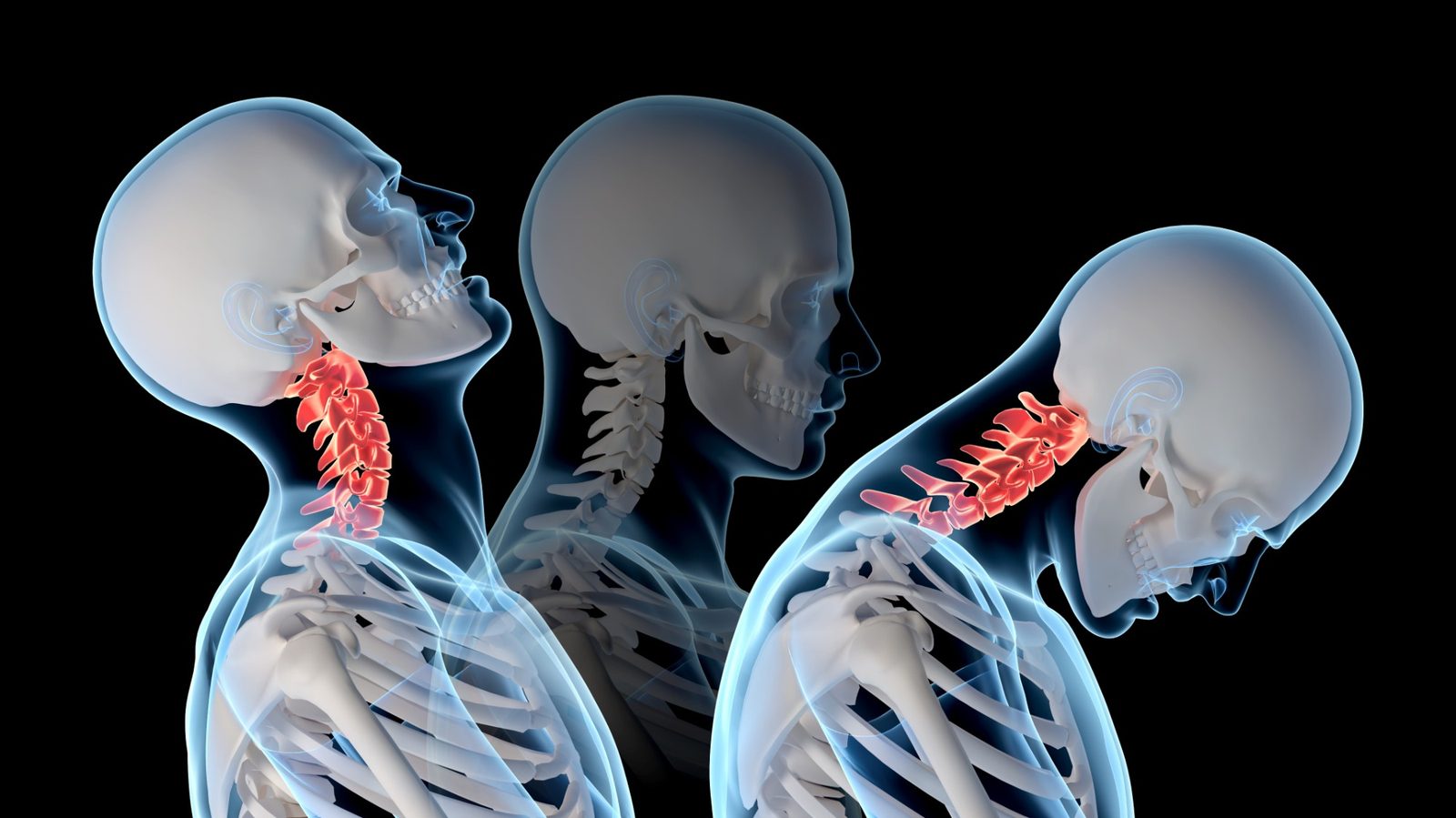
The car's damage and your neck's damage are two different questions. Your exam answers the second one.
What it feels like
Whiplash rarely stops at a stiff neck.
It often shows up late. Adrenaline is a painkiller. It's why so many people feel fine at the scene and wake up hurting the next day — or feel mostly okay for a week before the stiffness sets in. A delay doesn't mean the injury is small. It means your body was busy.
What people describe most:
A neck that won't turn.
Stiff, sore, tight — worse in the morning, worse after driving, hardest when you check a blind spot or look up.
A headache at the base of the skull.
The upper joints of your neck share nerve pathways with your head. When they're injured, pain can travel upward — into the back of the head, sometimes behind an eye or into the temple. It usually starts in the neck and climbs. It's a headache coming from the neck, and it's treated at the neck.
Shoulders and upper back.
An ache between the shoulder blades, or tight bands across the tops of the shoulders. The muscles that run from your neck into your upper back took the same jolt.
Tingling, numbness or weakness in an arm or hand.
This one matters. It can mean an injured disc or joint is irritating a nerve where it leaves your neck — the symptom shows up at the far end of the nerve, in your arm or fingers. If you have it, tell us on day one. It's a reason for a closer look, and often an MRI (see below).
Other things people mention.
Trouble sleeping because no position is comfortable, fatigue, jaw soreness, dizziness. Tell us about all of it — including anything that seems unrelated.

Why it can hurt more now
The crash took a second. The healing takes months — and it can go two ways.
This is the part nobody explains at the ER, and it's why so many people feel worse at week six than they did at week one.
Your body starts repairing a sprained, strained neck the day of the crash. The repair runs in three overlapping stages:
The swelling stage.
Injured tissue swells and gets tender. Adrenaline often hides this for a day or two.
The rebuilding stage.
Your body lays down new fiber to bridge the small tears. It works fast and it works hard — and it builds in whatever position you give it. A neck held still and guarded for weeks gets rebuilt short and stiff.
The settling stage.
The new tissue tightens and matures. Rebuilt while moving, it matures flexible. Rebuilt while guarded, it matures tight — and a tight neck passes extra strain to the joints and discs beneath it every time you turn your head.
"Will it go away?" is really two questions.
The sharp soreness of the first days does ease. The question that matters is how your neck finishes healing — flexible or stiff — and that's decided in the weeks right after the crash. That's why early care matters: it's the window when the new tissue can still be guided back to full motion.
When it's more than a sprain
Sometimes a disc was hurt too. Here's how we find out — and what we do about it.
Most whiplash is a soft-tissue injury. But the same force that sprains a ligament can injure a disc, and a disc injury behaves differently: pain that doesn't settle the way it should, pain that travels into an arm, tingling or numbness in the hand, a grip that feels weaker than it used to.
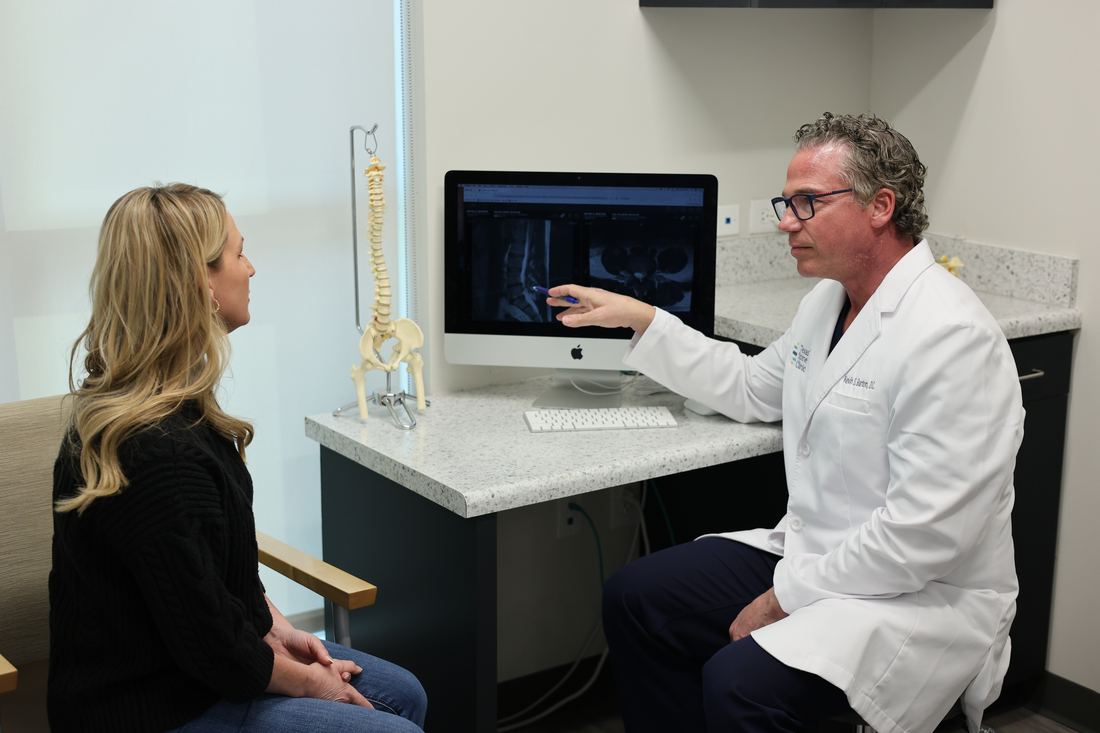
When your exam or your symptoms point past soft tissue, we order an MRI and arrange it for you. You don't have to find an imaging center or chase a referral. An X-ray shows bone; an MRI shows the disc, the nerves and the soft tissue around them.
Then we go through it with you, on the screen. The radiologist who reads your MRI writes a report but never meets you. We put the pictures up and show you what's pressing on what, why it hurts where it hurts, and what we plan to do about it — the pictures, not just the report.
If imaging shows a disc injury, decompression is down the hall. The DRX9000 is an FDA-cleared spinal decompression system, and it treats the neck as well as the low back — with a different harness, a different angle and a small fraction of the force. A neck program starts at 5% of your body weight — about eight pounds for a 160-pound person — and climbs by roughly 1% per visit toward a ceiling of 10%. You lie on your back with your head in a padded cradle, the machine applies a slow, steady pull along the line of your spine, and you hold a switch that stops it instantly. No thrust, no twist, nothing cut, nothing implanted.
 Watch · The neck setup
Neck pain and neck discs — the full explanation → · DRX9000 spinal decompression →
Read this first
Most whiplash isn't an emergency. A few things are.
If you haven't been checked since the crash, go to an emergency room today if you have:
- Severe neck pain right after the crash, especially with pain directly over the bones of the spine
- A headache that keeps getting worse, repeated vomiting, confusion, unusual drowsiness, or you were knocked out — even briefly
- New numbness, tingling or weakness in both arms, or in your legs
- New loss of bladder or bowel control, rapidly worsening weakness, or numbness in the groin, the inner thighs, or the area you sit on — what doctors call saddle anesthesia
See a doctor this week — not in a few weeks — if you notice: weakness in an arm or hand that keeps getting worse; new clumsiness with buttons, zippers or keys; a change in how you walk; or shock-like feelings down your spine when you bend your head forward. Those can mean pressure on the spinal cord, which needs imaging and a specialist's opinion. If that's what your exam suggests, we tell you plainly and help you get to the right person.
How we treat whiplash
Get the neck moving again — while it's healing.
Day one: the whole story, and a real exam.
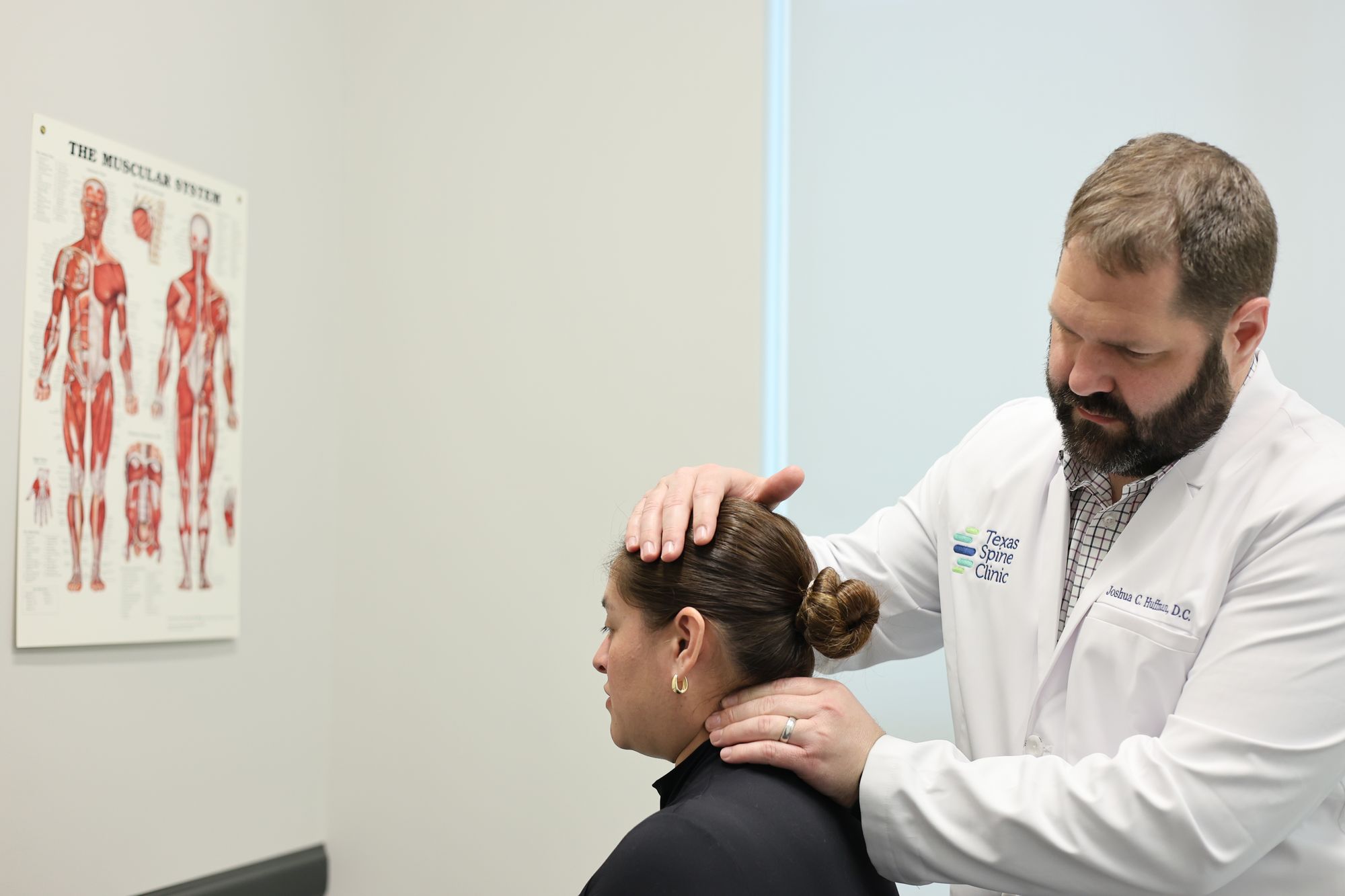
You'll tell us exactly what happened — which way you were hit, where you were sitting, which way your head was turned, where it hurts and when it started. Then a hands-on exam: how far your neck turns, which movements provoke pain, where it's tender, and your arm reflexes, strength and sensation. Plan on about 90 minutes, first treatment included. If your injury calls for medication, our nurse practitioner, Meredith Reynolds, ACNP-BC, can see you that same day, in the same building.
Hands-on care, starting that day.
Your plan is built from what the exam finds. It usually combines:
- Chiropractic adjustments, when they're the right tool. An adjustment is a stretch for a joint: a quick, controlled movement that takes a stuck joint back through the motion it's lost. We adjust a neck only when it's the neck that hurts, and only with your OK.
- Myofascial release — hands-on work on the muscles and the connective tissue wrapped around them, to ease the guarding that keeps your neck locked.
- Laser therapy — light energy aimed at the injured tissue to help calm the inflammation.
- Ultrasound, heat, ice and muscle stimulation — ultrasound to warm tissue deeper than a heating pad reaches; heat to loosen, ice to cool what's freshly inflamed; gentle electrical pulses to help clamped-down muscles let go.
- Rehab exercise — stretches and strengthening chosen for your neck, learned here and done at home, so the healing tissue rebuilds moving.
No narcotics.
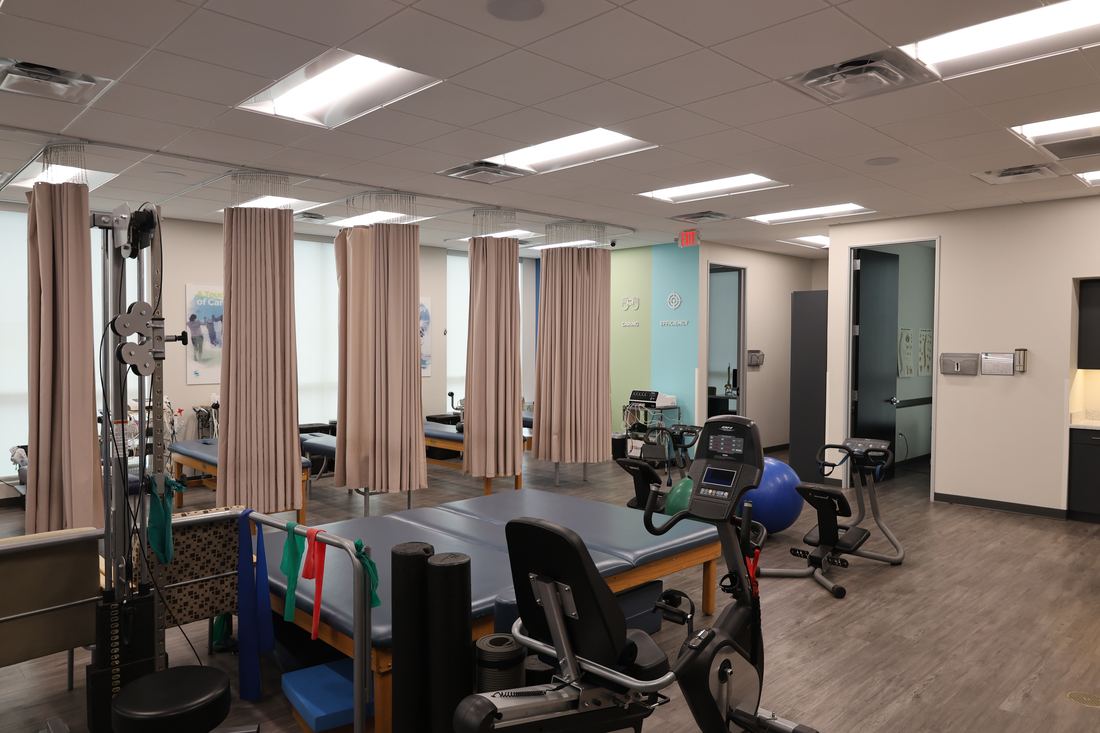
Rehab exercise keeps healing tissue moving, so it rebuilds flexible. Rather not have your neck adjusted? That's completely fine. An adjustment is never required for any care here. Tell us, and your plan is built around the other tools on that list. Nobody will argue with you or ask you to justify it.Re-checks along the way.
We re-examine you and compare against day one — your pain, how often it shows up, and what you can do again: turning to back out of the driveway, sleeping through the night, getting through a workday at a screen. You fill out the same short questionnaire at your first visit and at your re-checks, so the progress is measured, not guessed. We listen to what you tell us, and your plan changes as you improve.
If imaging shows a disc injury: decompression.
A course on the DRX9000, in the same building. How it works for a neck →
If pain still won't let go: pain management, in-house.
Dr. Praful C. Singh, M.D. — a board-certified anesthesiologist, fellowship-trained in pain management — evaluates you here. Same building, same chart, no starting over. The exam decides whether you need it.
Released when you're better.
When your neck turns, your headaches have settled and normal days don't flare it, or when you've reached maximum medical improvement — not when a visit count runs out.
What we stand behind
Four things you can hold us to.
-
1. An exam before anything else.
A hands-on exam on day one, before any treatment — and your whole story in one chart from that first visit on.
-
2. A reason for every visit,
written in your chart.
-
3. Progress you can see.
Measured at every re-check and shown to you.
-
4. One roof.
Exam, hands-on care, a nurse practitioner when you need medication, imaging, decompression and pain management in one building, with one team that knows your whole story.
Paying for it
Your first visit costs you nothing out of pocket.
After a wreck, we bill the coverage responsible for your accident — that's our job, not yours. Letters of protection are accepted. No attorney? You don't need one to be treated here, and that decision is yours.

Questions patients ask about whiplash
Fair questions
How long does whiplash last?
It depends on what was injured and how it heals. The sharp soreness of the first days eases as the swelling stage passes; the rebuilding runs for weeks after that, and the tissue keeps maturing for months. The weeks right after the crash are when care has the most say in whether your neck finishes healing flexible or stiff. Your exam tells us what you're working with, and your re-checks show how it's going.
Why does my neck hurt more now than right after the accident?
Adrenaline hid it at first, and the swelling takes a day or two to build. After that, a sore neck that's held still starts to stiffen as it heals. Getting it moving early is the point of care.
The ER said my X-rays were normal. Why does it still hurt?
Because an X-ray shows bone, and whiplash is mostly an injury to the muscle, ligament and joints around the bone. Normal X-rays mean nothing is broken — which is good news, and it's where the ER's job ends. Ours starts there.
Can whiplash cause headaches?
Yes. The upper joints of your neck share nerve pathways with your head, so an injured upper neck can send pain up into the back of the head, and sometimes behind the eye. Headaches that start in the neck are treated at the neck.
Why is my hand tingling if I hurt my neck?
The nerves to your arm and hand start in your neck. If an injured disc or joint irritates one where it leaves the spine, you feel it at the far end — in your arm or fingers. Tell us on day one; it's a reason for a closer look, and often an MRI.
Will you crack my neck?
Only if your neck needs it and you say yes. An adjustment is never required for any care here, and there are plenty of other ways to get a stiff neck moving — myofascial release, laser, ultrasound, heat and ice, muscle stimulation and rehab exercise.
Do I need an MRI?
Not everyone does. If your exam points to a disc or nerve — pain into the arm, numbness, weakness, or pain that isn't settling — we order one and arrange it for you, then go through the pictures with you on the screen.
My accident was months ago. Can whiplash still be treated?
Yes. Tissue that healed stiff can still be worked back toward normal motion, and an injury that was missed can still be found. The sooner you're examined, the sooner we know what we're working with.
What does it cost?
Your first visit costs you nothing out of pocket. We bill the coverage responsible for your accident, letters of protection are accepted, and Silvia walks you through where things stand before you leave.
Can I come in today?
Monday through Thursday, yes — we see new patients the same day. Call (210) 741-9166.
Come in today
Your neck has already started healing. Make sure it heals moving.
The weeks after a wreck decide how a whiplash injury finishes — flexible or stiff. Come in and find out exactly what's injured: same-day appointment, no-cost evaluation, and one team from the first visit to the last.
Texas Spine Clinic · 3212 Napier Park, San Antonio, TX 78231
Monday–Thursday, 8 a.m.–5 p.m. · Same-day appointments
Book your no-cost evaluation
No referral needed. Same-day appointments available.
Calendar not showing? Open it in a new tab.
Rather book by phone? Call (210) 741-9166.