
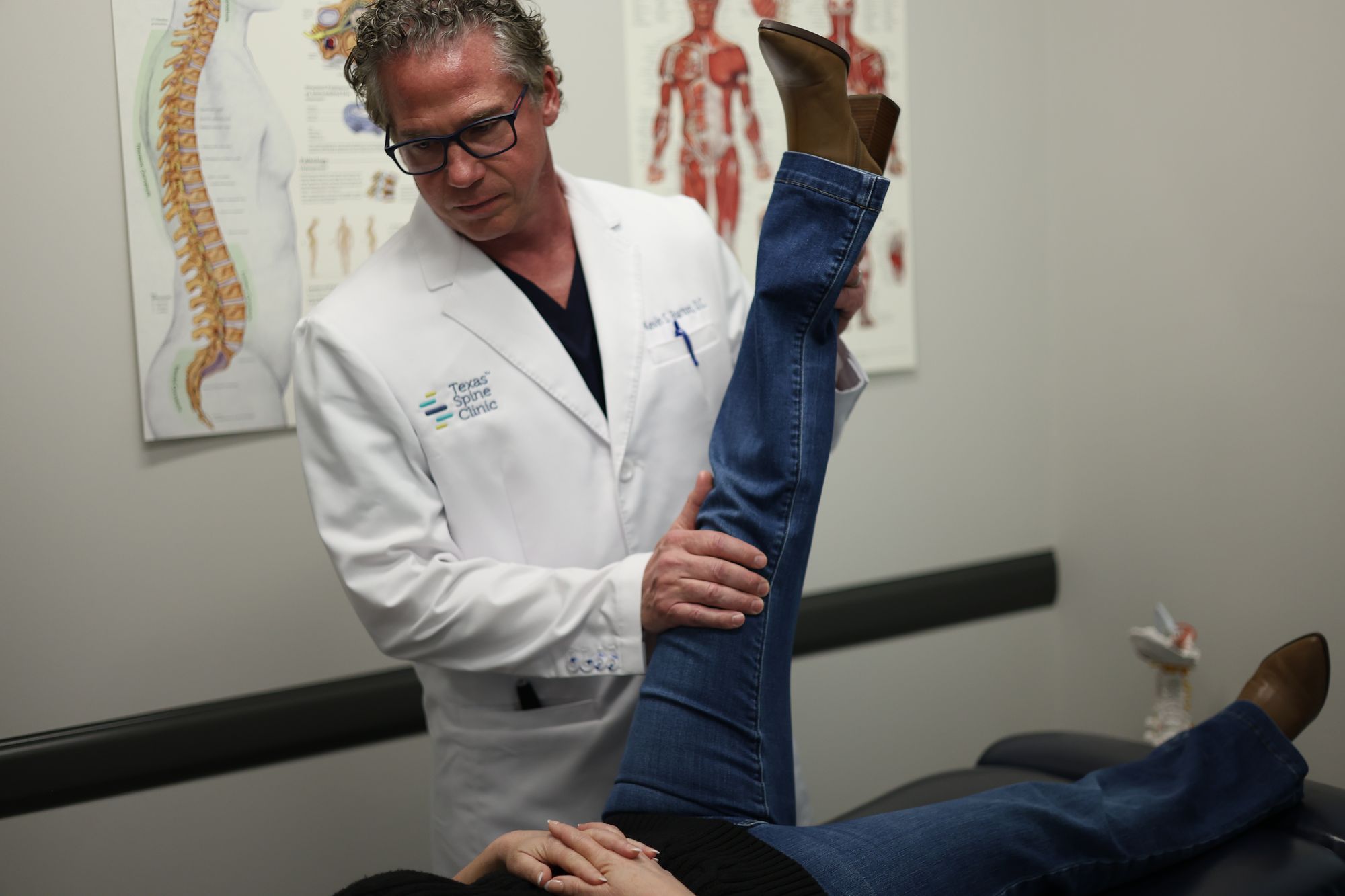
For people in San Antonio whose leg pain has a mind of its own
Sciatica isn't a leg problem.It's a pressure problem — in your back.
That lightning down your leg — the burning calf, the tingling foot, the jolt when you sit down wrong — is a nerve in your lower back being squeezed, usually by a bulging or herniated disc. The nerve keeps firing until the pressure comes off. Whether this started last Tuesday or two years ago, that's the part nothing you've tried has touched. It's what we treat: the pressure itself, without surgery, injections, or living on medication.
Maybe this is week one.
You didn't do anything heroic. You bent down to put your shoes on. You stood up out of the car. Something went through you like a lightning bolt — and now here you are. You can't sit through dinner, so you eat standing at the counter. At 2am you're not asleep, you're pacing the hallway, because walking is the only thing that takes the edge off. And underneath it is the question nobody has answered: is this permanent?
Or maybe this is year two.
You know your MRI report by heart. You can pronounce "L5-S1." You've got the meloxicam, the muscle relaxer that makes you useless by 8pm, the gabapentin you're afraid to take, the exercise sheet from the second physical therapist, the adjustments that felt wonderful for two days, the shot that bought you six good weeks the first time and almost nothing the third. You've stopped bringing it up, because you can see people deciding you're dramatic. And the last specialist told you you're "not bad enough for surgery yet" — which sounded like good news for an hour, until you realized it meant nobody had a plan.
Or maybe you got the opposite answer.
The surgeon looked at the same MRI and said yes — you're a candidate, here's a date. And you went home and sat with it. You read about fusions. You found the person at work who had one and still hurts. You did the arithmetic on six weeks off your feet. And you decided you'd like to try something else first — not because you distrust surgeons, but because an operation is a door that only opens one way. Everybody knows somebody whose back surgery didn't go well. You can have the best surgeon in the world, and back surgery can still bring complications that can never be taken back. Dr. Barton felt the same way about his own disc.
Either way, two things are true. What you're feeling is real, it has a mechanical cause, and it usually shows up on imaging. And whether you were told you're not bad enough for surgery or handed a surgery date, you belong here first. If your pain hasn't gotten better with the easy stuff, you're exactly who we treat. "Wait until it gets worse" and "have the operation" are not the only two options.
Start here
What sciatica actually is
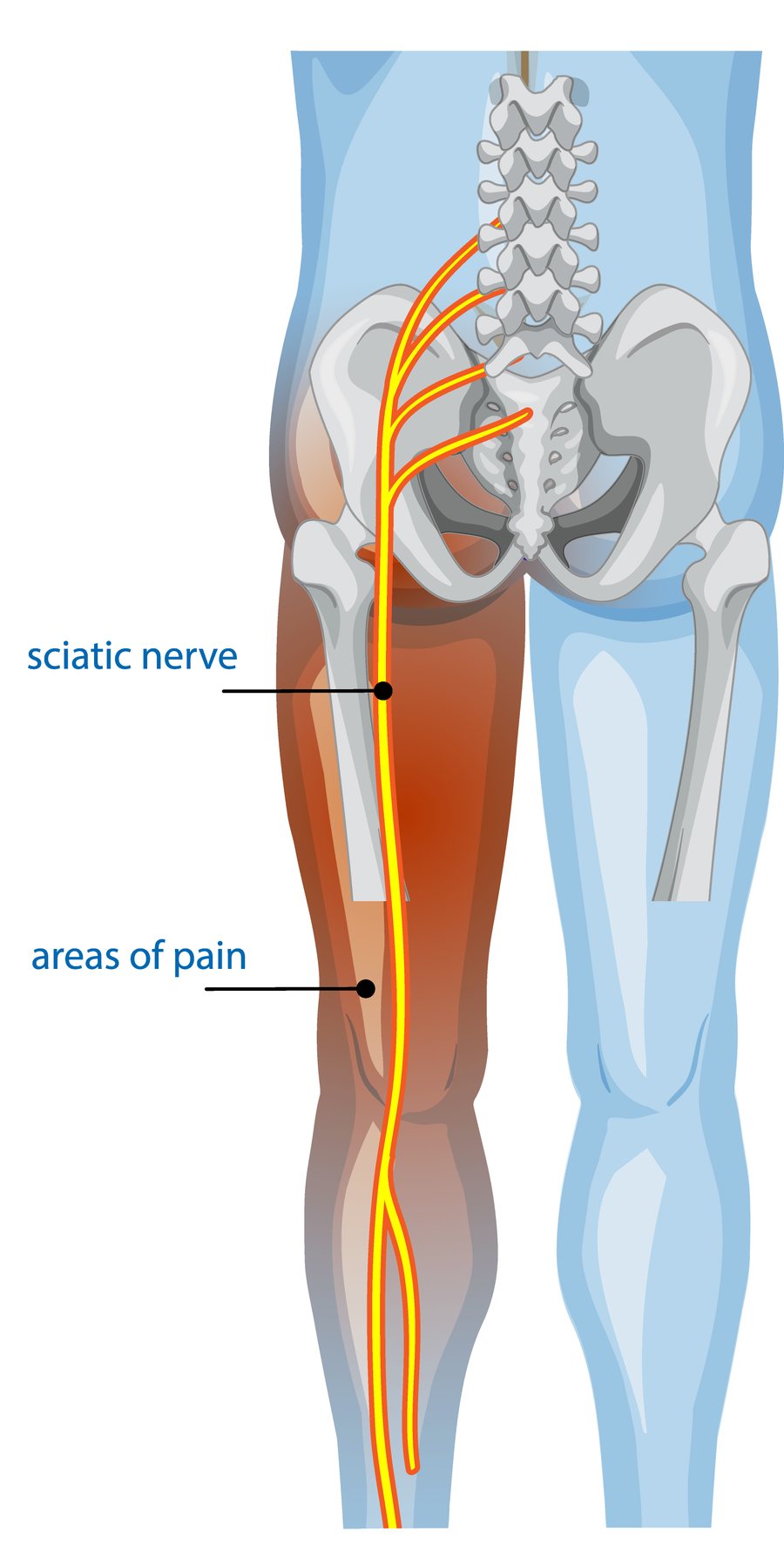
"Sciatica" is not a diagnosis. It's a description — pain traveling the path of the sciatic nerve. Being told you have sciatica is like being told you have a cough: true, and it doesn't tell you what's causing it.
The nerve is built from roots leaving your lower spine at the levels on your report — L4, L5, S1 — and beside every one of them sits a disc, about 90% water. Overload one and it dries out, flattens and bulges, usually straight into the space where the root lives.
A squeezed nerve does one thing: it fires. That's the electric shock, the burning, the numb patch, the weakness pushing off. It's also why the pain isn't where the injury is — your calf is fine, and a root in your lower back is doing the reporting.
The nerve is the messenger, not the problem.
Pills quiet the messenger. Injections quiet the messenger. None of it moves what's pressing on the root.
So what is actually pressing on it?
Nearly always, one of these. Which one you have is what the exam and your imaging are for — and it decides what your treatment should be.
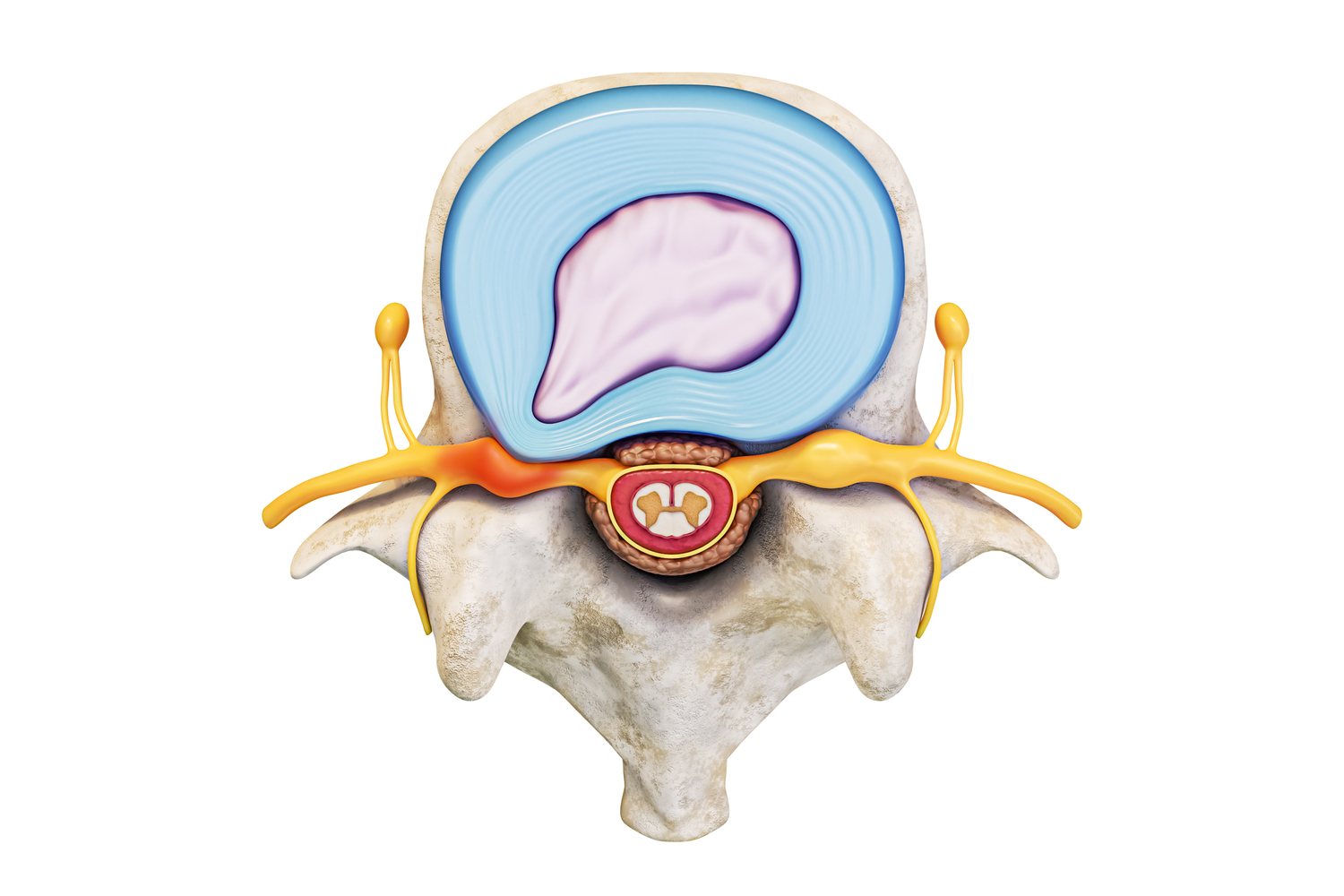
A herniated disc.
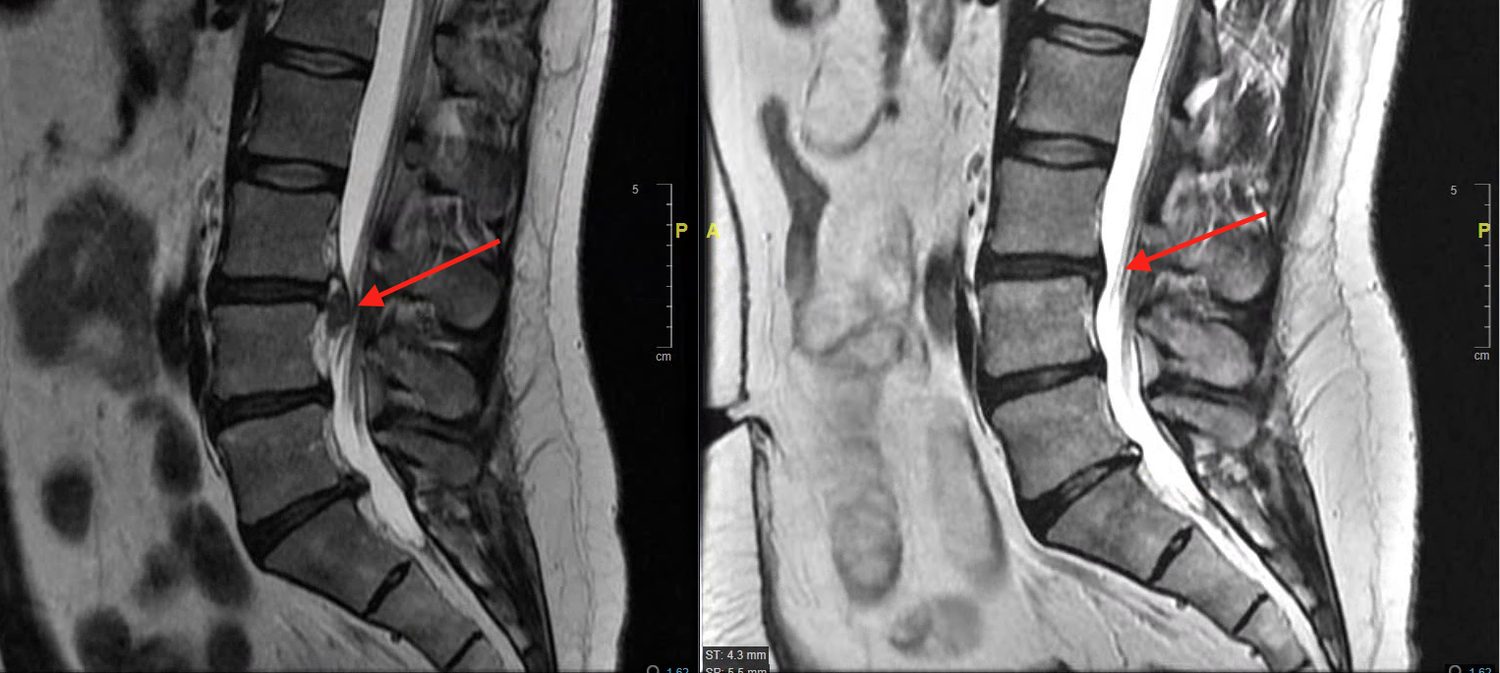
The most common cause by far, and the one in the picture here. The soft center of the disc pushes through its outer wall and lands in the space where the nerve root sits. The pain usually arrives fast, it favours one leg, and it gets worse when you sit, bend or cough. Herniated discs — the full page.
A disc that has lost height.
Years of load dry a disc out and flatten it. As the disc gets shorter, the opening the nerve root travels through gets shorter too, and the joints at the back of that level take weight they weren't built for and thicken. Nothing ruptured — the room around the nerve simply closed in. Degenerative disc disease · facet syndrome.
Spinal stenosis.
Narrowing of the canal or the side tunnels the nerves exit through, usually from a mix of disc height loss, thickened ligament and bone spurs. The tell is different: both legs more often than one, worse the longer you're upright, and easier when you lean forward on a cart. Spinal stenosis.
Rarely, something else entirely.
Sciatic pain can also come from a fracture, an infection, or a tumour pressing on the nerve. It's uncommon, it doesn't look like the others on an exam or a scan, and it needs a different doctor and a different plan. That's one of the reasons nobody here builds you a treatment plan from a report alone.
Read this before anything else
When sciatica is an emergency
A small number of sciatica cases need an emergency room today — not an appointment with us, not an appointment with anyone.
At the bottom of your spinal cord the nerve roots fan out in a bundle doctors named after a horse's tail: the cauda equina. That bundle runs your bladder, your bowel, and the feeling in the area that would touch a saddle. If a large piece of disc presses on it, those functions can fail — and the window to protect them is measured in hours.
Go to an emergency room now if you have:
- New trouble controlling your bladder or bowel — including not being able to feel that you need to go, or not being able to start
- Numbness in the groin, inner thighs, or the area you sit on
- Weakness that is spreading quickly, or weakness in both legs
This is rare, and most people with sciatica will never see it. But it's the one version of this problem where speed matters more than choosing the right clinic. Tell the ER exactly which of those things you have, and ask about urgent imaging.
A step below that: a foot that's getting weaker, a toe catching on carpet, a numb patch that's spreading — that's not an ER trip, but it's not a "watch it another month" situation either. Days, not seasons. Call and tell us that's what's happening, and we'll get you in.
The clue in your own symptoms
Why sitting makes it worse — and what that tells you
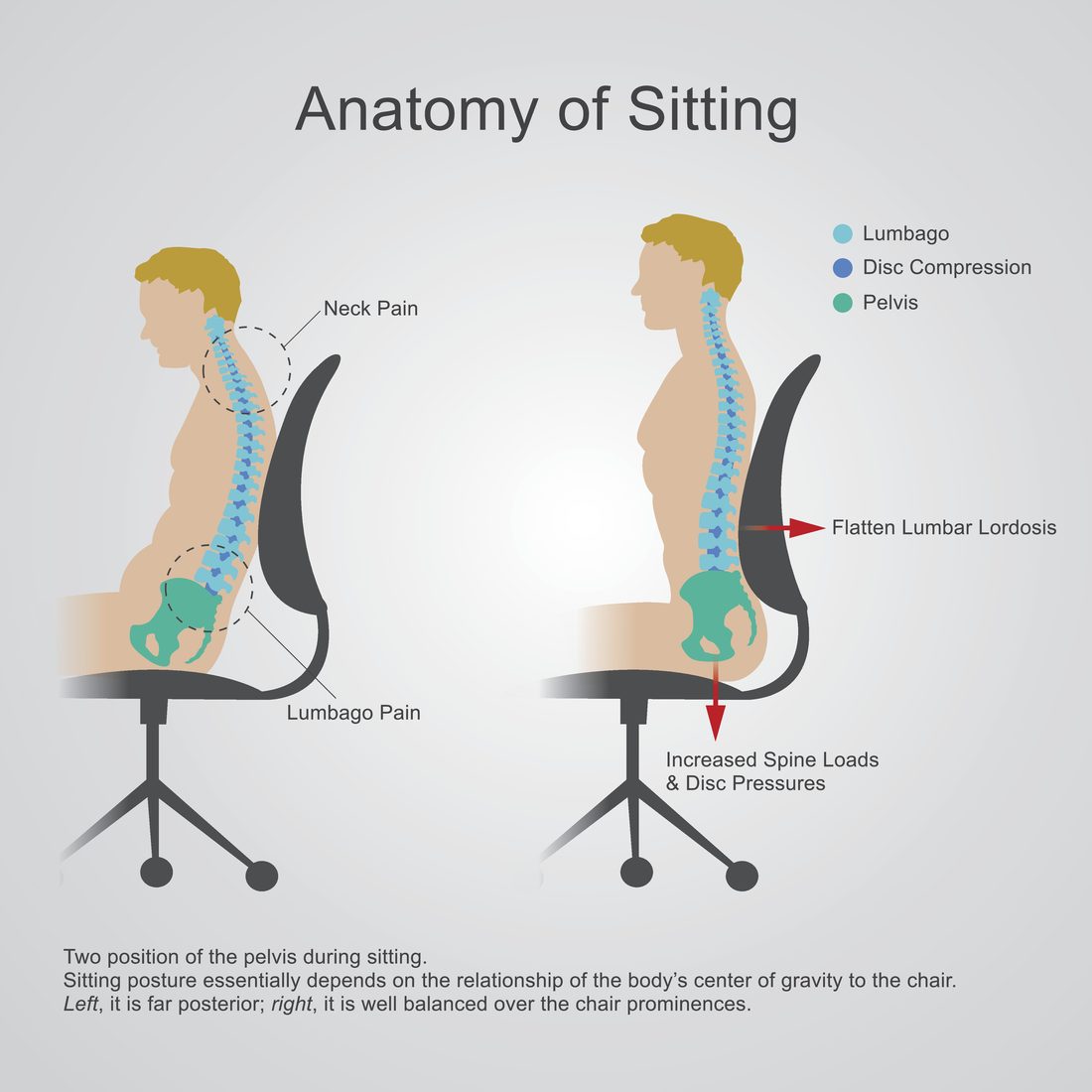
Almost every sciatica patient finds the same infuriating thing: standing hurts less than sitting. The car is torture, the desk chair is torture, but you can walk the grocery store. When you sit, your pelvis rolls back and the curve in your lower back flattens, tipping the load onto the front of the disc and pushing its soft center backward — exactly where the nerve root is. It isn't that a chair presses harder than standing does; it's that a chair aims the load in the worst direction and holds it there for an hour. Bending forward bites hardest of all, because a lumbar disc carries far more load bent over something than standing upright.6 Coughing sends a jolt straight to the disc, and getting out of the car is flexed, twisted and loaded at once.
That pattern is a clue about the cause. Worse sitting, worse bending, better standing points toward a disc on a nerve; the reverse — worse walking, better leaning on a shopping cart — points toward narrowing of the bony canal. Spinal stenosis. Which is why the exam comes before the plan.
Your treatment history
Everything you've already tried — and why none of it held
None of it was stupid. Most of it was the right first step.
Rest.
Good for two days. After that it just lets everything get weak.
Ibuprofen, naproxen, meloxicam.
Real relief from inflammation. Nothing to the pressure.
The steroid dose pack.
Same idea, stronger. A dramatic few days, then over.
Muscle relaxers.
The spasm returns — those muscles are guarding something.
Gabapentin or pregabalin.
They work on the signal, not the pressure. Half-drunk at work.
Hydrocodone or tramadol.
Four hours of sleep. Nobody's plan for year two.
Physical therapy.
Valuable aimed at you, not as a conveyor belt. If nerve glides made your toes light up worse, that was the wrong exercise at the wrong stage.
Chiropractic adjustments.
They restore motion to locked joints, and many people feel great for a day or three — then the same load on the same disc locks it up again. Adjusting a joint doesn't unload the disc underneath it.
Massage, dry needling, TENS, ice, heat.
Aimed at muscles and signals. Temporary by design.
The inversion table, the dead hang, the belt.
Right instinct — but pull steadily and the muscles clamp down, so the force never reaches the disc.
The mattress, the standing desk, the ergonomic chair.
Worth having. Not treatment.
Every item is aimed at the alarm. Not one is aimed at the fire.
Why the shot worked less the second time
The first epidural worked — the best few weeks you'd had. The second worked less, and the third often does almost nothing. That isn't bad luck, and it doesn't mean the injection was a mistake.
When a disc first presses on a root, two things hurt: the mechanical squeeze, and a chemical fire, because disc material is inflammatory. Steroid is very good at putting out that fire — but months later the fire has burned down and what's left is mechanical, the disc still pressing where it pressed. To break a flare or make rehab possible it's a good decision; the trouble is when nobody builds anything at the far end of the bridge.
The mechanism
How we take the pressure off
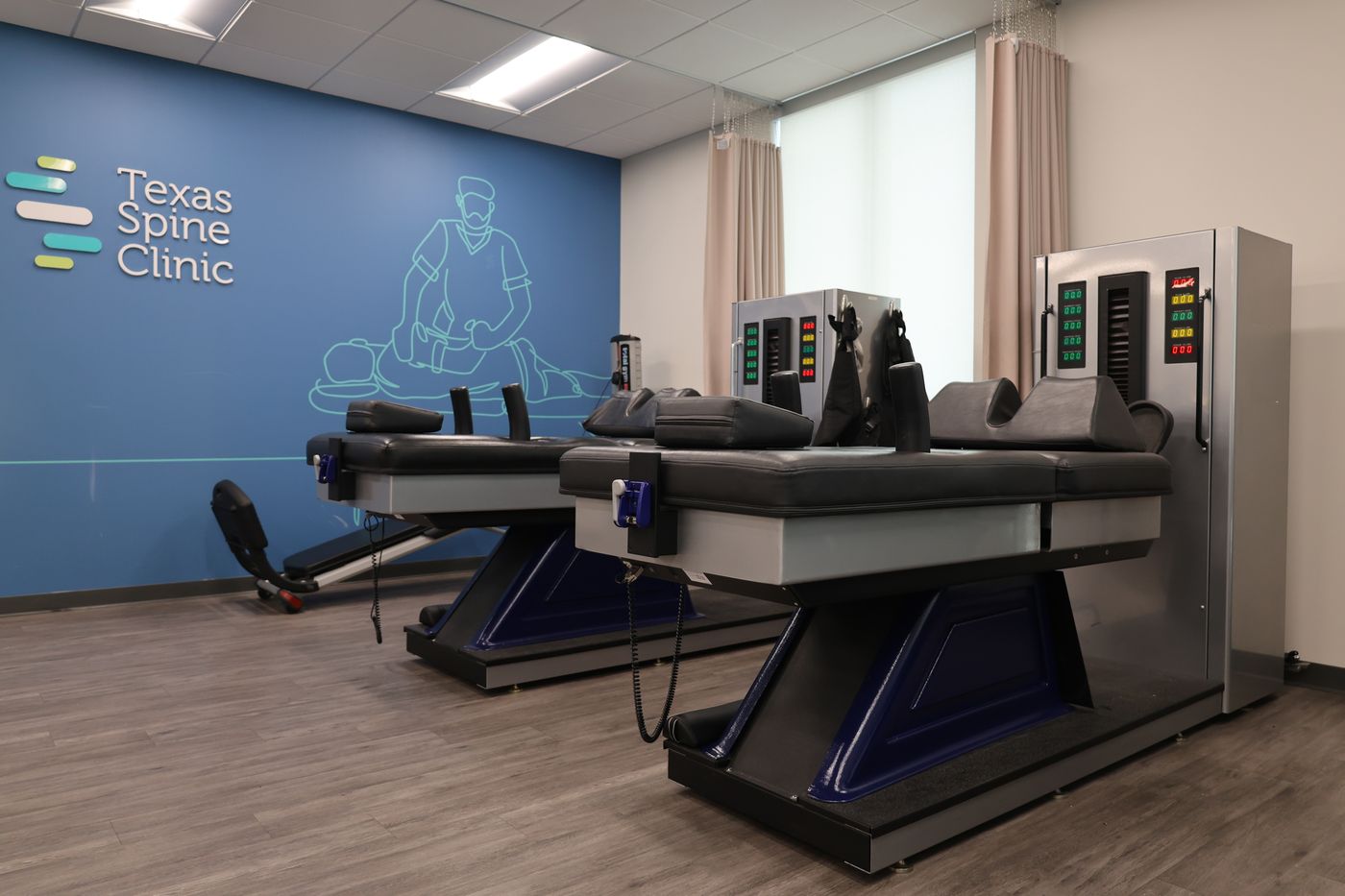
Our primary tool for disc-driven sciatica is the DRX9000 — an FDA-cleared, computer-controlled spinal decompression system. You lie on your back, fully clothed, held by a harness at the hips. The machine applies a slow, precise pull to the one level where your disc is bulging, then eases off, then pulls again, for about 25 to 30 minutes. Most patients read, talk, or fall asleep.
Taking the compression off creates negative pressure — a vacuum effect — that draws fluid, oxygen and nutrients back into the disc. Discs have almost no blood supply; they feed by exactly this exchange, which is what your daily life has stopped giving yours. Over a course of sessions the disc rehydrates, a bulge can begin to retract away from the nerve, and as it regains height the joints behind it stop grinding. The DRX9000 page — the four tissues in full.
As that pressure lifts, symptoms often retreat back up the leg — toes first, then foot, then calf. "Often" is doing real work there: it's a pattern we look for, not a result we promise, and symptoms marching down into new ground is the signal we want to hear about the day it happens.
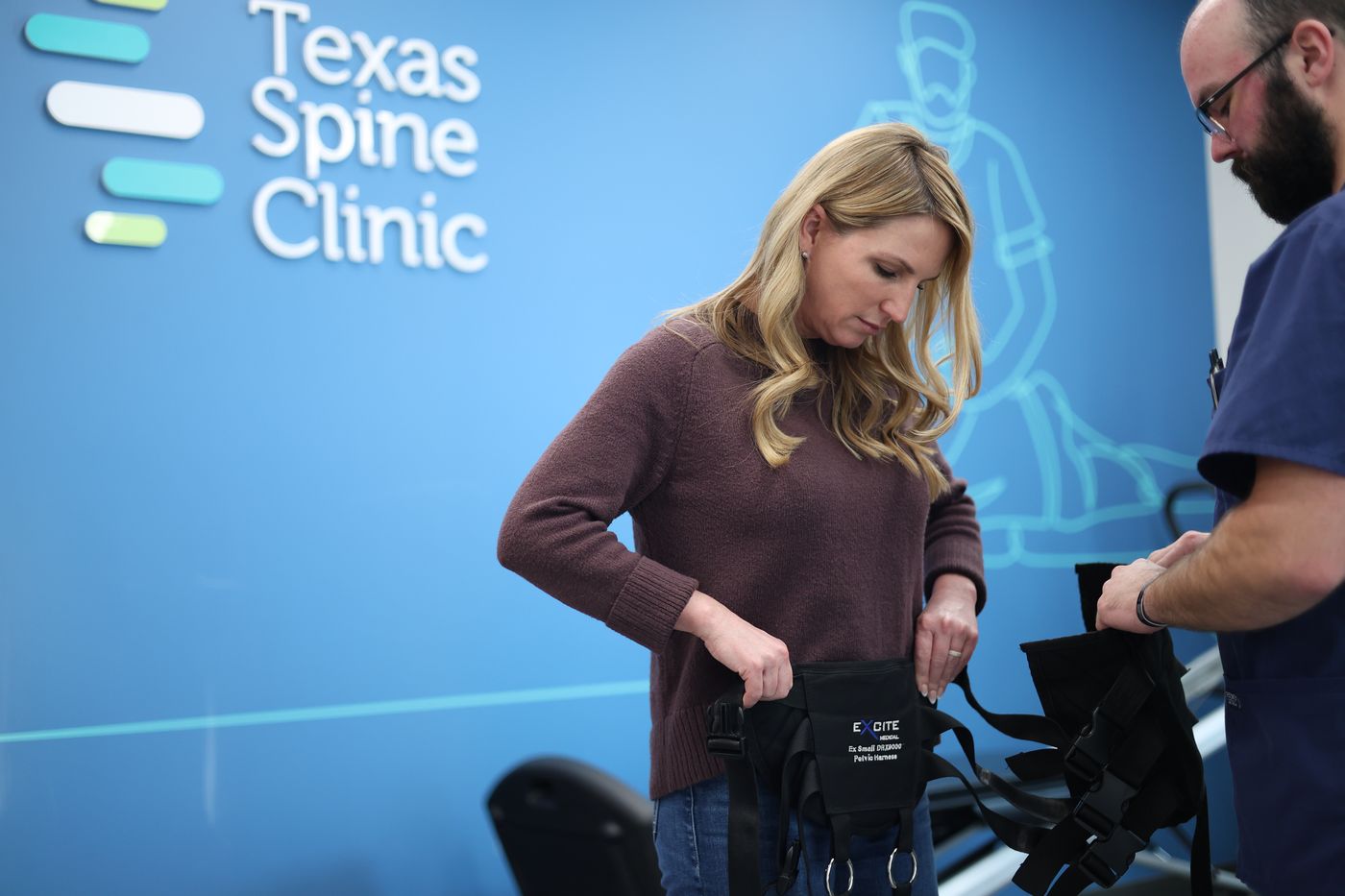
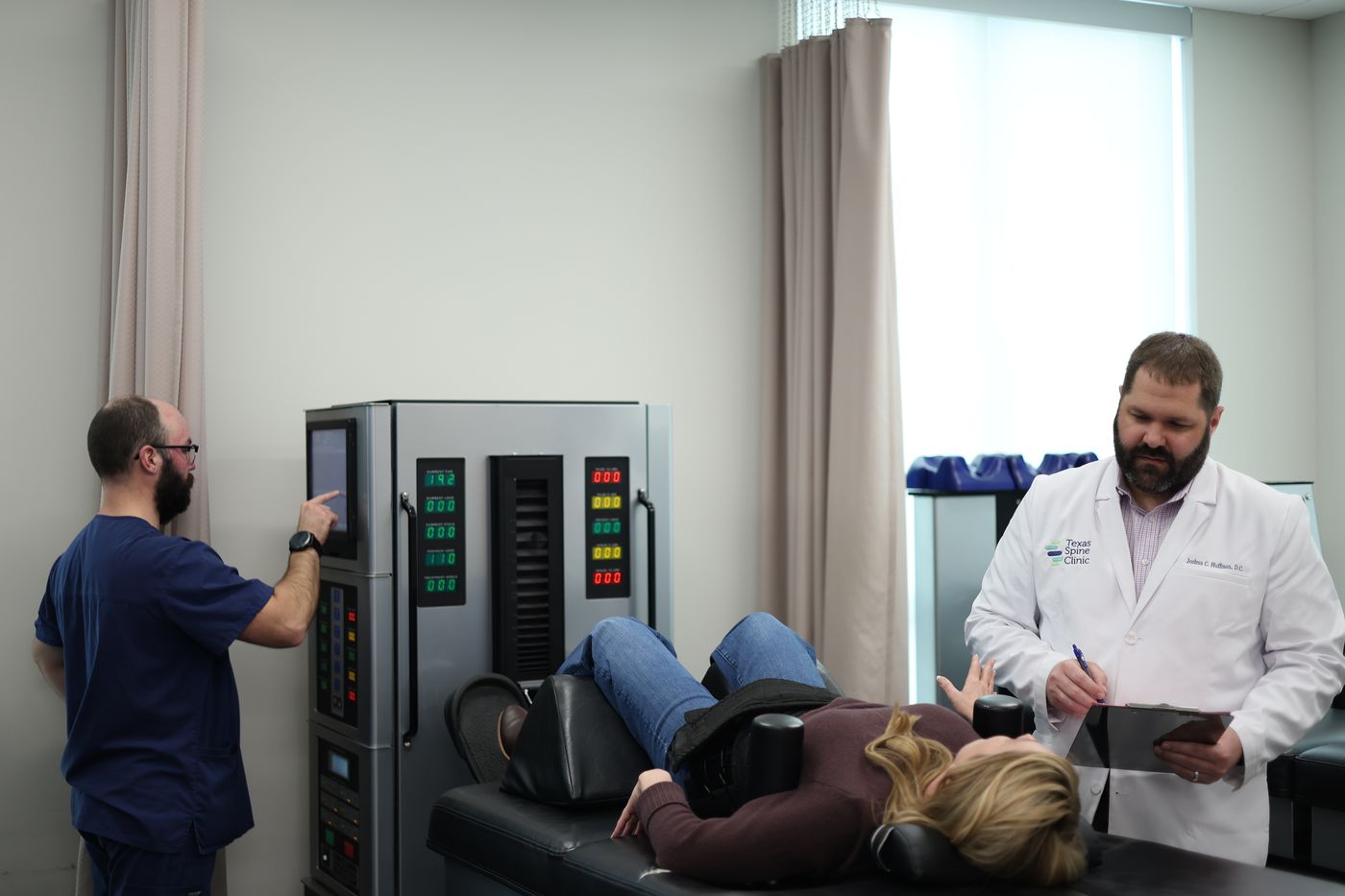
The two reasons this program works
The first is the machine — and knowing how to run it. The DRX9000 is genuinely effective at what it does, but owning one and knowing how to use it are different things. Every protocol is set by hand: the angle of pull, the force curve, the specific level being treated, adjusted as your spine responds week to week. We've been doing that for 21 years. That experience is the difference between a table and a treatment.
The second matters just as much, and almost nobody in this industry will tell you about it:
We screen patients the way a spine surgeon screens surgical candidates.
"Isn't this just traction with a computer attached?"
Both pull — the difference is what happens next. Pull steadily and the muscles fight back, so most of the force never reaches the disc. That's also why the inversion table in your garage did so little. The DRX9000 ramps its force along a curve built to slip underneath that reflex, aimed at the one level that's injured. And in a randomized trial against a sham treatment, real decompression shrank herniations far more than the sham did — the numbers are below.
"How do I know it will be done right?"
Ask us the hard questions — we like them. Here's how care is decided here, and you can hold us to every line: your imaging comes first — a doctor reviews your actual MRI before anyone discusses a plan or a price. The exam sets the protocol, built for your spine and adjusted as you respond. Your cost is in writing before your program begins, and you pay only for care you actually receive — Texas law backs you on that, and so do we.
"Your imaging comes first" also means something you may not have had yet. Patients tell us the same thing all the time: nobody ever showed them the pictures. There's a reason. The doctor most trained to read your MRI — the radiologist — writes the report and never meets you. The doctors who do meet you usually work from that report, and a surgeon's schedule rarely has room to sit down and walk through the images with you. Nobody did anything wrong — and you still ended up owning a spine you've never seen.
We think that's backwards. Your consultation happens in front of a screen with your MRI on it. We go through the pictures — not just the report — and show you what's pressing on what, why it hurts the way it does, and exactly what we plan to do about it. You leave understanding what your spine looks like and how we intend to fix it.
"Why does it take so many visits?"
Because the disc is avascular, meaning it has no blood vessels of its own, which is why it's one of the slowest-healing structures in your body. One session produces a real effect that mostly fades by the next day; twenty, spaced correctly, are how the change starts to hold, while the strengthening work running alongside them rebuilds the support around it. A typical program runs about 20 to 25 sessions over six to eight weeks — a real commitment, and better you know now than in week three.
Weigh it against the alternative
The case for trying this first
Whatever else you decide about this program, weigh what it asks of you. No incision. No anesthesia. No hardware in your spine. No fusion. No narcotics and nothing to wean off. No recovery period, and no time off work — sessions run about half an hour and you drive yourself home afterward.
Why this works
Why this works — and who we won't treat
It can get worse before it gets better
It's common to feel more sore in the first handful of sessions, and patients who ended up doing well routinely describe wanting to quit around session four or five. We tell you at the start so a rough week feels like information instead of betrayal. But sharply worse pain, new numbness, or symptoms marching further down the leg are not "part of the process" — tell us, and we change the plan or stop.
Why waiting it out costs more than it looks like
You'll hear that sciatica usually settles down by itself. Sometimes it does — the body can reabsorb disc material over months. If you're a few weeks in and clearly getting better, keep going, and we'll tell you that at the consultation. But waiting has a price:
- You can't know in advance which way yours will go. "It usually resolves" is a statement about a crowd. You're one person with one disc.
- The waiting isn't free. It's paid in months of your life — the job, the sleep, the things you've stopped doing. That's a real cost even when the ending is good.
- A nerve under heavy pressure for a long time can be slower to recover even after the pressure comes off. Every month of compression is a month the nerve has to come back from.
So the question isn't whether it might get better someday. It's what's the trend? Weeks in and flat or worse — or a foot going numb or weak — is the point to take the pressure off.
When it's a surgeon's call
Two situations aren't ours to treat, and we screen for both at the first visit. Cauda equina signs — sudden trouble with bladder or bowel control, numbness in the saddle area — are an emergency room today. And a foot that is actively dropping, or a leg that keeps giving out, needs a surgical opinion now. For everyone else: if a fusion has been put on the table, ask plainly what problem it solves — and whether anyone has tried taking the pressure off first.
Candidacy
Who we don't treat
Decompression is the wrong tool — and we'll say so — if you have:
- A spinal fusion or hardware at the level that needs treating — that's an absolute no. The level next door to a fusion is a case-by-case evaluation, never a phone answer.
- Severe osteoporosis
- A spinal fracture, tumor, or infection
- Severe bony stenosis — narrowing from bone rather than disc. That gets a referral to a surgeon, not a table.
- Unstable spondylolisthesis — a slip that shifts more than 5 mm on the flexion-and-extension X-rays we take to check. A stable slip, of any grade, can still be a candidate.
- Pregnancy
- Any of the cauda equina warning signs above — emergency room, not an appointment
Had a discectomy or laminectomy with no hardware left behind? That's not on this list — we treat post-surgical discs all the time, generally starting two to three months after surgery, once your surgeon has released you.
The exam and your imaging — not the machine, and not your credit card — decide whether someone is treated here.
The checkpoint
We assess whether your spine is responding around the second week, after eight to ten sessions. If it isn't, we say so then — not after another month of visits — and you don't pay for the rest.
What it costs
What insurance covers, and what to expect
You'll have your figure in writing before you commit to anything.
The decompression program isn't a covered benefit under any plan. If you carry a commercial health plan, we can usually generate an insurance credit through it, which we apply against your cost. How big that credit is depends on your specific benefits. So expect an out-of-pocket investment, and expect to know exactly what it is before you commit. We verify your benefits at no charge, paying at time of service earns a discount, and CareCredit, Affirm and in-office payment plans are available. You only ever pay for care you actually receive — if you paid ahead and the program stops being right for you, the unused portion comes back to you. Cost & Insurance — how the investment works.
What we stand behind
We don't put a success-rate number on a web page — a percentage scraped off a clinic's website has never told one patient what would happen to their own disc. Here's what you get instead, and you can hold us to all of it: an exam, your imaging read with you on the screen — picture by picture, out loud — a straight answer on candidacy that your exam decides rather than your credit card, your number in writing before you commit, and a real checkpoint two weeks in where we tell you whether your spine is responding.
And we bring some mileage to that judgement. Dr. Barton has been in practice since 2003 and has run this machine since 2005 — 21 years and more than 2,000 patients on the DRX9000. That's long enough to know which spines respond to it and which ones don't, and to tell you which one you are early instead of late.
The research
What it looks like in numbers
The research on spinal decompression has measured what happens inside the disc, on imaging, and in patients' own pain scores. Here's what it found.
The vacuum effect was measured, not imagined. Researchers publishing in the Journal of Neurosurgery put pressure sensors inside human lumbar discs during decompression and recorded the pressure dropping to −100 to −160 mm Hg1 — a true vacuum, measured inside a living disc.
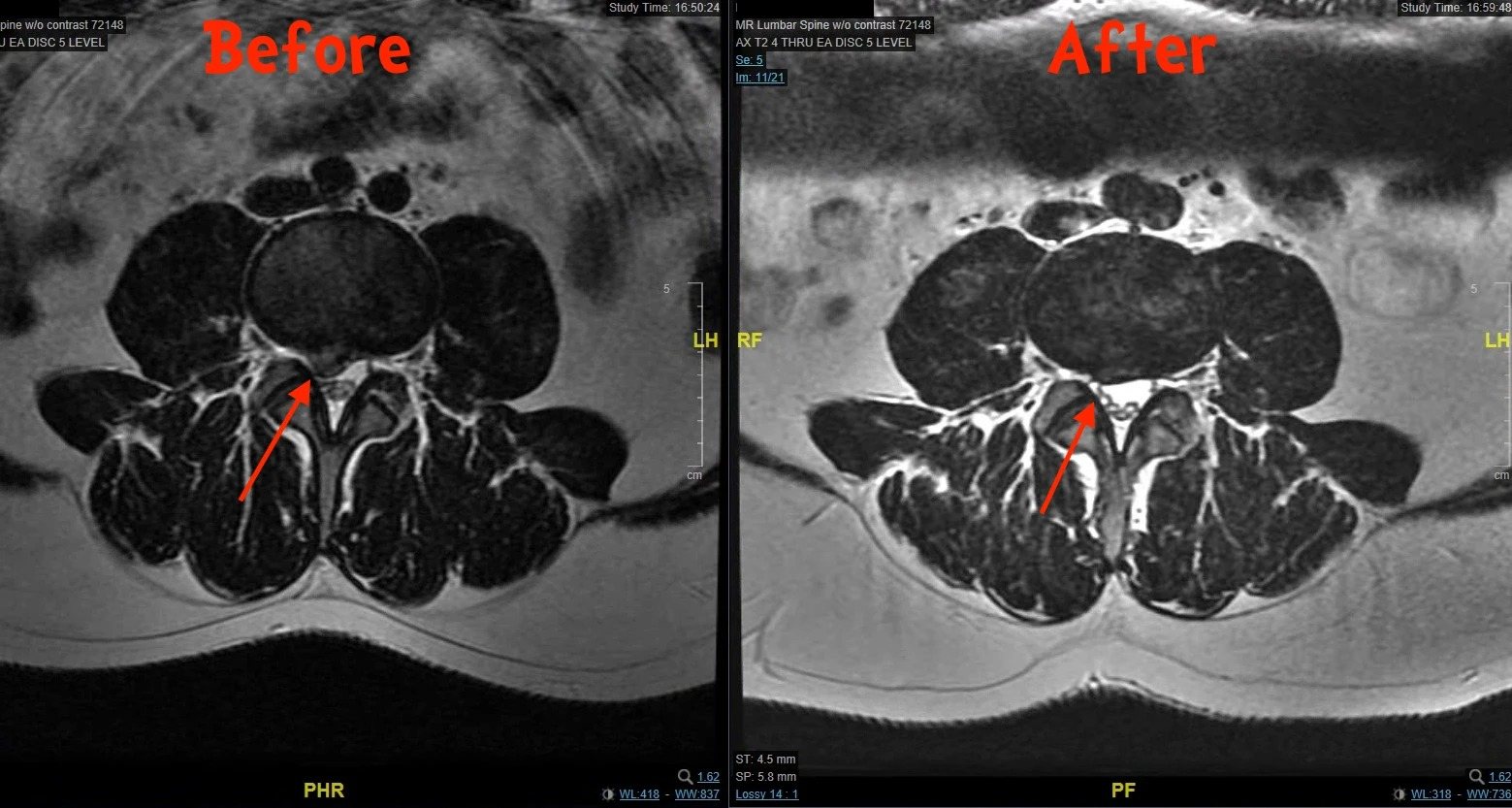
Herniations shrank more than with a sham treatment. In a randomized trial of real decompression against a sham — so patients couldn't tell which they got — the herniation index fell 27.6% with real treatment against 7.1% with sham, with better leg pain and disability scores at follow-up.2
Discs measurably gained height. Thirty patients scanned before and after a six-week DRX9000 program showed average disc height rising 7.5 mm → 8.8 mm, with pain falling 6.2 → 1.6 out of 10 — and the two changes tracked together.4
Leg pain responded most. In 73 patients compared against physiotherapy plus conventional traction, radiating leg pain and disc height improved far more with decompression.3
Across working clinics. The largest recent series followed 267 patients across multiple clinics: average pain fell from 6.9 to 2.5, with measurable improvement in reflexes and daily function.5
What the change looks like on MRI
How the program runs
Decompression and strengthening, together
Taking pressure off the nerve is one part of the program. If that were all we did, you'd feel wonderful and then walk back into the same life that loaded the disc. So alongside it we rebuild what Dr. Barton calls your structural margin — progressive core strengthening, and retraining what months of pain quietly rewired: how you get out of a car, how you pick something up, how you sit through a workday. It isn't optional; it's the reason the result holds.
Patients
Patient stories








“I am so grateful to Dr. Huffman and Texas Spine Clinic for offering Non-Surgical Spinal Decompression treatment. After a few short series of treatments, I always leave pain-free… The team, the physical therapists and Jennifer (the receptionist), are so attentive and caring.”
“When I started the program, I was in pain all day and had trouble sleeping at night due to pain. I was using a walker at home and struggled with a cane when I went to the doctor. I was confined at home with pain killers. Now, I don’t take pain medication… I have made so much progress, and my activity level has improved greatly.”
“Dr. [Huffman] and his Physical Therapists have been dedicated in healing my back and sciatica problems. I appreciate all that they have done in helping my relieve my pain and suffering They communicate well and I can’t say enough how they have helped my healing process.”
Reviews quoted verbatim from our public Google profile.
Every patient's story is their own. Results vary. These are real Texas Spine Clinic patients, sharing their experiences with their permission — watch them tell it in their own words.
Questions patients actually ask
Before you call
Can sciatica go away on its own? Should I just wait?
Often, yes — herniations can shrink, and many people recover with time. The catch is that you can't know in advance whether you're one of them, and the waiting costs you the weeks either way. Watch the trend, not the calendar: flat or worse after several weeks, or a foot getting numb or weak, is the moment to have the pressure looked at.
How soon would I know if this is working?
We assess it formally around the second week, after eight to ten sessions. Some people feel better in the first week, more often it's week two or three, and it's normal to feel stirred up before then. If your spine isn't responding by the checkpoint, we tell you then — and you don't pay for the rest.
Does it hurt? Can it flare me up?
The session itself doesn't hurt — most patients find it relaxing, and soreness in the first week or two is common. What is not expected: sharply worse pain, new numbness, or symptoms spreading further down the leg. Tell us right away if that happens.
Do I need an MRI first?
Yes — an MRI, or a CT if you can't have an MRI. Those are the only two kinds of imaging that show a disc; an X-ray shows bone, and nobody should be sold a decompression program off an X-ray. Bring your MRI and we'll put it on the screen and walk through the pictures with you — not just the report — patients tell us constantly that nobody has ever done that with them. No imaging yet? We'll refer you for it.
Is the pain damaging my leg? Can nerve damage become permanent?
Your leg usually isn't the injured part, and pain alone, however brutal, isn't damage. What deserves prompt attention is loss of function: numbness that spreads, a foot that drags. Nerves recover once pressure is relieved, but a root squeezed hard for a long time recovers more slowly — which is why weakness changes the timeline.
What does it cost, and will insurance cover any of it?
The decompression program isn't a covered benefit under any plan. If you carry a commercial health plan, we can usually generate an insurance credit through it, which we apply against your cost. How big that credit is depends on your specific benefits. So expect an out-of-pocket investment, and expect to know exactly what it is, in writing, before you commit to anything. We verify your benefits free, and you only ever pay for care you actually receive. Full breakdown on the Cost & Insurance page.
Footnotes
- Ramos & Martin, J Neurosurgery 1994 — intradiscal pressure during vertebral axial decompression. ↩
- Choi et al., Int J Clinical Practice 2022 — randomized sham-controlled trial. ↩
- El-Zayat et al., Egyptian Rheumatology & Rehabilitation 2019 — decompression vs. physiotherapy with traction. ↩
- Apfel et al., BMC Musculoskeletal Disorders 2010 — disc height with the DRX9000. ↩
- Schueren et al., Military Medicine 2025 — 267-patient multi-clinic series. ↩
- Wilke et al., Spine 1999 — in vivo intradiscal pressure in daily life; the source for the bending-vs-standing comparison in "Why sitting makes it worse." ↩
Full citations on the evidence page.
The ask
Find out what's pressing on that nerve — and whether we can take the pressure off.
Call (210) 741-9166 or send the form. The consultation is $49 — and it isn't a sales pitch.
- The call. Tell us what your leg is doing and how long it's been doing it. We check your insurance benefits before you come in, so nobody is guessing about money later.
- The consultation and exam. You're examined — the actual orthopedic and neurological exam, testing strength, reflexes and sensation, not a two-minute glance. Bring your MRI and we'll put it up on the screen and go through the pictures with you — not just the report: what's herniated, which nerve root it's sitting on, and whether that matches where your symptoms actually are.
- A straight answer. One of three. You're a good candidate — here's the program, timeline and cost in writing. You're not a candidate — here's who to see instead. Or you don't need us yet — you're improving on your own, come back if it stalls.
- If the answer is yes, your first treatment is included. The $49 covers the examination, the imaging review and your first session on the table. If the answer is no, it's no.
You'll leave knowing what's wrong with your back. Most people who walk in here haven't had that yet.
Book your $49 consultation
No referral needed. Same-day appointments available.
Calendar not showing? Open it in a new tab.
Rather book by phone? Call (210) 741-9166.
P.S. The version of this that gets harder to fix isn't the pain. It's the nerve quietly losing function under pressure: the numb patch that keeps spreading, the foot that starts to catch on the carpet, the leg that gives out on a curb. Loud legs have time. Quiet ones have less. One consultation tells you which one you've got — and after months of guessing, knowing is worth the drive by itself.