
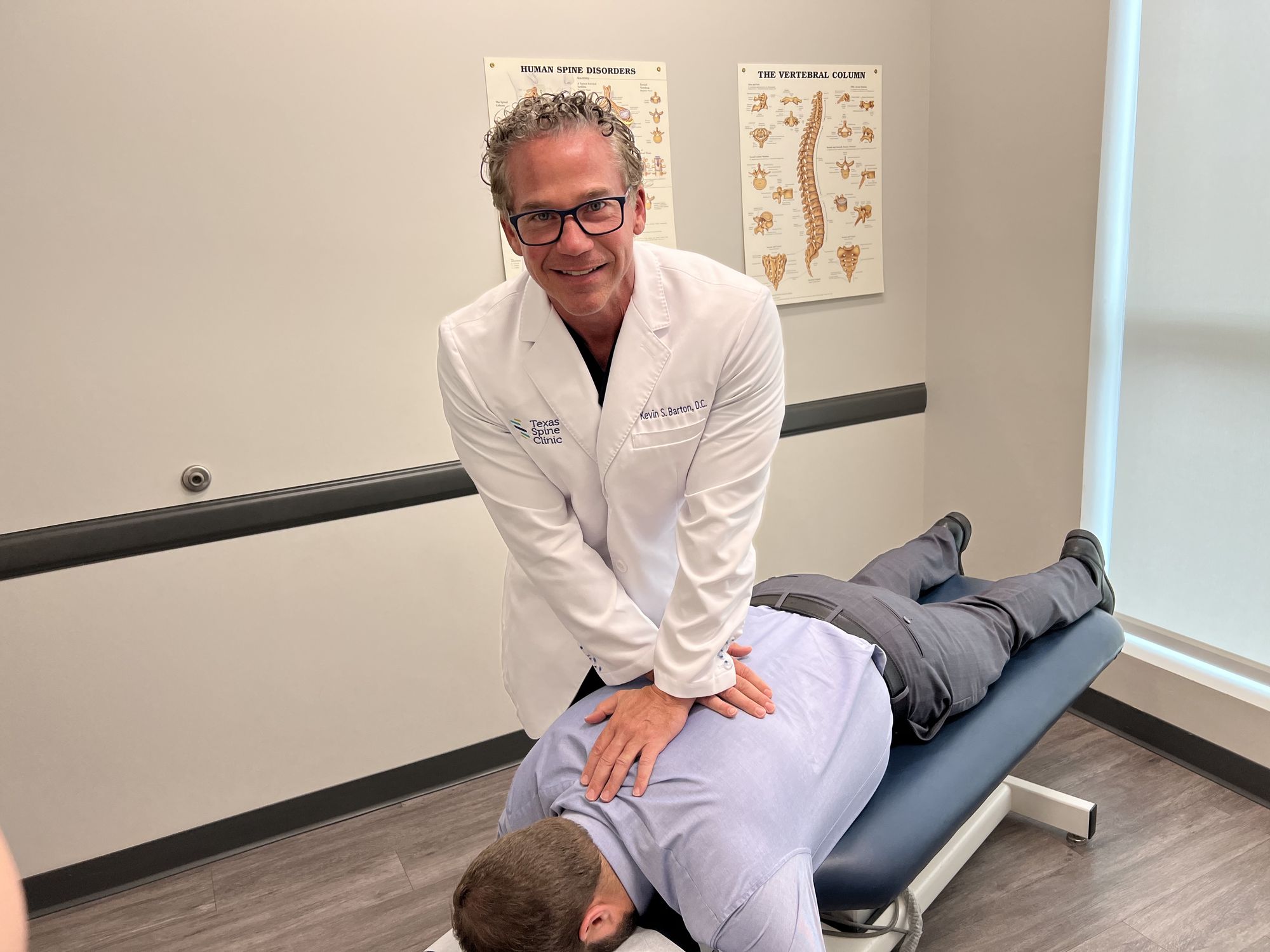

Dr. Kevin S. Barton, D.C., adjusting a patient's mid-back on a treatment table at Texas Spine Clinic in San Antonio.

For the back that locks up when you stand, and the neck that won't turn to check your blind spot

A stiff joint hurts. A joint that moves right doesn't.That's the whole job.

When a joint in your spine gets tight, it stops moving the way it was built to. It rubs wrong, it gets inflamed, and it hurts. An adjustment stretches that joint so it moves correctly again, the same way stretching a tight muscle gets it working again. No needles, no narcotics, no downtime. Just the joint doing its job.

  • Exam before anything else
  • X-rays only when your case needs them
  • New patients seen the same day
  • Most patients start treatment on the first visit
  • A plan with an end date
  • No referral needed
  • Most insurance and Medicare accepted

Sound familiar?

Your body is telling you a joint has stopped doing its job.

You know the feeling, even if you've never had a name for it.

  • You get out of the car in stages. Hand on the door. Straighten up slowly.
  • Checking your blind spot means turning your whole body, because your neck stops halfway.
  • Your low back is fine until you stand at the sink for ten minutes. Then it aches like a bruise.
  • You wake up stiff, and it takes a hot shower and an hour before you feel like yourself.
  • There's one spot between your shoulder blades that you're always pressing into a door frame.
  • Ibuprofen takes the edge off. Then it wears off, and the spot is right where you left it.

None of that means something is broken. Most of the time it means something is stuck: a joint that's lost its normal motion, and a body working around it. That's fixable.

How it happens

Tight joint. Bad motion. Inflammation. Pain.

Your spine isn't one long bone. It's a stack of small bones connected by small joints, about two dozen segments, each built to move a little. Bend, twist or look over your shoulder, and dozens of those joints each do their share.

When one of them gets tight (from how you sit all day, from lifting wrong, from an old injury, or just from never moving it through its full range), four things follow, in this order.

1

It stops moving the way it was built to.

Think of a door with one stiff hinge. The door still opens. But it drags, it squeaks, and it pulls on the frame every single time.

2

Its neighbors pick up the slack.

Picture a shopping cart with one stuck wheel. It still rolls, but it pulls to one side, you fight it the whole way down the aisle, and the other three wheels wear out doing the stuck one's work. The joints above and below a tight one over-move to make up for it, and they start to complain too.

3

The joint gets inflamed.

A shoe that rubs your heel the wrong way is nothing for one step. A thousand steps a day, and you've got a blister. A joint that moves wrong rubs wrong every time you bend, sit or turn, and the tissue around it gets irritated and inflamed.

4

The muscles lock down to protect it.

Your body guards a sore joint. The muscles around it tighten like a splint. That's the knot you feel. But a splinted joint moves even less, so it gets tighter, the rubbing gets worse, and the cycle feeds itself.

The pain cycle: a tight joint moves wrong, gets inflamed, and the muscles guard it, which makes it tighter. An adjustment breaks the cycle at the tight joint. 1Tight joint 2Moves wrong 3Inflamed 4Muscles guard An adjustment breaks the cycle here

Stuck in the cycle: each step makes the next one worse.

Pain is usually the last step, not the first. By the time it hurts, the joint has usually been moving wrong for a while.

Why the pills wear off. Anti-inflammatories and muscle relaxers quiet steps 3 and 4, the inflammation and the guarding. That's why they help for a few hours. But they don't touch step 1. The joint is still tight and still moving wrong, and the moment the pill fades the cycle picks up right where it left off. To end the cycle, you have to fix the motion.

What an adjustment actually does

An adjustment is a stretch for a joint.

You already know how this works, because you've done it to a muscle.

When your hamstring is tight, it doesn't work right. You can't bend as far, it pulls, and if you push it, it hurts. So you stretch it. You take it a little past where it's been stuck, and it starts moving the way it was built to again.

A spinal adjustment does the same thing for a joint. Your chiropractor finds the joint that's stuck, positions you so the pressure goes exactly there, and uses a quick, controlled stretch to take that joint through the motion it's lost. The joint moves the way it was designed to. And a joint that moves right stops rubbing wrong.

Here's what follows from it:

  • Motion comes back. The stiff hinge swings freely again. Turning, bending and reaching stop feeling like negotiations.
  • The rubbing stops, so the inflammation can settle. Take away what's irritating the tissue, and your body does what it always does when an irritation stops: it calms down.
  • The neighbors get a break. When the stuck wheel rolls again, the other three quit doing its work.
  • The muscles let go. A joint that isn't sore doesn't need a splint. The guarding eases.
What about the pop? Sometimes an adjustment makes a sound. It's the same thing that happens when you crack your knuckles: as the joint surfaces separate a little, a small pocket of gas in the joint fluid is released. It's not a bone "going back into place." Your bones weren't out of place. The sound isn't the goal, and it isn't how we measure an adjustment. The goal is the motion. Some adjustments pop, some don't, and both work.

What an adjustment isn't. It isn't forcing anything. It isn't something done to a joint that doesn't need it. And it isn't the only tool we have, which matters, because some joints and some patients do better with a different one.

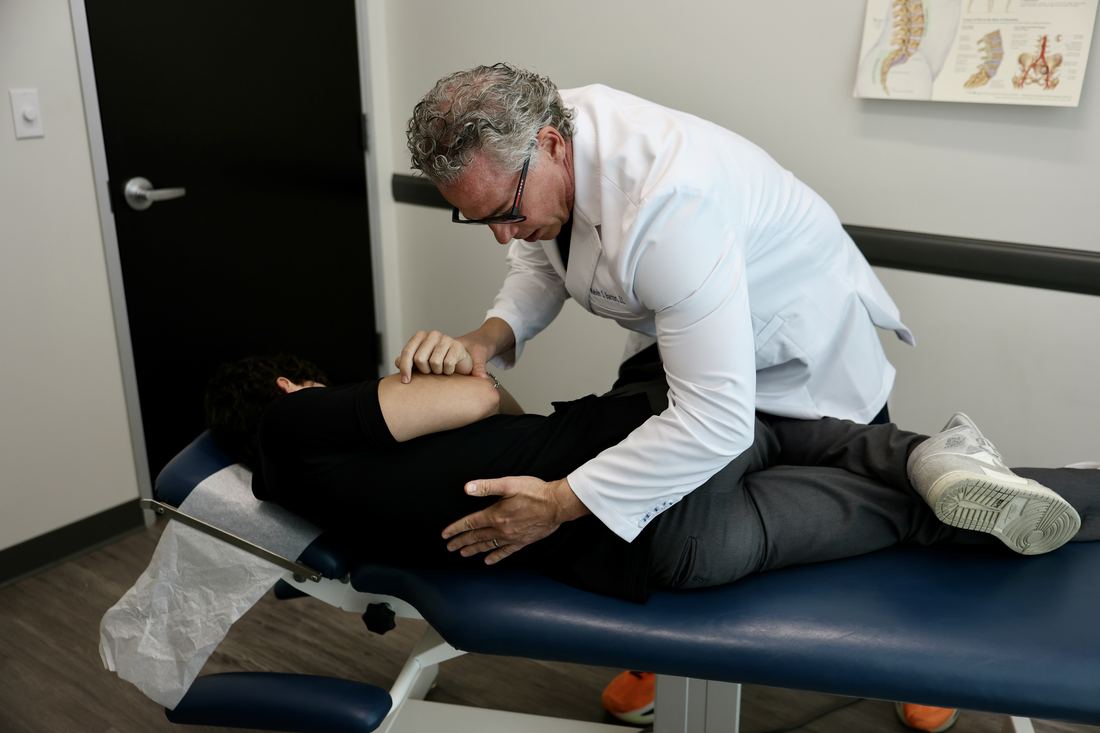
Dr. Kevin S. Barton, D.C., positioning a patient on their side for a low back adjustment at Texas Spine Clinic.
The adjustmentA precise adjustment, aimed at the part of your spine that's stuck.
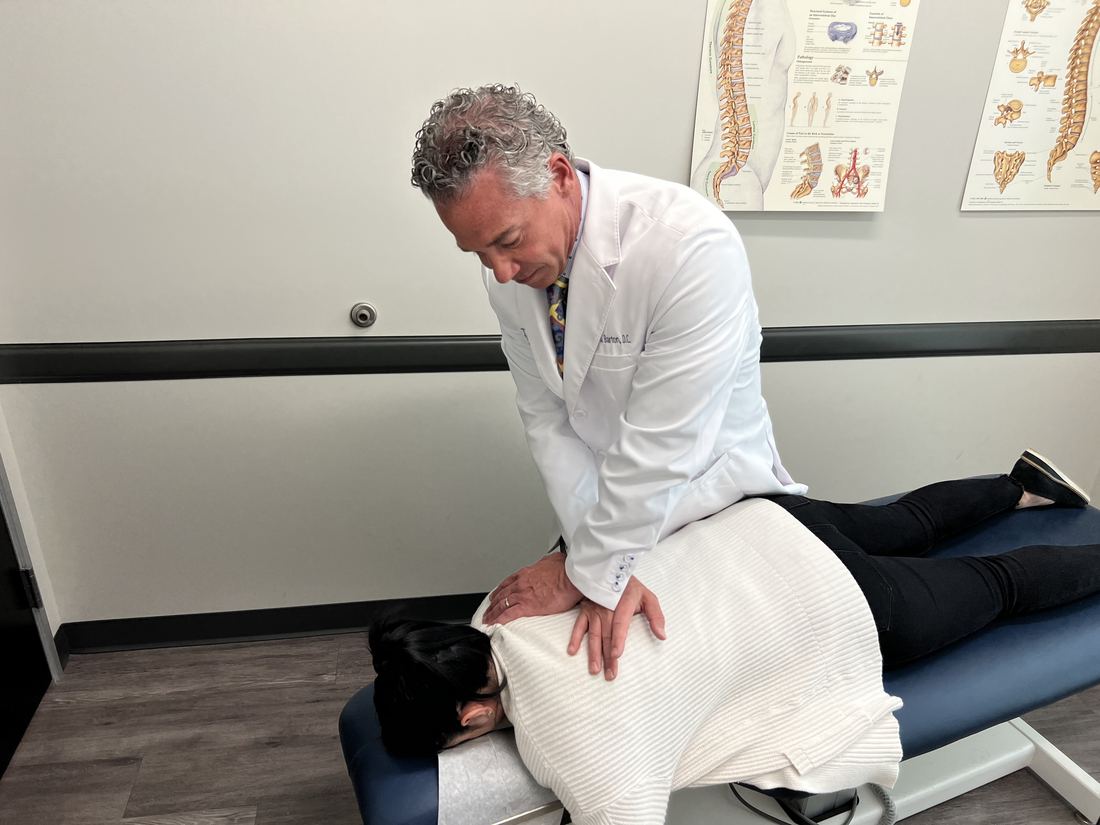
Dr. Kevin S. Barton, D.C., with both hands on the upper back of a patient lying face down on a treatment table at Texas Spine Clinic.
The upper backFace down on the table, with his hands placed right where your spine isn't moving.
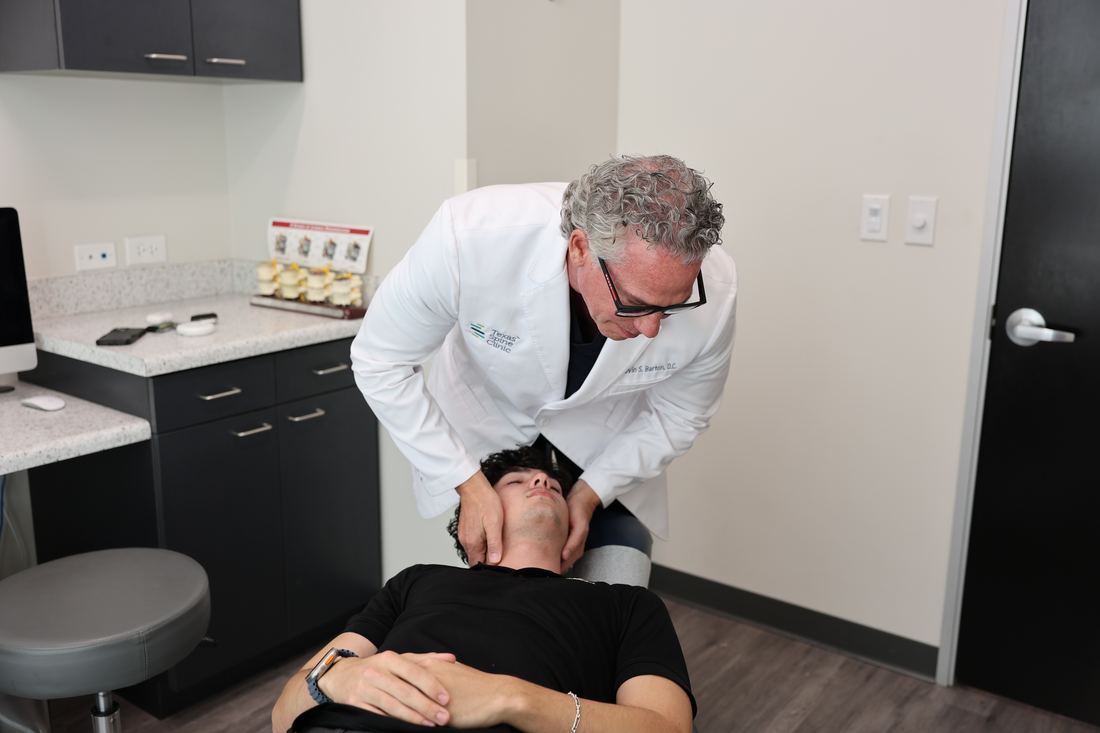
Dr. Kevin S. Barton, D.C., with his hands on the sides of a patient's neck for a neck adjustment, the patient's head resting on the table's headrest, at Texas Spine Clinic.
The neckYour head lies on the headrest the whole time. The adjustment is precise and aimed at the part of your neck that's stuck.

What we treat

Joint and muscle pain, where it starts. Not just where it hurts.

Low back pain and stiffness

The back that aches after standing, locks up getting out of a chair, or tightens overnight.

Is it a joint, a disc or a nerve? →

Neck pain and stiffness

The neck that won't turn, and the ache at the base of the skull after a day at a screen.

More on neck pain →

Mid-back pain

The knot between the shoulder blades. Your rib cage holds the mid-back in place, so it doesn't respond to decompression the way the low back and neck do. It responds to hands-on care. This is where it's treated.

SI joint and pelvic pain

The one-sided ache low in the back, near the dimple, that often gets mistaken for a disc problem.

Headaches that start in the neck

The kind that begin as tightness at the base of the skull and climb.

Injuries from a car accident

Whiplash, and the soreness that shows up days later. This has its own program, with medical care under the same roof when you need it.

Our injury program →
When it's not a joint. Sometimes the exam finds that the joint isn't the whole story: a disc pressing on a nerve, a nerve that's firing on its own, or an injury that needs a physician. You won't be sent across town. Spinal decompression, scrambler therapy and interventional pain management are all here, under one roof. The exam decides which one your case needs, so when we recommend an adjustment, it's because an adjustment is what your joint needs.

DRX9000 Spinal Decompression · Scrambler Therapy · Car Accident Injury Program

More than an adjustment

Free the joint. Then teach it to stay free.

An adjustment gets the joint moving. What keeps it moving is everything around it: the muscles that were guarding it, and the habits that tightened it in the first place. So your visits pair the adjustment with therapy aimed at the same spot.

Muscle stim

Gentle electrical pulses that help the guarding muscles let go of their splint, so the joint isn't squeezed stiff again the moment you stand up.

Ultrasound

Sound waves that warm the tissue deep around the joint, below where a heating pad can reach.

Heat or ice

Heat to loosen tight muscles, ice to cool down a joint that's freshly inflamed. Your doctor picks the one your joint needs that day.

Laser

Light energy aimed at the sore tissue to help calm the inflammation.

Exercises

Stretches and strengthening chosen for your joint, not a photocopied sheet. You learn them here and do them at home in a few minutes a day. The stronger the muscles around the joint, the longer it holds its motion.

Would you rather not have your neck adjusted? That's completely fine. You don't have to explain it or defend it. An adjustment is never required, for your neck or anywhere else. We don't adjust a neck unless it's the neck that hurts, and even then, only with your OK. There are other ways to get a stiff neck moving. Tell us, and that's the plan.
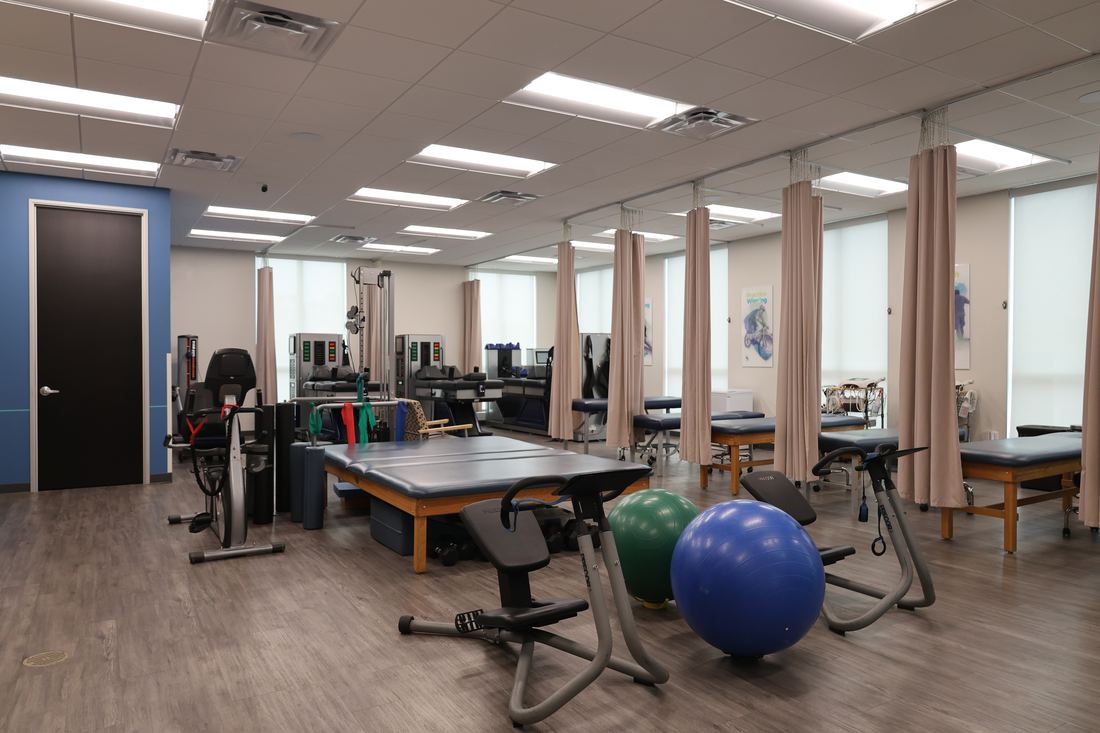
The rehabilitation room at Texas Spine Clinic: therapy tables, a stationary bike, exercise balls and training equipment.
The rehab roomWhere you learn the exercises that will help your spine stay strong.
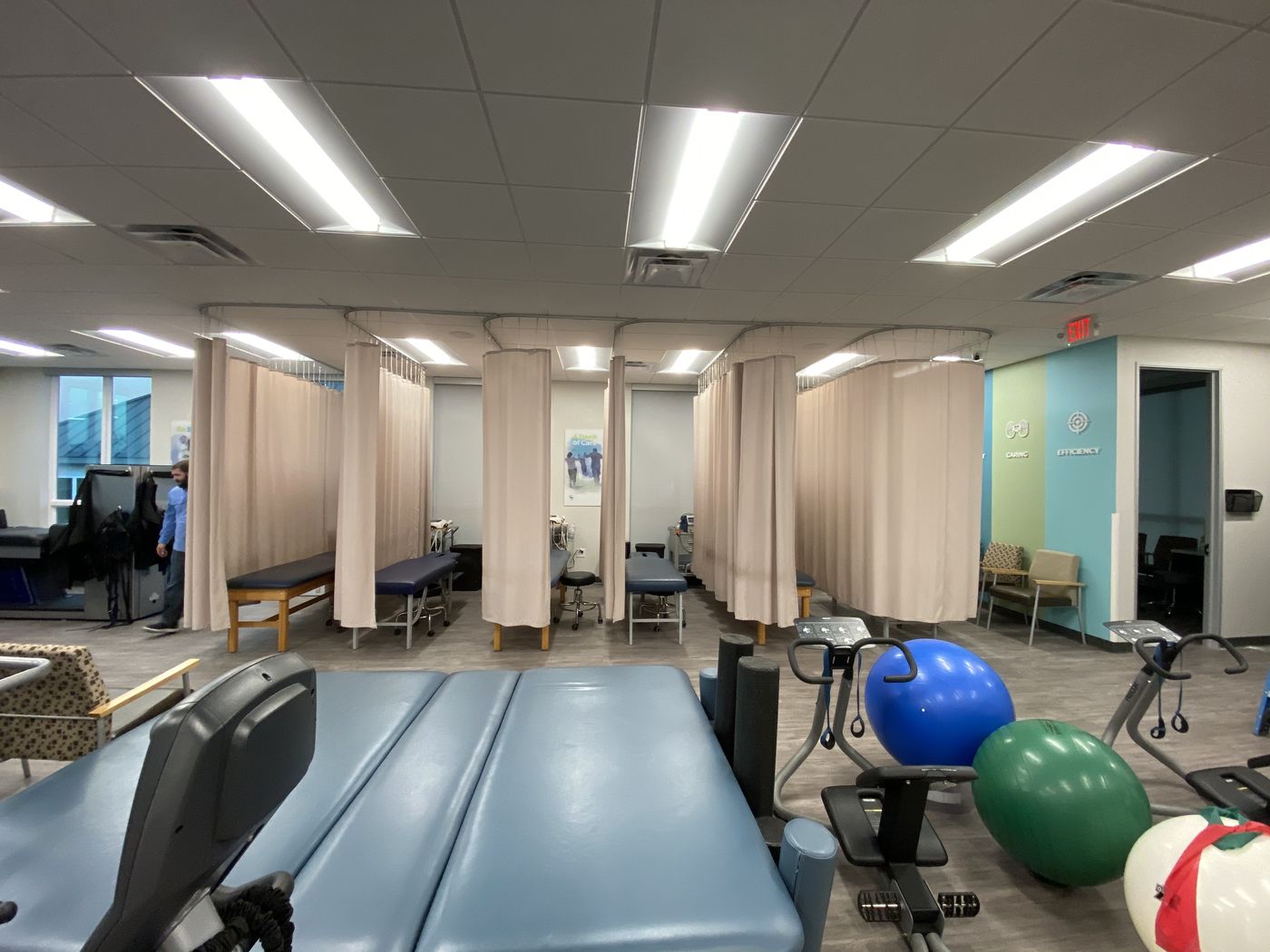
The Texas Spine Clinic rehab room seen from the other end: therapy tables, curtained treatment bays, exercise balls and bikes.
The same room, from the other endTherapy tables, with curtained bays for treatment.

Your first visit

What happens on your first visit, step by step.

You should know exactly what you're walking into. Here it is.

  1. You talk, we listen. Where it hurts, when it started, what makes it worse, what you've already tried. Your doctor asks what you can't do right now that you want to do again, because that's the real goal.
  2. A hands-on exam. Your doctor checks how each part of your spine moves, finds the joint that's stuck, and tests the muscles and nerves around it. This is where the real cause usually shows up, sometimes a few inches from where it hurts.
  3. X-rays only if your case needs them. Plenty of people don't. When the exam says an image will change your care, they're taken right here. Already have an MRI or X-rays? Bring them.
  4. You find out what's wrong, in plain words. Before anyone touches your spine, your doctor explains which joint is tight, what it's doing to the joints around it, and the plan to fix it. You hear it today, not at a second appointment.
  5. Treatment starts the same day. Most patients get their first adjustment and therapy on this visit.
  6. You leave with a short plan sized to your problem. Most plans are a small number of visits, often somewhere between 6 and 12, depending on the problem. Some people need just one. Your doctor tells you how many your joint needs, how often, and when you'll be re-examined.

Plan on 45 to 60 minutes, a little longer if X-rays are taken and you're filling out new-patient paperwork. The adjustment itself takes only five or six minutes; the rest is your exam and any therapy afterward.

Hurting today? New patients can be seen the same day. One visit gets you the exam, the answers, your first treatment and a plan. No referral needed. Call (210) 741-9166.
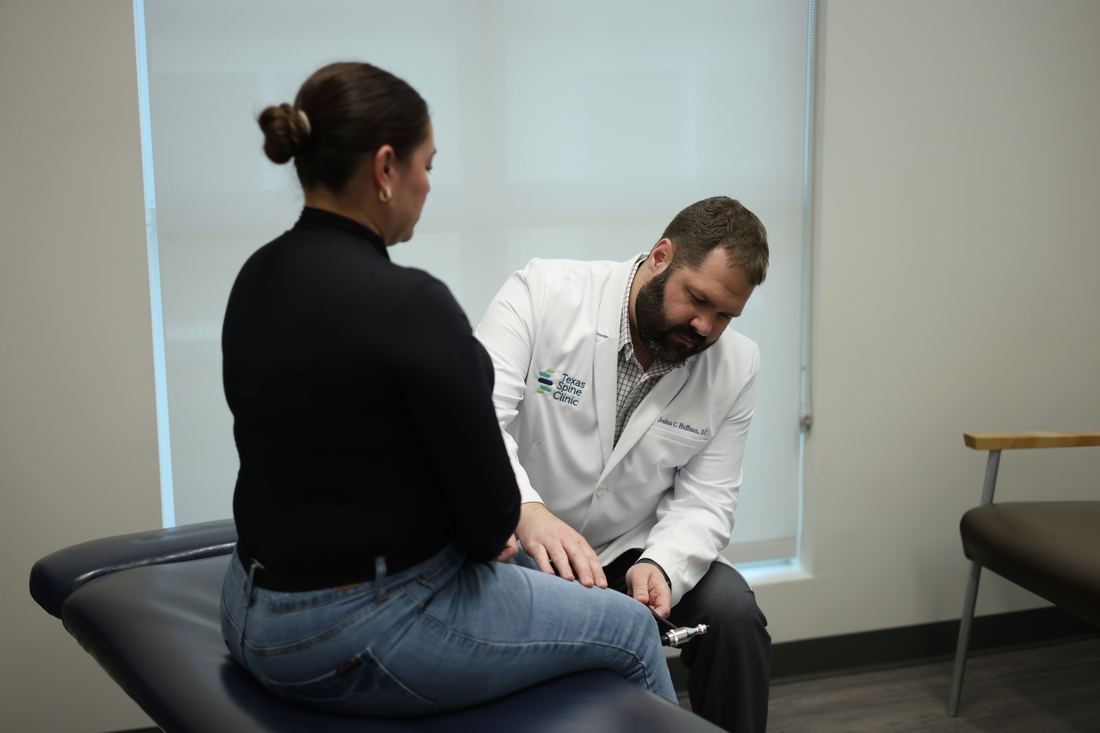
Dr. Joshua C. Huffman, D.C., testing a seated patient's knee reflexes with a reflex hammer at Texas Spine Clinic.
The hands-on examReflexes, strength and movement, checked before anyone decides on your care.
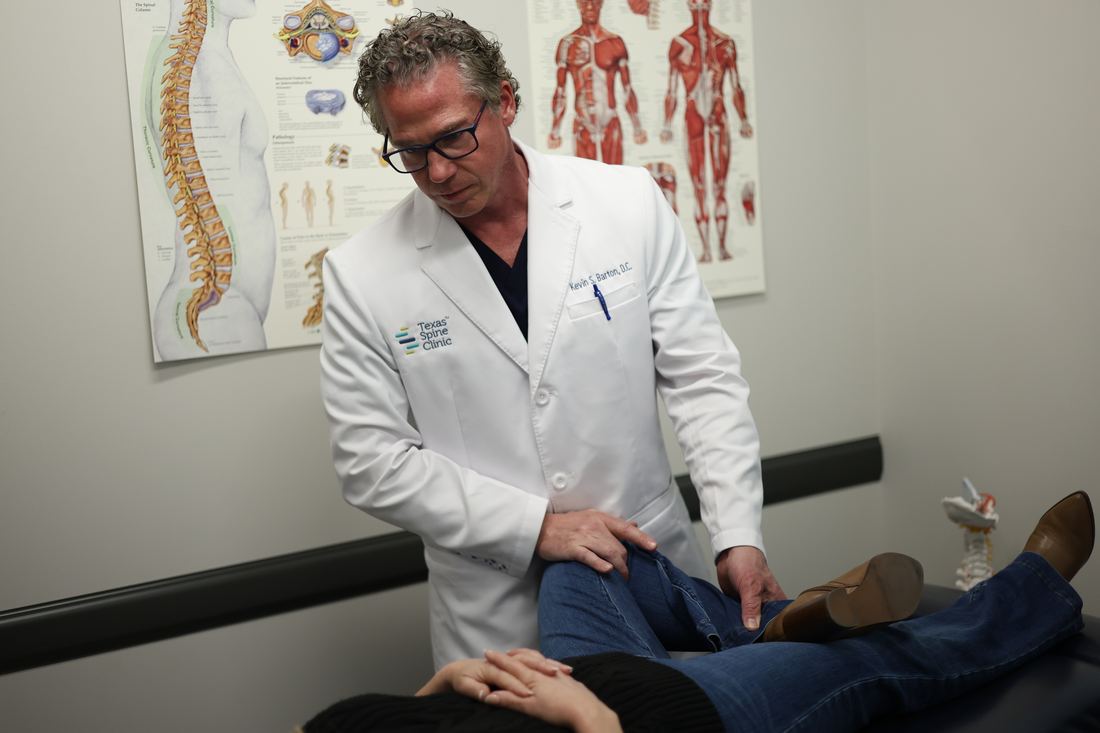
Dr. Kevin S. Barton, D.C., bending a patient's hip and knee to test how the joints move, with the patient lying on a treatment table at Texas Spine Clinic.
Testing how you moveYour doctor moves each joint to find what's tight and what's causing your pain.
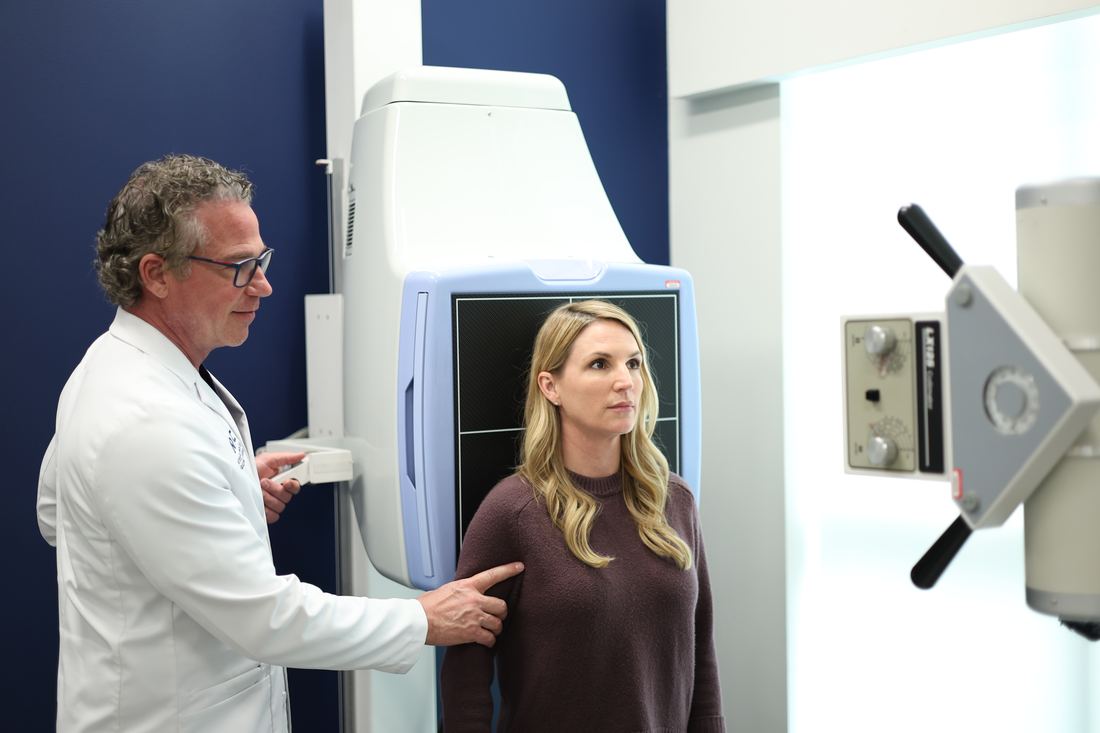
Dr. Kevin S. Barton, D.C., positioning a patient at the X-ray unit at Texas Spine Clinic.
X-rays, only if you need themTaken right here in the office, so you don't get sent somewhere else for pictures.

What we stand behind

A plan with an end date. Progress you can measure.

Here's how chiropractic care works at Texas Spine Clinic. Hold us to every line.

01Your plan is short, and it has an end date. Usually somewhere between 6 and 12 visits, sometimes just one, sized to your problem. You'll know the number before you start.
02You're re-examined on a schedule. Your doctor compares your pain (how bad, how often) and what you can do, like how long you can stand or walk, against where you started. You answer the same short questionnaire you filled out on day one, so progress is measured, not guessed.
03We listen to you. What you tell us about how you feel counts as much as what we measure, and we never ignore it.
04If it isn't working, the plan changes. A different approach, a different treatment under this roof, or a straight answer that you need something else. Nobody keeps adjusting a joint that isn't responding.
05The goal is you, back to your life. Getting out of the car in one motion. Checking your blind spot without turning your shoulders. Sleeping through the night.

After your plan. Once your joint is moving right and the pain has settled, a check-in visit every so often keeps it that way, the way a dental cleaning keeps a small problem from becoming a big one. The load of daily life doesn't stop, and a joint that starts to tighten again is much easier to catch early. That's good care, and we'll recommend it plainly. How often is up to you.

Who you'll see

Your care team

We work as a team. Dr. Barton and Dr. Huffman have practiced side by side for more than 18 years, and your care is a team effort from your first visit.

Dr. Kevin S. Barton, D.C.

Kevin S. Barton, D.C.

Chiropractor · In practice since 2003

Dr. Barton has been in practice since 2003 and has used the DRX9000 since 2005, with more than 2,000 patients treated on it. He's the author of the treatment philosophy here: find the source of the pain and treat it there, without surgery and without narcotics. He completed advanced scrambler therapy training in Rome with Dr. Giuseppe Marineo, the inventor of the treatment.

In 2025 he went through the DRX9000 program himself, for one of the worst herniated discs he'd seen in his career, and filmed the whole course of treatment, MRIs included. Watch his nine-part series.

Dr. Joshua C. Huffman, D.C.

Joshua C. Huffman, D.C.

Chiropractor · In practice since 2007

Dr. Huffman earned his Doctor of Chiropractic degree from Texas Chiropractic College in Pasadena, Texas, and completed his internship at Moody Health Center, with a rotation at the Michael E. DeBakey VA Medical Center in Houston. He has advanced training in myofascial release technique and is certified as a designated doctor for the State of Texas.

A Texas native, he was born and raised in Matagorda County. When he isn't getting patients well, he's hunting, fishing, kayaking and hiking with his wife, Kendra, and their two children, Titus and Alley.

What patients say

In their words.

Her daughter had two herniated discs on her MRI. The exam found the real problem was a joint.

“As a mom, I was at my breaking point trying to find answers for my daughter's back pain… Over the next 11 weeks, we did everything we could—X-rays, an MRI, consultations with three different doctors, and multiple treatments that only brought temporary relief. Nothing was truly helping… She couldn't tie her shoes or sit without pain. Then we found Dr. Huffman and decided to try one more time. Within two days, we had answers—and almost immediate relief. He truly listened, asked thoughtful questions, performed a thorough exam, and carefully reviewed everything we had already done. He came back with a plan that took a different approach. Although my daughter had two herniated discs (which previous doctors had focused on), he identified an issue with her lower SI joints and proposed a targeted treatment plan. Using state-of-the-art equipment alongside hands-on care, we saw results that same day. Watching her go from bracing through every movement to smiling—and even dancing to the office music—felt unbelievable… I'm beyond grateful. This experience gave us our daughter—and her life—back!”
Gina Robertson · Posted on Google
“Dr. [Huffman] and his Physical Therapists have been dedicated in healing my back and sciatica problems… They communicate well and I can't say enough how they have helped my healing process.”
Alfred Hawkins · Posted on Google
“Dr. Barton here at the Texas Spine Clinic is great, he took the time to reach out and have me come in for a consultation and treatment. I have been having issues with my lower back and he got me seen and treated in a very timely manner.”
Jerry Gonzales · Posted on Google
“My experience was amazing… now no pain at all. The team is very professional and understanding. Dr. Huffman was great in explaining the process.”
Roxanna Morales · Posted on Google
“Dr. Huffman and his team have been amazing. I met Dr. Huffman in 2015 when I initially began to have back problems… We continue to recommend him to others.”
Liz Gutiérrez Manley · Posted on Google

Reviews quoted verbatim from our public Google profile. Individual results vary.

Insurance and investment

Is chiropractic covered by insurance?

Usually, yes.

Most major health plans cover chiropractic visits, and we accept Medicare.

Copays vary by plan, and we verify your benefits before your first appointment so you know what to expect.

No insurance? You'll still know the number before you book.

There's a set investment for the first visit (X-rays are taken only when your case needs them, and the fee reflects whether they were) and a lower set fee for routine visits after that. Call and the front desk will give you the numbers.

Six-visit packages, or one visit at a time.

If you need a course of care, we usually set it up as a six-visit package. Some people only need a visit or two and pay one visit at a time. We decide that case by case, after your exam. Care is prorated, so you only ever pay for visits you actually receive.

Payment options

CareCredit, Affirm and in-office payment plans are all available.

Car accident? Your care may cost you nothing out of pocket. Letters of protection accepted. See our injury program.

Common questions

Before you call

Is a chiropractic adjustment safe?

Your doctor examines you before anything is adjusted, and that exam is what decides whether an adjustment is right for your joint. If something in your history or exam says an adjustment isn't the right tool, you won't get one. You'll get a different treatment. And nothing is adjusted without your OK.

Does it hurt?

Usually, no. You'll feel pressure and a stretch as the joint moves. Depending on your condition and why you're being treated, a little soreness afterward can be expected, the way you feel after a good stretch or a new workout. It usually passes within a day.

What is the popping sound?

Gas being released from the fluid inside the joint as its surfaces separate, the same thing that happens when you crack your knuckles. It's not your bones moving back into place. Some adjustments make it and some don't; both work.

Will I have to keep coming back forever?

No. Your plan has an end date and checkpoints along the way. When your joint moves right and the pain has settled, you're done with the plan. Many people choose an occasional check-in afterward to keep it that way, like a dental cleaning. We'll recommend it, and it's your call.

How many visits will I need?

Usually a small number, often somewhere between 6 and 12, depending on the problem. Some people need just one. Your doctor sizes the plan to what your exam finds and tells you the number on your first visit. You're re-examined along the way, and the plan adjusts to how you're responding.

Do I need X-rays?

Only if your exam says an image will change your care. Many people don't. If you already have X-rays or an MRI, bring them.

Do I need a referral?

No. No referral is needed for your initial visit. If your care later requires one, we’ll get it for you.

Can I be seen today?

Usually, yes. New patients can be seen the same day. Call (210) 741-9166.

Can I get therapy without an adjustment?

Yes. An adjustment is never required. If you'd rather not be adjusted, or a joint does better with a different approach, your plan is built around therapy instead: muscle stimulation, ultrasound, heat or ice, laser therapy and exercises.

Do you adjust shoulders, hips or knees?

No. Our chiropractic care is for the spine and pelvis: the neck, mid-back, low back and SI joints.

How much does a chiropractor cost without insurance in San Antonio?

There's a set fee for the first visit and a lower set fee for routine visits after that, and the front desk will tell you both before you book. You'll never be asked to invest in a block of visits up front.

What's the difference between chiropractic care and spinal decompression?

An adjustment stretches a stiff joint so it moves right again. Spinal decompression gently takes pressure off a disc that's bulging or pressing on a nerve. They treat different problems, and your exam tells you which one you have. Both are here. Read about DRX9000 spinal decompression.

When are you open?

Monday through Thursday, 8 a.m. to 5 p.m. Friday is scrambler therapy only, by appointment. 3212 Napier Park, San Antonio, TX 78231. (210) 741-9166.

What happens next

Get the stuck joint moving again.

  1. An exam and a plain answer. Your history, a hands-on exam, X-rays only if your case needs them, and an explanation of which joint is stuck and why it hurts.
  2. Your first treatment, the same day. Most patients start with an adjustment and therapy on this visit.
  3. A written plan with an end date. How many visits, how often, and when you'll be re-examined.

New patients can be seen the same day. No referral needed. Most insurance and Medicare accepted. Monday–Thursday, 8 a.m.–5 p.m. · 3212 Napier Park, San Antonio.

Book your first visit

No referral needed. Same-day appointments available.

Calendar not showing? Open it in a new tab.
Rather book by phone? Call (210) 741-9166.

P.S. Stiffness is easy to live with until it isn't. The longer a joint moves wrong, the more the joints around it work to cover for it, and the more of your day you spend working around the pain instead of living. One visit tells you which joint is stuck and what it will take to free it. Call (210) 741-9166.