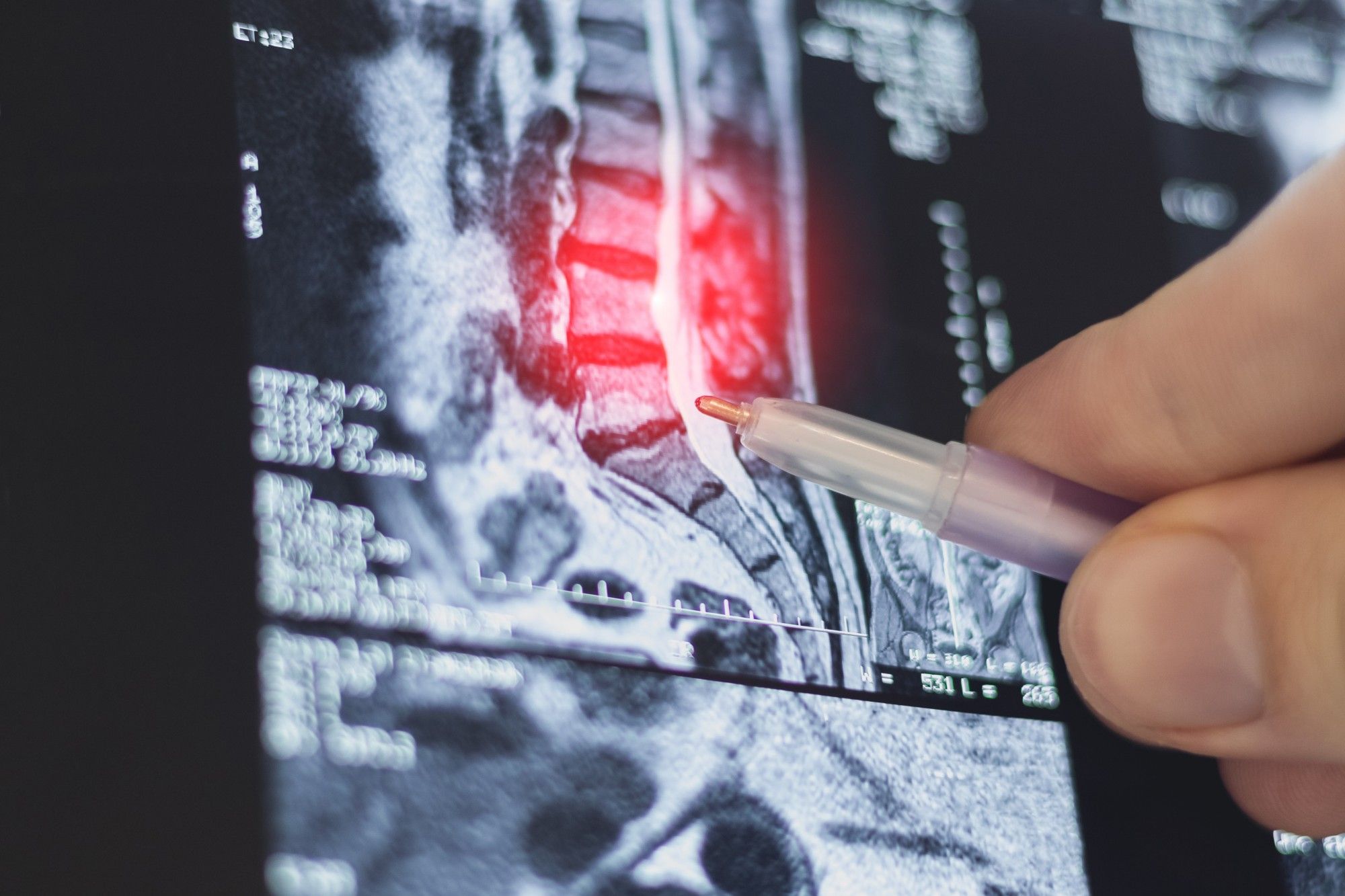
A pen pointing at a lumbar MRI on screen, with the worn disc levels highlighted in red.

For people in San Antonio who were handed the words “degenerative disc disease” and nothing else

The scariest thing about degenerative disc diseaseis the name.

Start here: it isn't really a disease, and "degenerative" doesn't mean your spine is crumbling on a schedule. It means your discs — the water-filled shock absorbers between your bones — have been losing fluid and height under years of load. Discs are living tissue. They respond to how they're loaded. That's the whole reason there's something to do about this, and it's the part nobody explained at your appointment.

23 years in practice
21 years using the DRX9000
2,000+ patients treated on it

Maybe you're 34, and the report stopped you cold.

Degenerative? Already? You typed the words into your phone at 11 at night and got back pictures of collapsed spines and people talking about fusion surgery. Nobody had told you your back was on a countdown. Now it feels like it is.

Or maybe you're 62, and you got the opposite problem: a shrug.

"Just wear and tear. Everybody your age has it." Said in the tone people use for gray hair. Which would be fine, except everybody your age isn't the one awake at 4 a.m. hunting for the one position that doesn't ache.

Either way the visit ended the same. A frightening name, no explanation, and no plan beyond anti-inflammatories and "stay active."

Meanwhile, here's your actual week. Stiff for the first 30 minutes every morning, like your back has to warm up before it agrees to be a back. A long drive costs you the rest of the day. Math on everything — which chair, which shoes, whether to carry both bags in one trip. Putting on socks is a decision now. You stand up from a movie in stages.

And underneath it sits the sentence the name planted: this only goes one direction.

Let's fix the sentence first. Then let's talk about the back.

The four minutes nobody gave you

First, how a disc actually stays alive

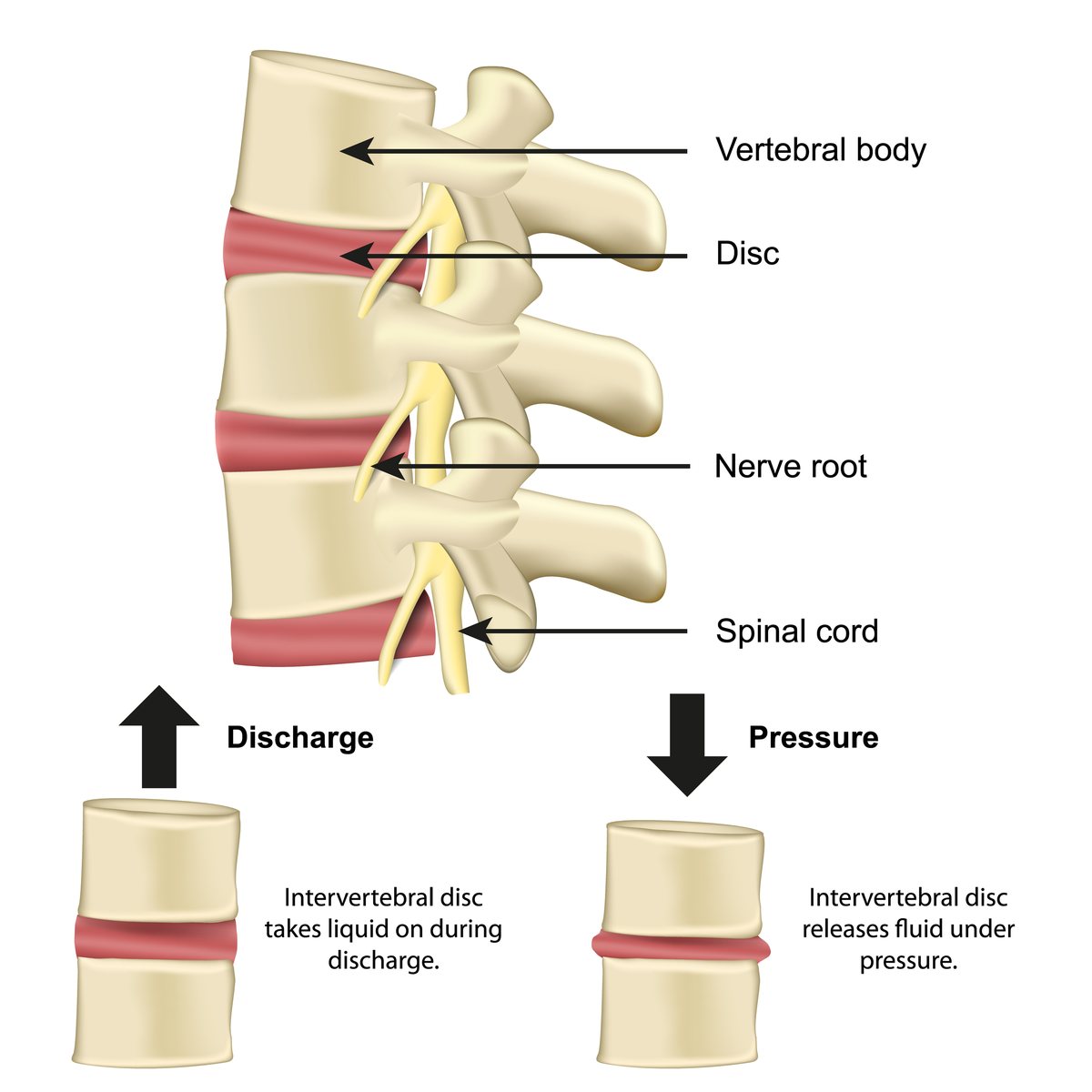
Between each pair of bones in your spine sits a disc: a tough outer ring with a soft, water-rich center. A young, healthy disc is mostly water. That's not trivia — the water is the shock absorber. Pressurized fluid is what lets a disc take the load of every step, every lift, every hour in a chair, and spring back.

Now the part almost nobody is told:

Your discs have almost no blood supply. By the time you're an adult, the disc is the largest structure in your body with essentially no blood vessels running into it. Nothing delivers water, oxygen, and nutrients to it the way blood delivers them to your muscles.

So how does it eat and drink? It sponges. Fluid seeps in and out through the thin layers of bone and cartilage above and below it. Load the disc — stand, sit, lift, walk — and fluid gets squeezed out, along with waste. Take the load off — lie down, sleep — and the disc draws fluid back in, bringing oxygen and nutrients with it. Doctors call it imbibition. You can call it drinking.

That's not a theory. It's why you are measurably taller in the morning than you are at night. Your discs drank overnight.

A disc's entire life depends on one rhythm: load, then unload. Squeeze, then drink.

Illustration of lumbar vertebrae, discs, nerve roots and spinal cord, with two smaller diagrams below: a disc taking fluid in when the load comes off, and the same disc releasing fluid under pressure.
Load the disc and fluid is squeezed out. Take the load off and it drinks back in — the rhythm your disc lives on.

What modern life does to that rhythm

Now run that system through your actual day. Eight or ten hours in a chair — a steady load the disc never gets a break from, so it keeps squeezing and rarely gets to drink. A commute. An evening on the couch. And every time you bend forward to pick something up, which loads a lumbar disc far harder than standing upright does — the one comparison every direct measurement agrees on.7 Weekend projects. Maybe an old injury that changed how you move, so one level takes more than its share.

The squeezing goes on all day. The drinking gets a few hours, if you sleep well — and pain is very good at making sure you don't.

Do that for a decade and the math stops working. The disc loses more than it takes back in. It flattens. It stiffens. On the MRI that shows up as a dark disc and lost height, and the radiologist writes the words that scared you.

Read the name again with that in your head. It isn't a disease your body caught. It's a load-versus-recovery imbalance that ran for years. And an imbalance is a very different problem from a countdown, because you can change one side of it.

The cascade

Why one flat disc makes four tissues hurt

A flattened disc almost never hurts alone. When a disc loses height, everything built around it moves — and four separate tissues start complaining at once.

1. The disc itself.

Stiffer, less hydrated, worse at absorbing load, and carrying sensitive nerve endings in its outer ring. This is the deep, dull, central ache.

2. The facet joints jam.

Behind each disc sits a pair of small joints — real joints, with cartilage and a capsule, like little knuckles. They're designed to share the load, not carry it. When the disc in front of them gets shorter, they press together and take weight they weren't built for. They get irritated and arthritic. If your back is worse standing and better sitting, that's them talking. Facet syndrome.

3. The nerve openings narrow.

Your nerves leave the spine through small side windows, and the height of the disc is part of the frame of that window. Lose disc height and the window shrinks. That's how a "back problem" starts sending signals down a leg — the ache in the hip, the pins and needles in the calf, the toes that go quiet. If your legs give out after a block of walking and leaning on a shopping cart fixes it, that's narrowing at work. Spinal stenosis.

4. The muscles guard.

Your body isn't stupid. When a segment isn't stable, the muscles around it clamp down to protect it. Guarding is helpful for about a week and miserable for a year. It's the morning stiffness, the "my back is 80 years old" feeling, the spasm that shows up two days after the yard work.

One under-watered disc. Four tissues in trouble.

And this is exactly why nothing you've tried has held. Anti-inflammatories calm tissue #4 and some of #2. An injection quiets #2 or #3 — for a while. Exercise genuinely helps #4, and it's worth doing. But none of them reach #1, and #1 is the reason the other three are loaded.

Strengthening around a disc that stays compressed is like re-lacing a shoe with a worn-out sole. Worth doing. Not sufficient.

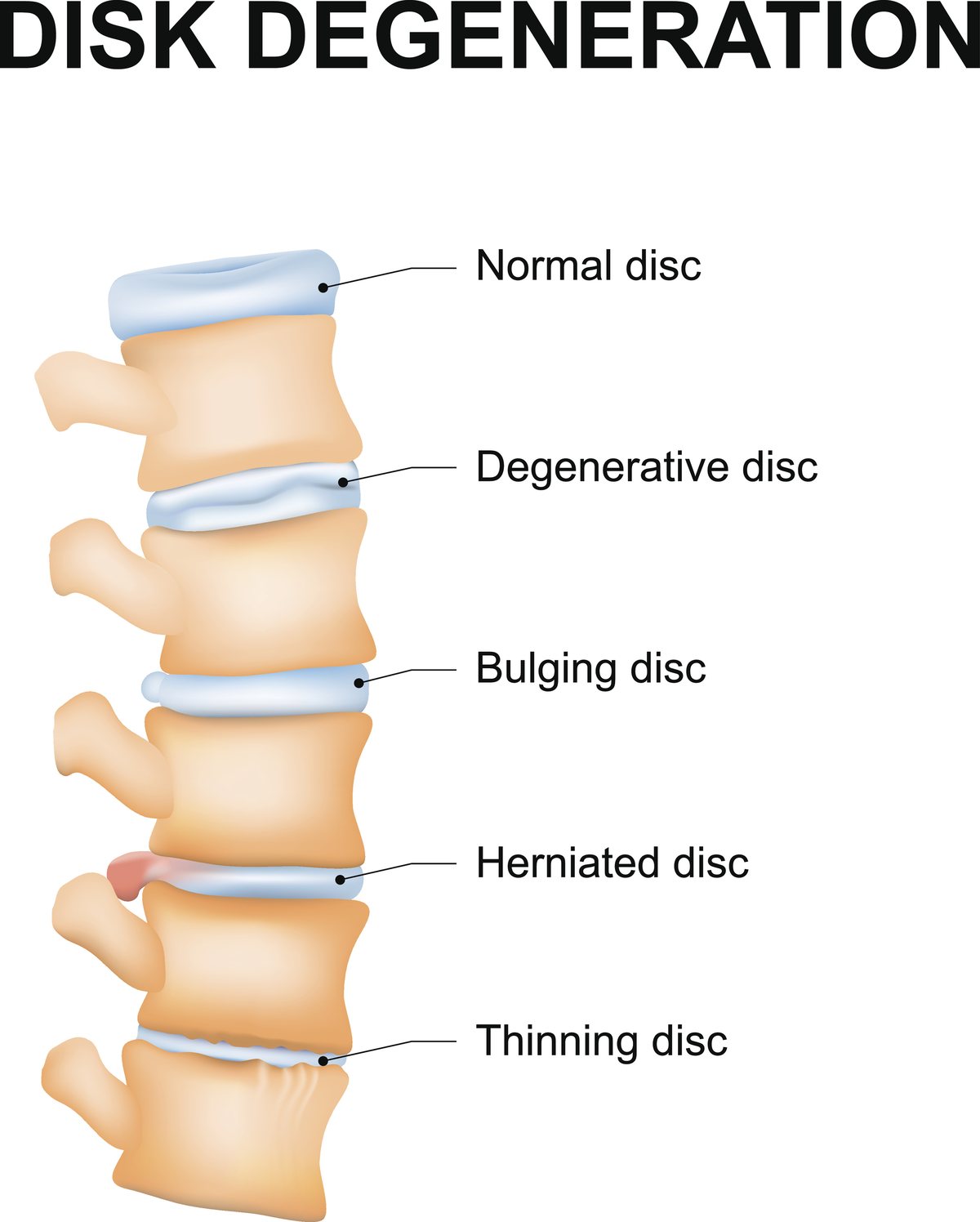
Illustration of a spine from the side showing a normal disc, a degenerative disc, a bulging disc, a herniated disc and a thinning disc.
The same spine, level by level: a normal disc, a degenerative one, and the flattened, thinning disc at the bottom — each one changing what the level above and below has to carry.

Want the full mechanics? The DRX9000 page walks all four tissues in detail, with the interactive diagram.

The mechanism

What decompression actually does

The DRX9000 is an FDA-cleared, computer-controlled spinal decompression system. You lie on a table, fully clothed, for about 25 to 30 minutes while it applies a slow, gentle, rhythmic pull, aimed at your specific level, on a force curve set by hand.

The point should sound familiar by now: it gives the disc the one thing your day never gives it — a long, deliberate stretch of time with the load off, so it can drink.

When researchers put pressure sensors inside human lumbar discs during decompression, the pressure inside went negative — roughly −100 to −160 mm Hg.1 Negative pressure is a vacuum, and a vacuum pulls fluid inward. That's the sponge action of your disc, produced on purpose, for half an hour, over and over.

Then the cascade runs backward. As the segment opens, the jammed facet joints get room and start moving. As they move, the guarding muscles are allowed to let go. As disc and joints decompress, the nerve windows regain some space and the signals down the leg get quieter.

Which is why patients keep asking us the same surprised question: "why is my flexibility coming back so fast?" Because you lost motion for several reasons at once — lost disc height, locked joints, muscles in spasm — and unloading the segment reaches all of them at the same time.

Dr. Barton puts it this way: if you had a bruise on your arm and somebody pressed on it all day, every day, it would never heal. Your disc is no different.

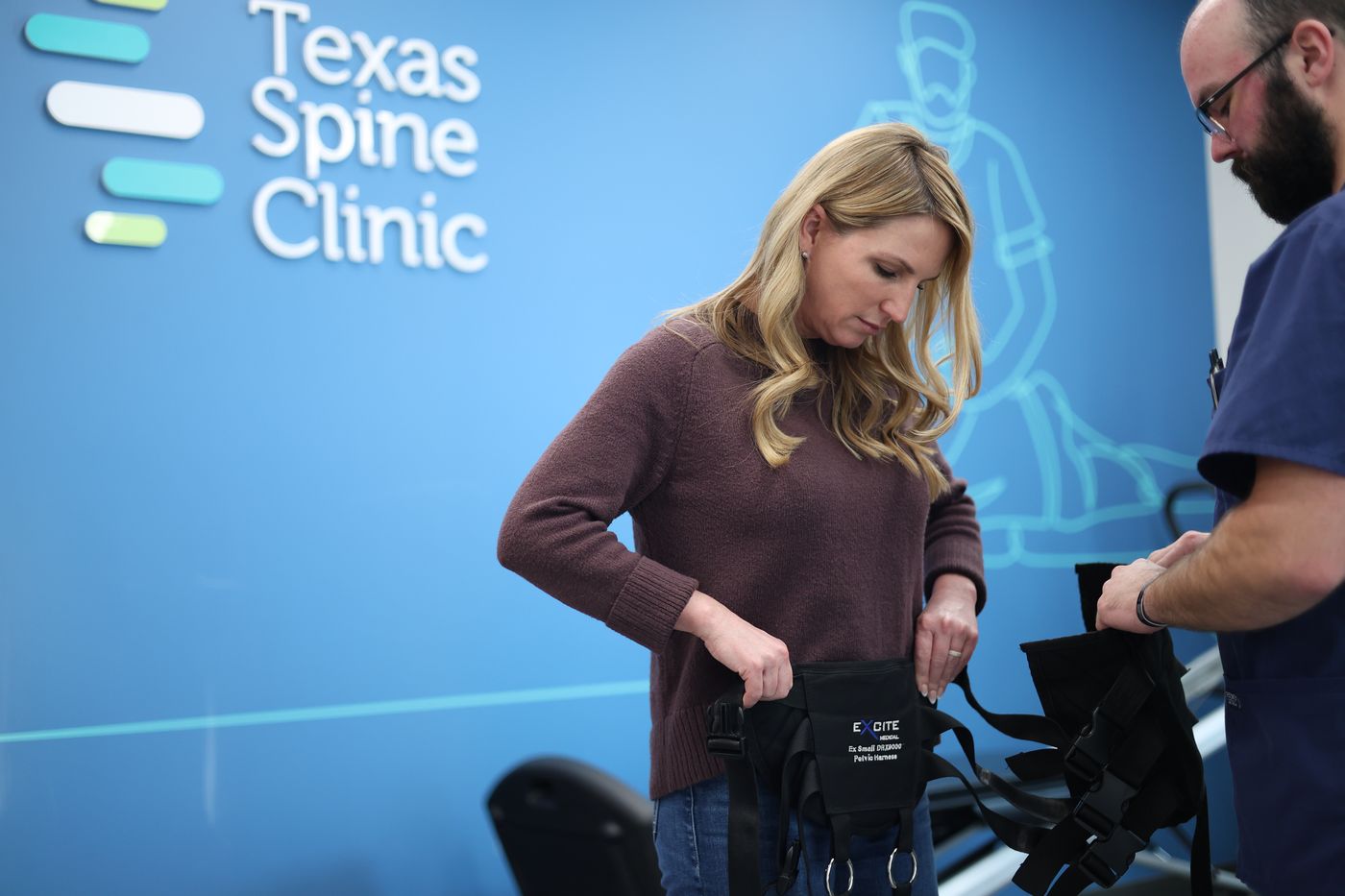
A Texas Spine Clinic team member fitting the DRX9000 pelvic harness around a patient's hips before treatment.
Getting set up. Fully clothed — the pelvic harness goes on over your own clothes before you lie down.
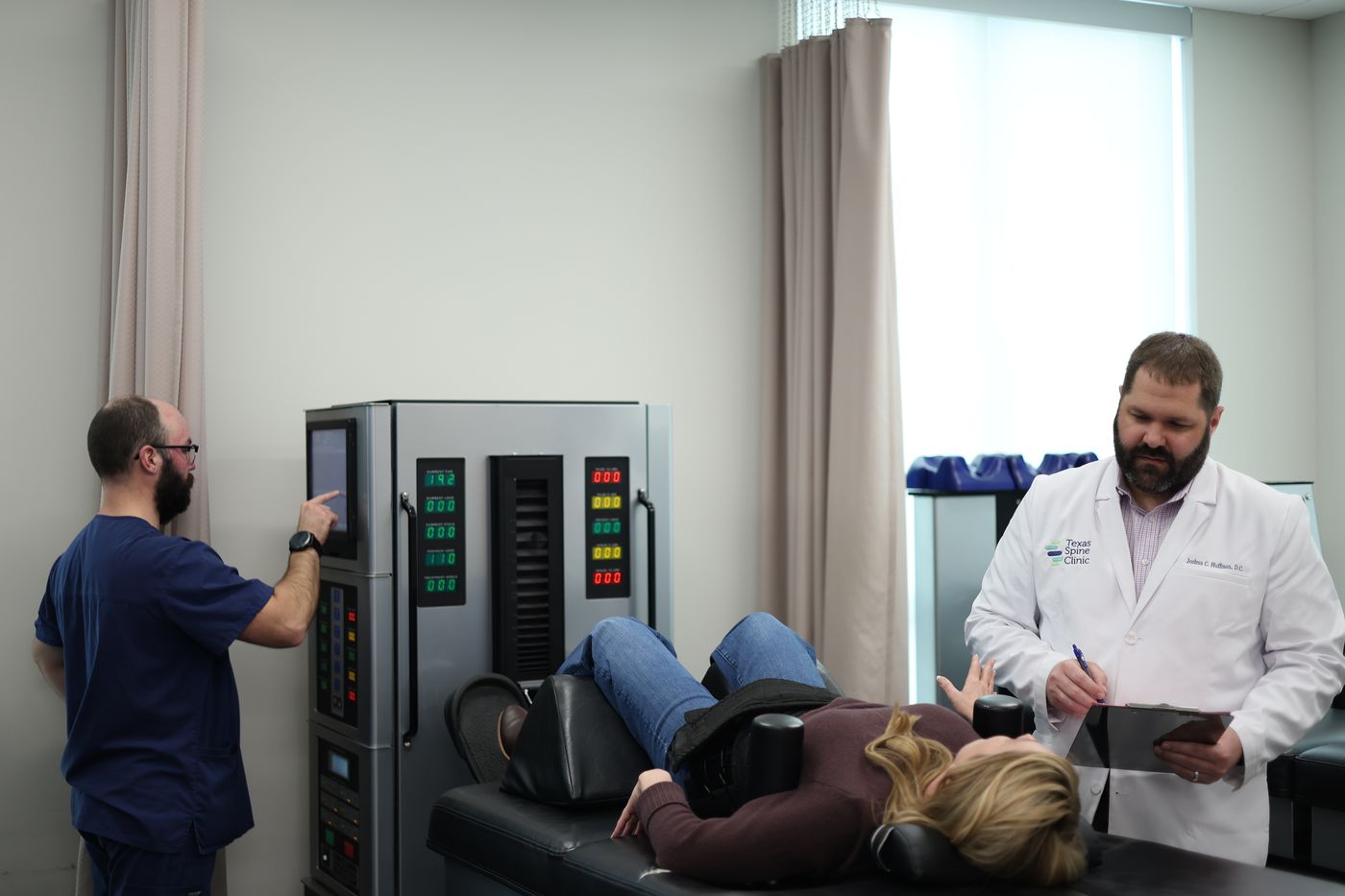
A patient lying on the DRX9000 table while a team member sets the console and Dr. Huffman reviews her chart.
On the table. About 25–30 minutes. The pull is aimed at the one level being treated, on a force curve set by hand and adjusted as you respond.

Asked out loud or not

The three questions everyone is silently asking

"Isn't this just traction with a computer on it?"

traction pulls. Decompression pulls on a controlled curve, at a set angle, at a set level, with the machine sensing and backing off when your muscles resist — because if you guard against the pull, the disc never opens and you get nothing. Is that difference big enough to matter? The pressure work says the negative-pressure effect is real.1 The comparison studies point the same way but are small and imperfect.4 We'll show you both. And: if an inversion table and a pull-up bar give you lasting relief, do that and keep your money. Most of the people who end up here already tried.

"How do I know it will be done right?"

Ask us the hard questions — we like them. Here's how care is decided here, and you can hold us to every line: a doctor reviews your actual MRI before anyone discusses a plan or a price. A disc is never diagnosed from an X-ray, because an X-ray can't show one. The exam decides who is treated — screening comes before selling, every time, which is why we turn people away every week. And your cost is in writing before your program begins.

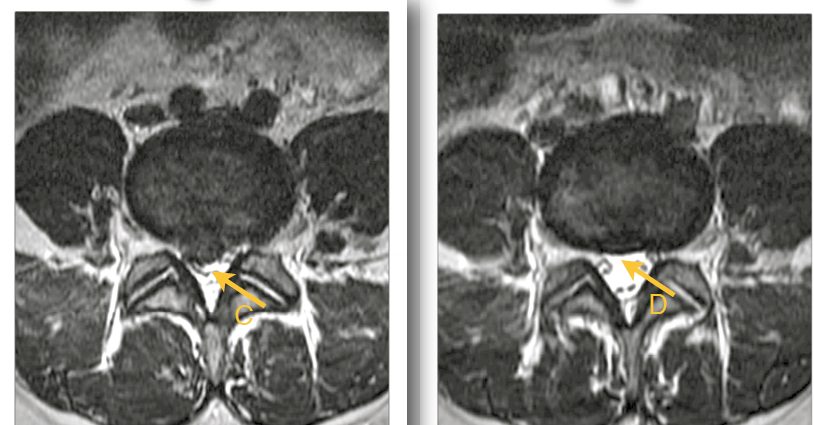
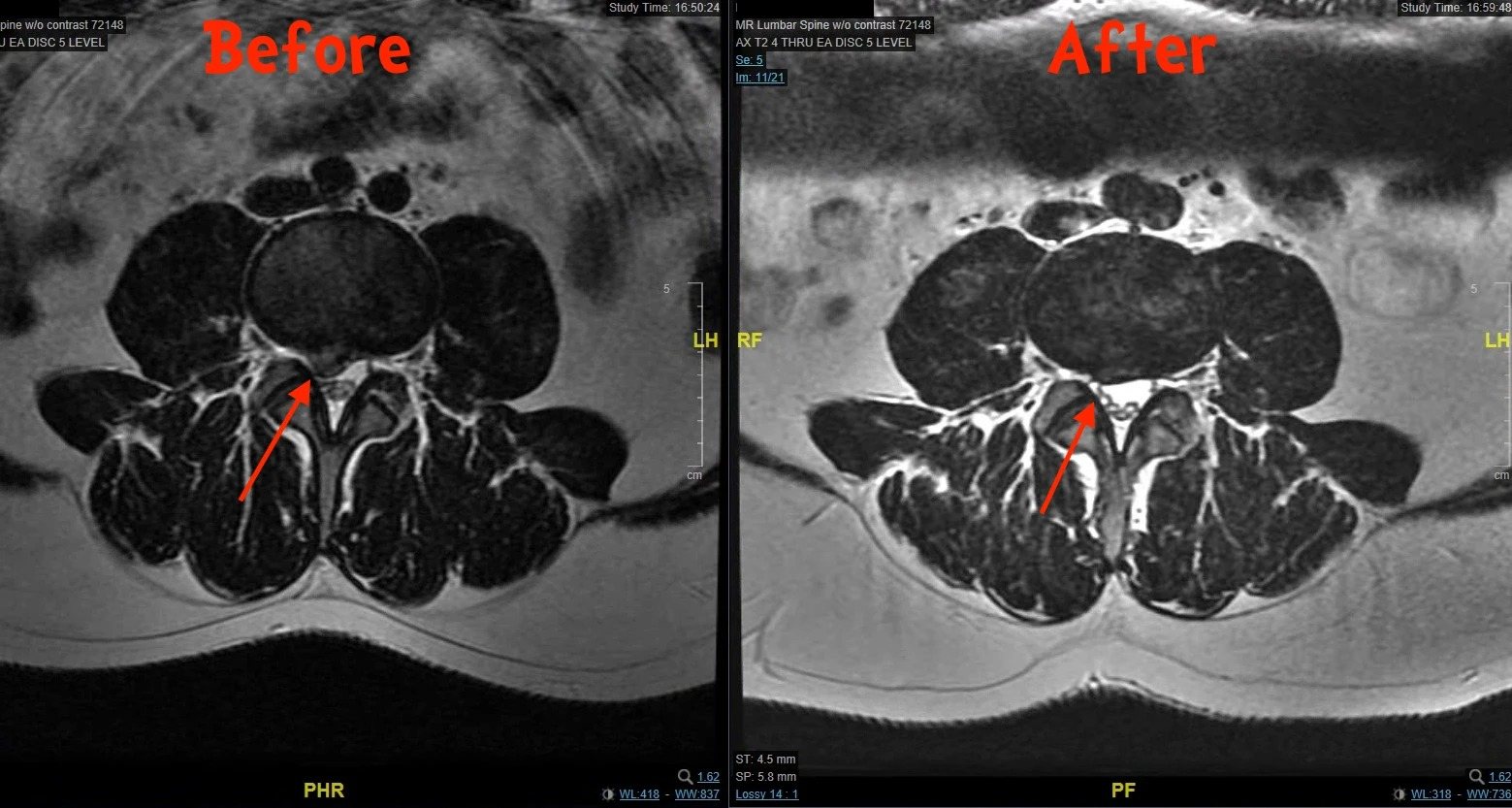
Axial MRI slices of a lumbar disc before and after treatment.
What a dried-out, flattened disc looks like from above — and what changed after a course of treatment.

"Why does it take so many visits?"

Because of how discs feed. The disc is avascular, meaning it has no blood vessels of its own, which is why it's one of the slowest-healing structures in your body. Nutrients get in by diffusion, and diffusion is slow. One good drink doesn't rehydrate a disc that's been under-watered for ten years, any more than one glass of water fixes a week of dehydration. The program runs about 20–25 sessions over 6–8 weeks, and that's a real demand on your time. Anyone who tells you a disc problem resolves in three visits is selling you something.

Weigh it against the alternative

The case for trying this first

Whatever else you decide about this program, weigh what it asks of you. No incision. No anesthesia. No hardware in your spine. No fusion. No narcotics and nothing to wean off. No recovery period, and no time off work — sessions run about half an hour and you drive yourself home afterward.

And nothing about it closes a door. Whatever options you have today — an injection, a surgical consult, a second opinion — you'll still have every one of them when you're done here. That isn't true in the other direction. A fused segment doesn't come back, and scar tissue doesn't unform. Trying the reversible thing first isn't a compromise; it's the order that makes sense.

Why this works

Why this works — and who we won't treat

"Degenerative changes" show up on the scans of people with no pain at all.

This is the most important thing on this page, it argues against us, so we'll say it first. When researchers put people who feel completely fine — no back pain, no leg symptoms — into an MRI machine, a large share come out with "degenerative changes" on the report. Pooling 33 studies of 3,110 people with no back pain at all, disc degeneration turned up in 37% of the 20-year-olds and 96% of the 80-year-olds.5 The share climbs steadily with age, and in the later decades it's closer to the rule than the exception. Read those as a direction, not a precise count: the studies span more than twenty-five years of changing MRI equipment, and volunteers aren't necessarily typical of everyone.

And the other half, which is just as true. The same researchers compared people with back pain against people without it, and disc degeneration, bulges, protrusions and extrusions were genuinely more common in the group that hurts.6 That comparison covered only adults under 50 and its estimates are loose, so don't lean on the size of the gap — but it rules out the conclusion that scans mean nothing. Your imaging is real information.

What it means is that the words on your report are not, by themselves, proof of why you hurt. Plenty of people have them and feel nothing. Some people hurt badly with mild-looking imaging. The question is never "does your MRI say degenerative?" It's whether everything tells the same story — where it hurts, what makes it worse, what the exam finds, and what the imaging shows.

We treat the person, not the report.

If your exam says your discs aren't what's driving your pain, we'll tell you that, and we won't put you on the table.

And when we say we review your imaging, we mean the pictures. Patients tell us the same thing all the time: nobody ever showed them the pictures. There's a reason. The doctor most trained to read your MRI — the radiologist — writes the report and never meets you. The doctors who do meet you usually work from that report, and a surgeon's schedule rarely has room to sit down and walk through the images with you. Nobody did anything wrong — and you still ended up owning a spine you've never seen.

We think that's backwards. Your consultation happens in front of a screen with your MRI on it. We go through the pictures — not just the report — and show you what's pressing on what, why it hurts the way it does, and exactly what we plan to do about it. You leave understanding what your spine looks like and how we intend to fix it.

Nobody reverses aging.

Worn cartilage does not grow back. A disc that has lost most of its height is not going to be rebuilt into the disc you had at 22. If someone offers to make your spine "young again," put your wallet in your pocket and leave.

What is realistic is specific, and it's worth being clear about:

  • Change the loading story — take the constant compression off the segment that's failing, so the tissue gets an environment it can actually repair in.
  • Rehydrate what can still recover — some discs have plenty of capacity left, especially in younger patients and in discs that have lost fluid more than structure.
  • Rebuild the support — progressive core strengthening and movement retraining, so the load-versus-recovery math stays fixed after the program ends. Dr. Barton calls it rebuilding your structural margin: the buffer between your daily life and your pain threshold. It's why the goal isn't just "out of pain" — it's harder to hurt again.

It can get worse before it gets better.

Patients who did well on this table routinely describe wanting to quit in the first two weeks. Some flare in the first four or five sessions. That pattern is common enough that we warn every patient about it in advance, and it is exactly why we build a real checkpoint into the program instead of asking you to just keep the faith.

The real checkpoint. We assess whether your spine is responding around the second week, after eight to ten sessions. If it isn't, we say so then — not after another month of visits — and you don't pay for the rest.

Two things make this program work, and only one of them is decompression.

The first is the machine — and knowing how to run it. The DRX9000 is genuinely effective at what it does, but owning one and knowing how to use it are different things. Every protocol is set by hand: the angle of pull, the force curve, the specific level being treated, adjusted as your spine responds week to week. We've been doing that for 21 years. That experience is the difference between a table and a treatment.

The second matters just as much, and almost nobody in this industry will tell you about it:

We screen patients the way a spine surgeon screens surgical candidates.

Candidacy

Who we don't treat

The exam and your imaging — not the machine, and not your credit card — decide whether someone is treated here. Nobody at this clinic is quoted a program price before their imaging has been reviewed.

  • A spinal fusion or hardware at the level that needs treating — no exceptions.
  • Severe osteoporosis — and this one deserves emphasis on this page, because it lives in the same age group as "degenerative changes," it is frequently undiagnosed, and it is the single most dangerous thing to miss before putting anyone on a decompression table. Screening is history-based: if you report being osteoporotic, we send you for a DEXA scan.
  • A spinal fracture, tumor, or infection
  • Severe bony stenosis — when the narrowing is overgrown bone rather than disc, unloading the segment won't give the nerve its room back, and we refer you to a surgeon.
  • Unstable spondylolisthesis — a slip that shifts more than 5 mm on the flexion-and-extension X-rays we take to check. A stable slip, of any grade, can still be a candidate.
  • Pregnancy

Had a discectomy or laminectomy with no hardware left behind? That's not on this list — we treat post-surgical discs all the time.

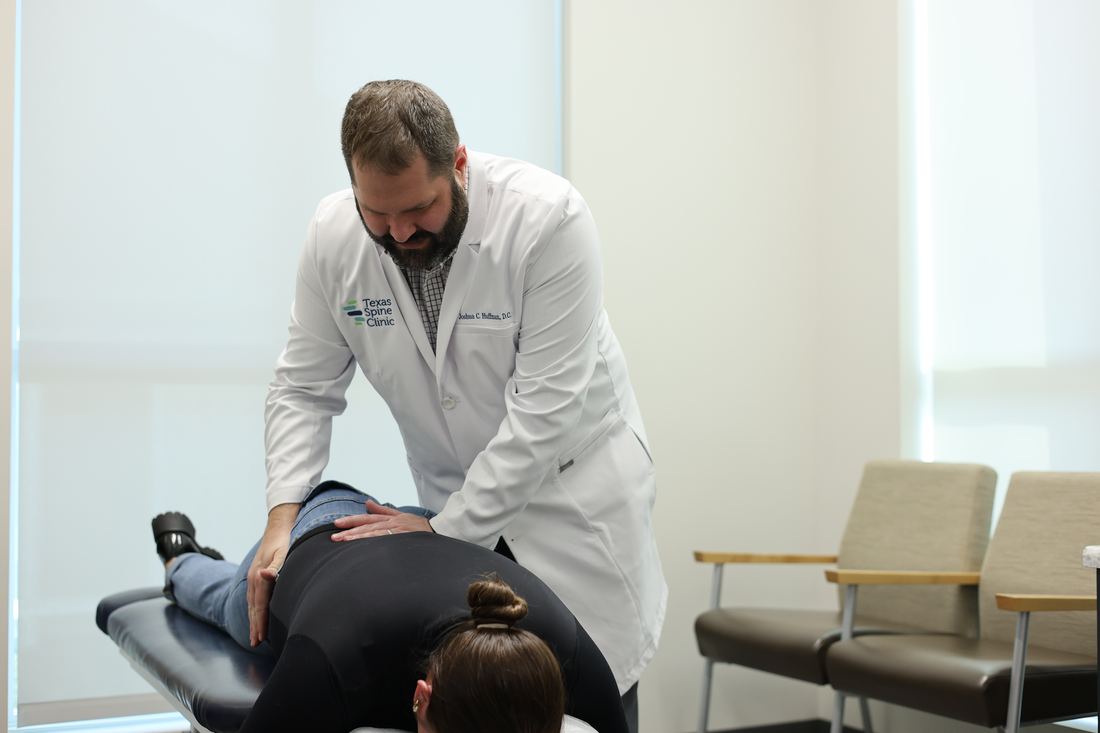
Dr. Joshua C. Huffman palpating the lower back of a patient lying prone on an examination table.
The exam comes before the plan. Dr. Joshua C. Huffman, D.C., examining a patient's lower back — the findings here, matched against your imaging, are what decide candidacy.
We have turned away more patients than we can count — including people who pushed, pleaded and offered to pay in full. Saying no costs us money every time. It's also the only reason we've been able to do this for 21 years and still have the reputation we have.

Go to an emergency room today, not to an appointment, if you have:

  • New loss of bladder or bowel control
  • Rapidly worsening weakness in a leg
  • Numbness in the groin, the inner thighs, or the area you sit on — what doctors call saddle anesthesia

That is not a decompression conversation.

Cost, straight

What insurance covers, and what to expect

You'll have your figure in writing before you commit to anything.

The decompression program isn't a covered benefit under any plan. If you carry a commercial health plan, we can usually generate an insurance credit through it, which we apply against your cost. How big that credit is depends on your specific benefits. So expect an out-of-pocket investment, and expect to know exactly what it is before you commit. We verify your benefits at no charge, paying at time of service earns a discount, and CareCredit, Affirm and in-office payment plans are available. You only ever pay for care you actually receive — if you paid ahead and the program stops being right for you, the unused portion comes back to you. Cost & Insurance — how the investment works.

The research

What it looks like in numbers

Here's the research, study by study: the published literature behind the DRX9000.

The vacuum effect was measured, not imagined. Researchers publishing in the Journal of Neurosurgery put pressure sensors inside human lumbar discs during decompression and recorded the pressure dropping to −100 to −160 mm Hg1 — a true vacuum, measured inside a living disc.

Herniations shrank more than with a sham treatment. In a randomized trial of real decompression against a sham — so patients couldn't tell which they got — the herniation index fell 27.6% with real treatment against 7.1% with sham, with better leg pain and disability scores at follow-up.3

Discs measurably gained height. Thirty patients scanned before and after a six-week DRX9000 program showed average disc height rising 7.5 mm → 8.8 mm, with pain falling 6.2 → 1.6 out of 10 — and the two changes tracked together.2

Leg pain responded most. In 73 patients compared against physiotherapy plus conventional traction, radiating leg pain and disc height improved far more with decompression.4

Across working clinics. The largest recent series followed 267 patients across multiple clinics: average pain fell from 6.9 to 2.5, with measurable improvement in reflexes and daily function.8

A vacuum measured inside the disc, discs regaining height, herniations shrinking more than sham, and leg pain responding most. Every figure here is from a named, published study. The research behind decompression.

What the change looks like on MRI

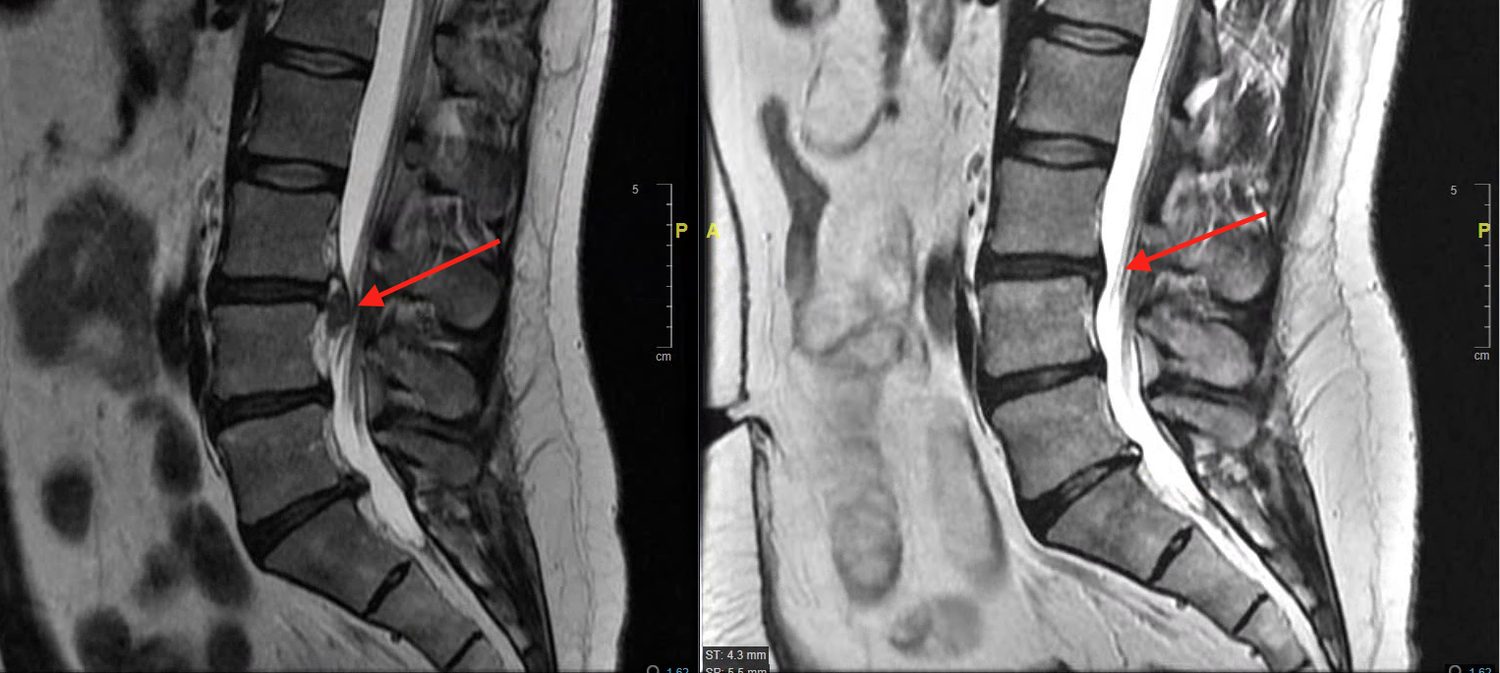
Before-and-after sagittal lumbar MRI scans shown side by side, with the disc visibly reduced in the second scan.
Before and after, side-on. Imaging is how disc change is measured in the studies on this page — and how your own progress gets shown to you rather than described to you.
Before-and-after axial lumbar MRI scans of the same patient, seen from above, with a red arrow marking the same spot on each.
The same disc from above — the arrow marks the same spot on both scans, before and after a course on the DRX9000.

Who you'll see

Your care team

We work as a team. Dr. Barton and Dr. Huffman have practiced side by side for more than 18 years, and your care is a team effort from your first visit.

Dr. Kevin S. Barton, D.C.

Kevin S. Barton, D.C.

Chiropractor · In practice since 2003

Dr. Barton has been in practice since 2003 and has used the DRX9000 since 2005, with more than 2,000 patients treated on it. He's the author of the treatment philosophy here: find the source of the pain and treat it there, without surgery and without narcotics. He completed advanced scrambler therapy training in Rome with Dr. Giuseppe Marineo, the inventor of the treatment.

In 2025 he went through the DRX9000 program himself, for one of the worst herniated discs he'd seen in his career, and filmed the whole course of treatment, MRIs included. Watch his nine-part series.

Dr. Joshua C. Huffman, D.C.

Joshua C. Huffman, D.C.

Chiropractor · In practice since 2007

Dr. Huffman earned his Doctor of Chiropractic degree from Texas Chiropractic College in Pasadena, Texas, and completed his internship at Moody Health Center, with a rotation at the Michael E. DeBakey VA Medical Center in Houston. He has advanced training in myofascial release technique and is certified as a designated doctor for the State of Texas.

A Texas native, he was born and raised in Matagorda County. When he isn't getting patients well, he's hunting, fishing, kayaking and hiking with his wife, Kendra, and their two children, Titus and Alley.

How the program runs

Decompression and strengthening, together

The most common question at the end of a program is some version of "and when I stop, does it all come back?" Fair question. Here's the real answer.

It isn't two programs, and the strengthening doesn't wait until the end. Decompression takes the pressure off the segment and gives the disc a better environment to work in. Alongside it, from as early as your symptoms allow, comes progressive core strengthening, therapy and retraining how you move — because pain changes the way people move, and those compensations will happily keep a pain cycle running long after the original problem has calmed down. The two run together through your program, and each one makes the other hold.

We re-examine you rather than just re-booking you. The week-two assessment isn't the only checkpoint — we measure and reassess as you go, and the program has a defined endpoint.

What maintenance means here. After the program, periodic maintenance treatments protect the result: a disc feeds by pressure exchange, ordinary life never stops loading it, and taking the pressure off from time to time keeps the margin you rebuilt. Alongside that, the boring, free half still counts — the strength work you keep doing, breaking up long sitting, and knowing which loads your back needs you to respect.

And if you flare in a year — people do, especially after a move or a winter off the exercises — call us. A flare isn't a failure, and it doesn't mean starting over.

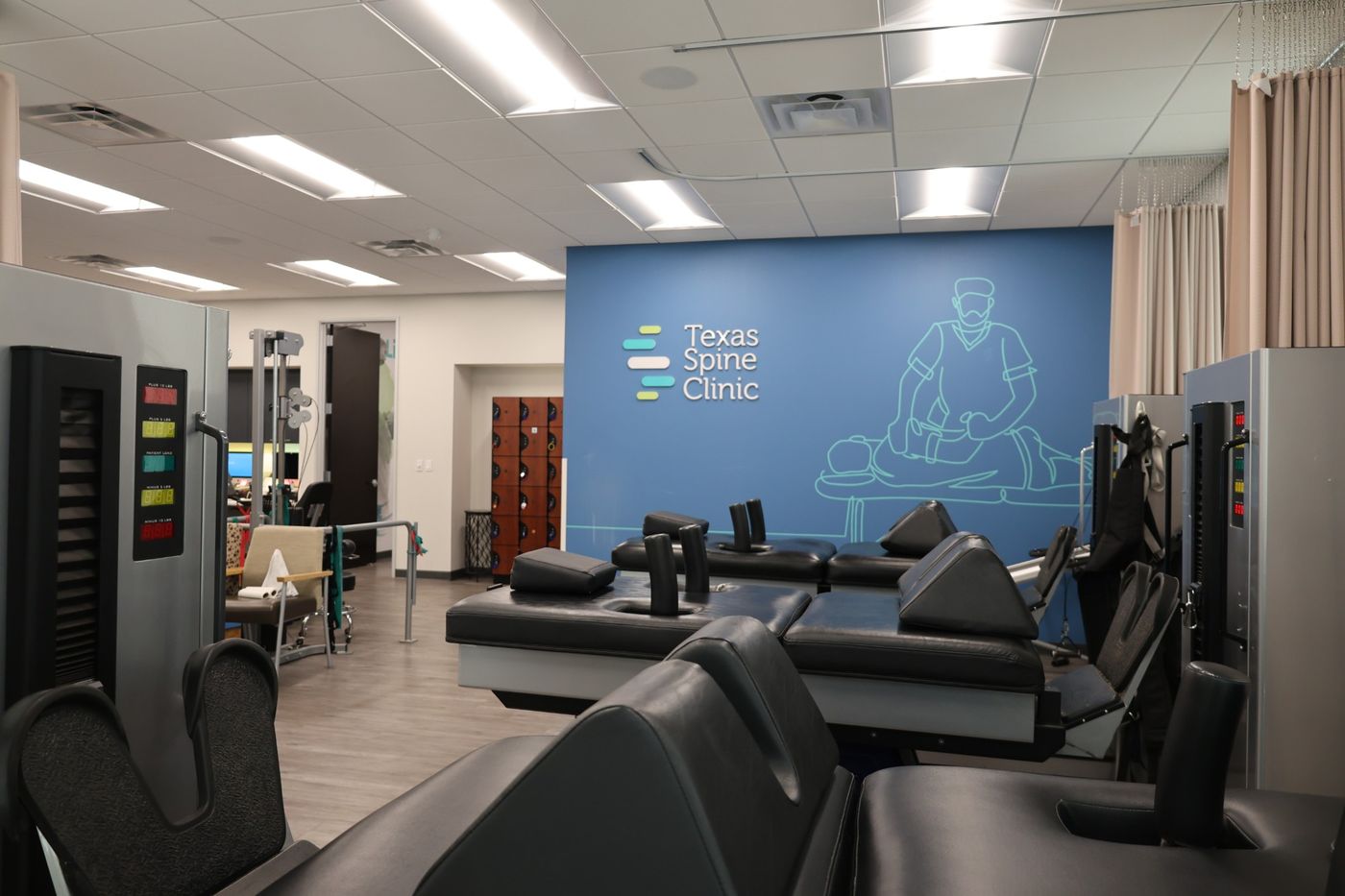
DRX9000 spinal decompression tables in the Texas Spine Clinic treatment room, in front of the clinic's logo wall.
The DRX9000 room. Taking the pressure off, so the disc can rehydrate in a better environment.
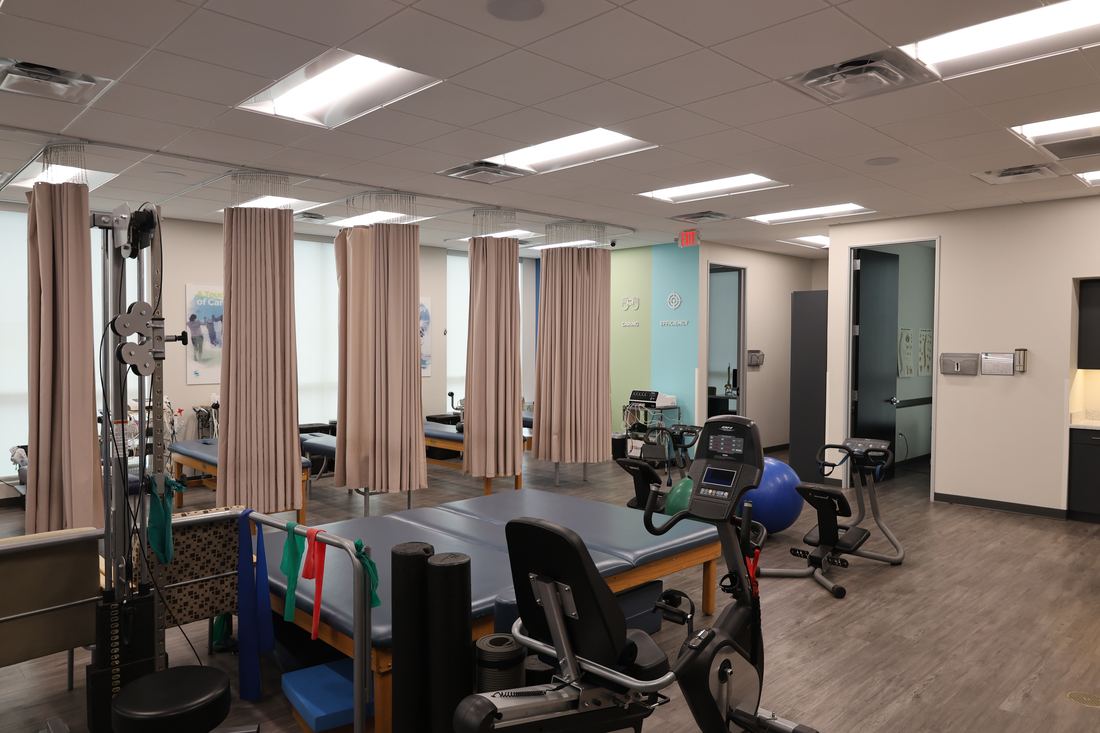
A patient performing guided core-strengthening exercises with a therapist at Texas Spine Clinic.
The therapy room. Strengthening and movement retraining, running alongside decompression — not after it.

Patients

Patient stories

Two readers came to this page — the 30-something who was frightened by the name, and the 60-something who was told to live with it. Both are here.

4.6 out of 5 · 112 reviews on Google
“In my 80s, still walking, driving and enjoying life.”
Elisa Gutierrez · Posted on Google
“Over a six-week period, I feel like a new man — I was treated using the DRX 9000.”
Matthew McFadden · Posted on Google
“I am so grateful to Dr. Huffman and Texas Spine Clinic for offering Non-Surgical Spinal Decompression treatment. After a few short series of treatments, I always leave pain-free… The team, the physical therapists and Jennifer (the receptionist), are so attentive and caring.”
Katie Breedlove · Posted on Google
“When I started the program, I was in pain all day and had trouble sleeping at night due to pain. I was using a walker at home and struggled with a cane when I went to the doctor. I was confined at home with pain killers. Now, I don’t take pain medication… I have made so much progress, and my activity level has improved greatly.”
Betty Cisnero · Posted on Google
“Dr. [Huffman] and his Physical Therapists have been dedicated in healing my back and sciatica problems. I appreciate all that they have done in helping my relieve my pain and suffering They communicate well and I can’t say enough how they have helped my healing process.”
Alfred Hawkins · Posted on Google

Reviews quoted verbatim from our public Google profile.

Every patient's story is their own. Results vary. These are real Texas Spine Clinic patients, sharing their experience with their permission.

Questions patients actually ask

Before you call

I'm in my 30s. Why does my spine already say "degenerative"?

Because the word describes a process, not an age. Discs lose fluid whenever the load outruns the recovery — and years of sitting, heavy training, a physical job, or one old injury can do that at any age. Finding it at 32 is not a catastrophe. It's early information, and early is exactly when the loading story is easiest to change.

Is it going to keep getting worse?

Not on a fixed schedule and not inevitably. That's the assumption the name plants, and it's the wrong model. Discs are living tissue that respond to how they're loaded. Change the loading — unload the segment, rebuild the support, fix the daily habits that were squeezing it — and for a lot of people "degeneration" simply stops being the thing that runs their life.

Dr. Barton greeting a patient in the reception area at Texas Spine Clinic.
Mondays through Thursdays, 8 to 5 — and established decompression patients can start at 7:30 a.m.
Is degenerative disc disease actually a disease?

No. It's a description of what a disc looks like, not an illness you caught and not something you can give anyone. Most doctors will tell you the name is poor. It survives because it's what the billing codes and the reports say.

My doctor said everybody my age has this. So why treat it?

Your doctor is right about the scans — and that's exactly why we examine before we treat. The question isn't whether your discs show mileage. It's whether that mileage explains your stiffness, your pain, and your exam findings. When all three point at the same level, "everybody has it" stops being a reason to live with it. When they don't point at the same level, we'll tell you, and we won't treat you.

Is this the same as arthritis in my spine?

They're neighbors, and they usually arrive in that order. The disc dries and loses height first; the facet joints behind it jam together and start carrying weight they weren't designed for; those joints then get arthritic. That's the "facet arthropathy" on your report. Treating the disc's loading problem is also how you take pressure off those joints. More on the facet syndrome page.

My report says degenerative changes AND stenosis. Does that rule me out?

Not automatically — it depends on what's doing the narrowing. If the space is crowded mainly because discs have flattened and bulged, unloading the segment can give the nerve some room back. If the narrowing is mostly overgrown bone and thickened ligament, taking load off won't move bone, and you belong with a surgeon, not on our table. That distinction is made from your imaging and your exam, and it's one of the most common reasons we turn people away. More on the spinal stenosis page.

Can't I just hang from a pull-up bar or buy an inversion table?

Sometimes, yes — and it's a lot cheaper. Any real unloading gives a disc a chance to drink, which is why some people feel better after hanging, floating in a pool, or lying in the 90/90 position. The difference is control: a clinical table applies a measured force, at a set angle, to a specific level, on a curve that keeps your muscles from fighting the pull — and it does it the same way every session so we can tell whether you're actually responding. If the cheap version works for you, use it. Most of the people who sit down with us have already tried it.

What if it doesn't work for me?

Then you find out in about two weeks, not two months. We assess after eight to ten sessions. If your spine isn't responding, we say so then and you don't pay for the rest of the program — Texas law requires chiropractic care to be prorated, so unused treatment gets refunded. That's the deal, and it's the reason we can be relaxed about telling you everything on this page that argues against us.

Footnotes

  1. Ramos & Martin, J Neurosurgery 1994 — intradiscal pressure during vertebral axial decompression. Authors declared no financial interest.
  2. Apfel et al., BMC Musculoskeletal Disorders 2010 — disc height and pain with the DRX9000.
  3. Choi et al., Int J Clinical Practice 2022 — randomized sham-controlled trial.
  4. El-Zayat et al., Egyptian Rheumatology & Rehabilitation 2019 — decompression vs. physiotherapy with traction.
  5. Brinjikji et al., AJNR 2015;36(4) — imaging features of spinal degeneration in asymptomatic populations. 33 studies, 3,110 people with no back pain; NIH-funded.
  6. Brinjikji et al., AJNR 2015;36(12) — the companion paper: degenerative findings are more prevalent in adults with low back pain than in asymptomatic controls.
  7. Wilke et al., Spine 1999 — in vivo intradiscal pressure in daily life; the source for the bending-and-lifting-vs-standing comparison.
  8. Schueren M et al., Military Medicine 2025 — 267 patients treated with non-surgical spinal decompression across multiple clinics.

Full citations on the evidence page — what the research actually shows.

The ask

Find out what your discs actually need — and whether we can help.

Call (210) 741-9166 or send the form. The consultation is $49 — and it isn't a sales pitch. Here's exactly what happens:

  1. We examine you. A real physical exam — how your spine moves, what reproduces your pain, what your nerves are doing.
  2. We put your imaging on the screen and go through the pictures with you — not just the report. Including what "degenerative changes" does and does not mean on your scan, at your levels. Bring your MRI or CT on a disc or a portal login if you have it. If you don't have imaging, we'll tell you whether you need it before anything else happens.
  3. You get a straight answer. Either this is a good fit for your spine and we'll show you why, or it isn't and we'll tell you what we'd do instead. About one in five people who ask us about this program are told no.
  4. If the answer is yes, your first treatment is included. The $49 covers the examination, the imaging review and your first session on the table. If the answer is no, it's no.

Nobody gets quoted a price before their imaging has been reviewed. No finance company will be sitting in the room.

Book your $49 consultation

No referral needed. Same-day appointments available.

Calendar not showing? Open it in a new tab.
Rather book by phone? Call (210) 741-9166.

P.S. You were handed a name that sounds like a verdict, and a plan that amounts to "wait and see." Neither one was accurate. Your discs are living tissue that drink when the load comes off and dry out when it doesn't — which means the trajectory you were quietly bracing for is not fixed. We can't make your spine 25 again. But the only version of degenerative disc disease that truly goes in one direction is the one nobody does anything about. Come let us look at it.