When a disc in your neck presses on a nerve root, the pain doesn't stay put. It
travels — into the shoulder blade, down the arm, into specific fingers. Sometimes it isn't pain
at all, just numbness, tingling, or a grip that's quietly gotten weaker. The DRX9000
spinal decompression system treats the neck, not just the lower back — gently,
computer-controlled, no surgery and no injections. Most people have no idea that's an option.
That's what this page is for.
23years in practice
21years using the DRX9000
2,000+patients treated on it
You've stopped counting the pillows. Memory foam, contour, the rolled towel somebody swore by.
You sleep on your back, then your side, then propped up on the couch — and you still wake at 4am
with your arm dead asleep and shake it out like it's an appliance.
You catch yourself resting your hand on top of your head, because for some reason that's the
position that makes the arm quit screaming.
The small things are what get you. Buttons take longer. Your keys need a second look. You
dropped a mug last month and told yourself it was slippery. Backing out of the driveway means
turning your whole body, because your neck stopped turning a while ago. A forty-minute drive
costs you the evening.
And you probably didn't do anything to deserve it. No accident, no fall. You reached into the
back seat, or slept wrong, or just looked up one morning and something felt off — and it never
went back.
You've done the ibuprofen, the heat, the stretches off YouTube. Massage that felt wonderful for
a day. Adjustments that held until Thursday. Maybe a shot that bought you a few good weeks
before the arm started up again.
And if the worst of it is in your arm or your hand, you may not have
connected it to your neck at all. Most people don't. They go get the hand looked at.
The part almost nobody knows
Yes — this machine treats necks
Almost everybody thinks decompression is a low-back machine. Including plenty of
people who work in healthcare. The lumbar version gets all the ads and all the internet
arguments.
The DRX9000 treats the cervical spine — your neck — and it has for as long as we've owned it.
It's a different setup entirely: a different harness, a different angle, and a fraction of the
force.
Here are the actual numbers, because nobody else in this market will show you
theirs. A cervical protocol starts at 5% of your body weight — for a 160-pound
person, that's eight pounds — and climbs by roughly 1% per visit toward a
ceiling of 10%. Some patients never reach 10%, and don't need to. Patients
carrying extra weight are started even more gently, because the percentage is set against what
your frame is built for, not just the number on the scale. Compare that with the lumbar side of
the machine, where the eventual working load is typically half your body weight plus ten
pounds — reached gradually over the course of care, never in one day. A neck is not a
lower back, and treating it like one would be a mistake.
Watch it before you call. Two minutes of video answers "what will they actually do to my neck?"
better than anything we can write here.
What's actually happening in there
Your neck holds up a bowling ball
Your head weighs about as much as a bowling ball, and your neck holds it up all day.
Compare the two ends of your spine. Your lower back is built like a foundation — thick bones,
big discs, muscles like cables. Your neck has to do the opposite job. It has to move:
turn, tilt, nod, check your blind spot. So it's built lighter. Smaller bones. Much
smaller discs. A thinner margin for error. That's the trade — your neck buys mobility
and pays for it in durability.
Now the part worth actually understanding, and it has nothing to do with willpower. Hold a
bowling ball against your chest and you could stand there a while. Hold that same ball at
arm's length and your shoulders burn in seconds. Same ball. Only the distance changed.
Your head works the same way. Stacked over your shoulders, the load runs straight down
through bone, which is what bone is for. Every inch it drifts forward — phone, monitor,
sewing, steering wheel — the muscles at the back of your neck work harder to stop it falling,
and the discs and joints underneath carry more.
This isn't a lecture about your posture. It's a lever. Your job, your phone and your car all
park your head slightly in front of your shoulders for hours a day, and the tissue does that
math whether you agree with it or not. Over years it shows up as a flattened disc, an
irritated joint, and muscles that never quite let go.
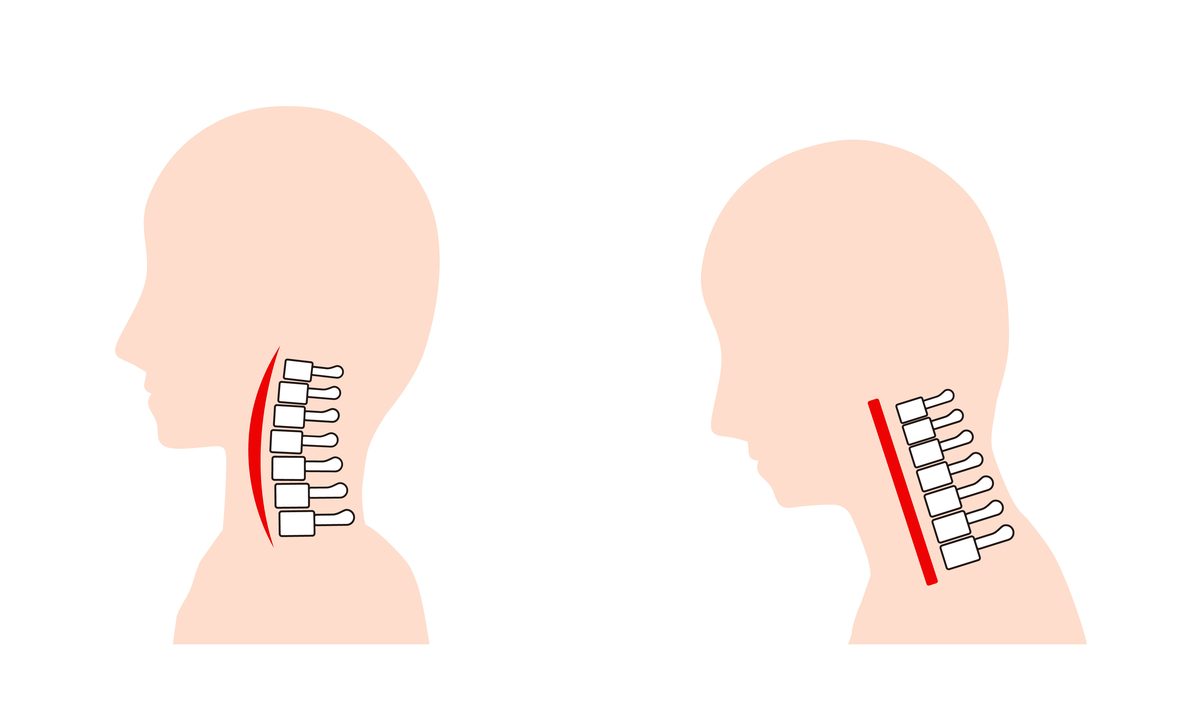
Left: the normal curve. Right: what a forward head does to it.
The cervical lordosis — the gentle forward curve your neck is built with — straightens out as
the head travels forward of the shoulders. That posture and that lost curve put more stress
on the discs and the facet joints, and stress is what accelerates degeneration in a
spine.
The mechanism of the symptom
When the disc reaches the nerve
Between every two bones in your neck sits a disc — a shock absorber, mostly water. Right beside
each disc is a small opening where a nerve root leaves your spine and heads out toward your
shoulder, arm, and hand.
When a disc dries out and flattens, that opening narrows. When a disc bulges, it can press
straight into the space the nerve needs.
A squeezed nerve does one thing: it fires. And it fires along its whole
length, not at the spot where it's pinched. That's the most confusing thing about this problem,
and the reason so many people never suspect their neck:
A deep ache under the shoulder blade you can never quite dig out
Pain running down the outside of the arm
Burning or electric shocks from the elbow to the fingers
Pins and needles, or a numb patch that doesn't move
A grip that's weakened — jars, keys, a coffee mug
The arm that goes dead at 4am
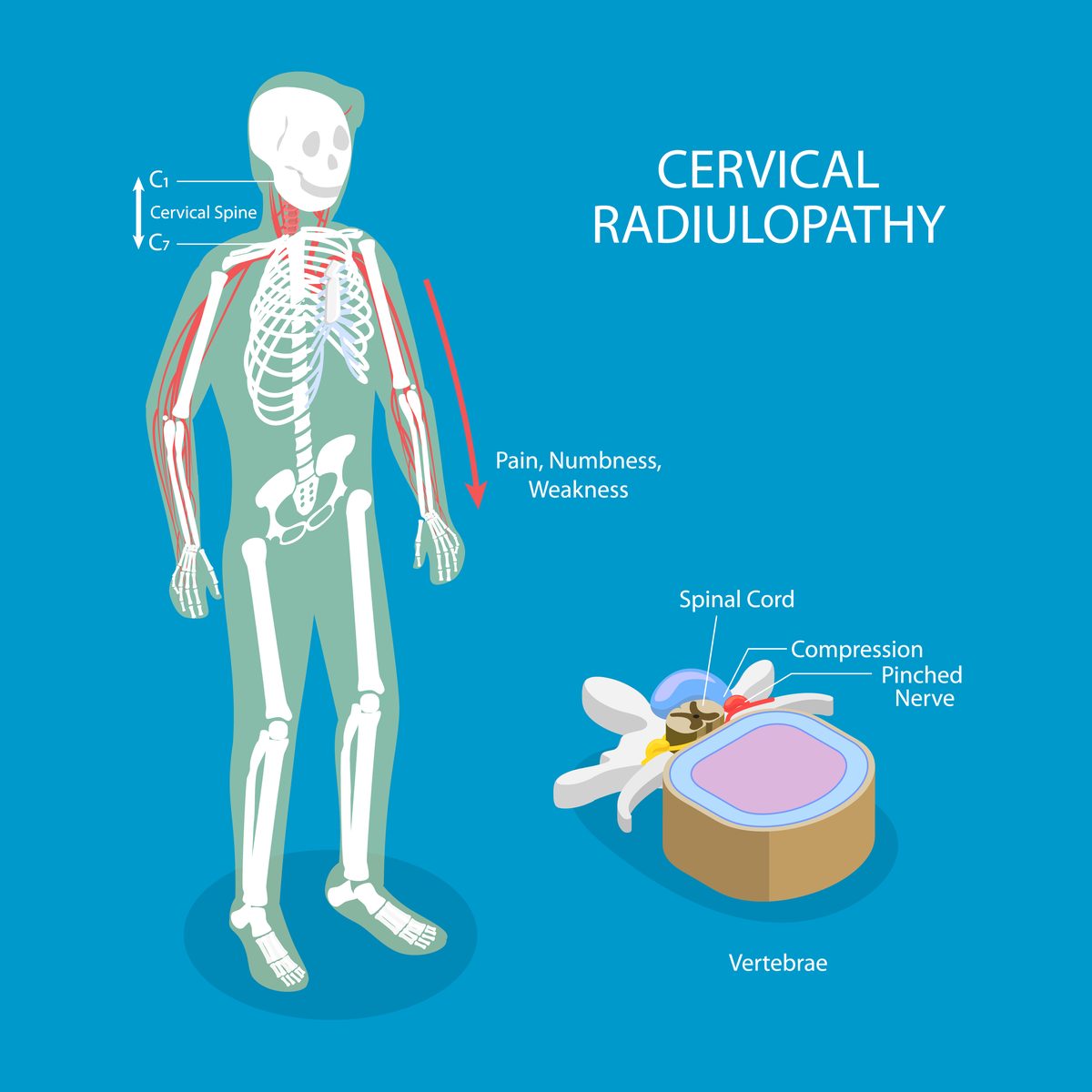
The name for this is cervical radiculopathy: a nerve root in your neck being
compressed or irritated. Not a shoulder problem. Not carpal tunnel. Not "you slept on it."
It also explains the hand-on-the-head habit. Resting your hand on top of your head takes slack
off that nerve root and briefly gives it room. Patients discover this by accident and assume
it's a quirk. It's actually one of the clearest clues in the whole exam — it
points straight at your neck.
The connection nobody drew for you
Why your hand — when the problem is in your neck
Here's the piece that makes the whole thing make sense, and it takes thirty seconds to learn.
Each nerve root leaving your neck heads somewhere specific. One runs down the thumb side of
your arm. One runs toward the middle of your hand. One runs down the little-finger side. Squeeze
any of them where it exits your spine and the symptom shows up at the far end,
out where the nerve finishes — in the forearm, the hand, the fingers.
The problem is in your neck. The complaint is in your hand. That single
sentence explains why people get a wrist scanned, a shoulder injected and an elbow braced for
months while the actual source sits above their collarbone, untouched.
The pinch is here. The feeling is there. A nerve root leaves the
neck at one level and carries sensation the length of the arm — which is why the symptom
lands in your hand and the cause sits above your collarbone.
Now a part that's easy to get wrong — and we'd rather be the ones who tell
you.
You'll find charts all over the internet: thumb means C6, middle finger means C7, little finger
means C8. They're printed as though your fingers can tell you which level of your neck is
involved.
They can't. And it isn't close.
Among patients whose level was confirmed on MRI — 30 with a C6 problem and 39 with a C7
problem — arm pain and numbness were diffuse, and not meaningfully different between
the two. The researchers' own conclusion was that the patterns overlap enough that
you should be careful predicting the level from
symptoms.6 A second study, on the same kind of
patients, found nearly complete overlap in where sensation was impaired for
C6 versus C7.7 Both were small — 69 patients between
the two levels — but they pointed the same direction.
In 83 patients, clinicians examined the neck without being allowed to see the
MRI and named the root they thought was involved. They were exactly right 31%
of the time, and within one level a further
28%.8 Two clinicians examining the
same patient agreed with each other only 58% of the time —
"fair agreement," in the authors' own words. Their own caveat is worth repeating: this was
deliberately built to mirror ordinary practice, and a more tightly controlled study might have
produced better agreement.
Across 226 nerve roots in 169 patients, neck pain did not follow a dermatome at all
in 69.7% of cases.9 Level by level it
barely moves: about a third of C6 and C7 cases matched the chart, and a quarter of C5
cases.
But here's the other side, and we'd rather give it to you than have you find it later. In
227 patients whose level was confirmed at surgery, 62.6% did have the
standard pattern.10 So the charts aren't
noise — they're just wrong far more often than anyone treating you should be comfortable with.
And a surgical series is made of the clearest, most severe cases, so 62.6% probably
flatters the chart compared with what walks into a clinic like ours.
The charts don't even agree with each other. A review of where these maps came from found
the ones in common use are inaccurate and built on flawed original
studies.11 A second review put it more
bluntly still: the maps in textbooks are inconsistent — some print one early
version, some print another, and some print maps that match
neither.12 That's why two textbooks will hand you
two different pictures of the same hand. Both are reviews of the anatomy literature rather
than trials, but nothing since has rescued the maps.
So here's the straight version. Which fingers are involved tells us a nerve root is
involved. It does not tell us which one. Anybody who looks at your hand, names a level
and quotes you a program is performing, not diagnosing.
That's not a disappointing answer. It's the whole reason an evaluation exists. Strength
testing, reflexes, sensation, the positions that provoke it and the ones that relieve it, and
your MRI read against all of that together — that's how a level actually gets identified. It
takes an appointment, not a chart.
The exam is the answer to the chart. Strength, reflexes, sensation,
and the positions that provoke and relieve — read together with your MRI, not one at a
time.
And here's the part that makes the exam worth having: the tests are far better in
combination than any of them is alone. In a 2003 study of 82 patients published in
Spine, four standard neck tests were performed on every patient and checked against
nerve testing.16 Taken singly they were mediocre —
the best-known of them, the one where the doctor gently compresses your neck, picked up only
about half of confirmed cases. But when all four were positive
together, the likelihood of a nerve-root problem being confirmed by nerve testing rose
substantially.
So we use the exam the way it should be used: it tells us the sensible next step, and your imaging confirms it.
When you come in, we'll still ask you to point at exactly where the numbness lives. It's real
information and it belongs in the exam. It just isn't the answer by itself.
One more thing about that MRI, because it's the other half of the answer. Patients tell us
the same thing all the time: nobody ever showed them the pictures. There's a reason. The
doctor most trained to read your MRI — the radiologist — writes the report and never meets
you. The doctors who do meet you usually work from that report, and a surgeon's schedule
rarely has room to sit down and walk through the images with you. Nobody did anything
wrong — and you still ended up owning a spine you've never seen.
We think that's backwards. Your consultation happens in front of a screen
with your MRI on it. We go through the pictures — not just the report — and show you what's
pressing on what, why it hurts the way it does, and exactly what we plan to do about it.
You leave understanding what your spine looks like and how we intend to fix
it.
The third arrival
If your headaches start at the base of your skull
A lot of people come in for the arm and mention the headaches as an afterthought.
The top of your neck and the base of your skull share nerve pathways with your head and face.
When those upper joints are irritated or overloaded, the pain can refer upward — into the back
of the head, behind the eye, sometimes the temple. Usually one-sided. Often starts in the neck
and climbs. Typically worse after a long drive or a long day at a desk, and it doesn't respond
much to migraine medication — because it isn't a migraine.
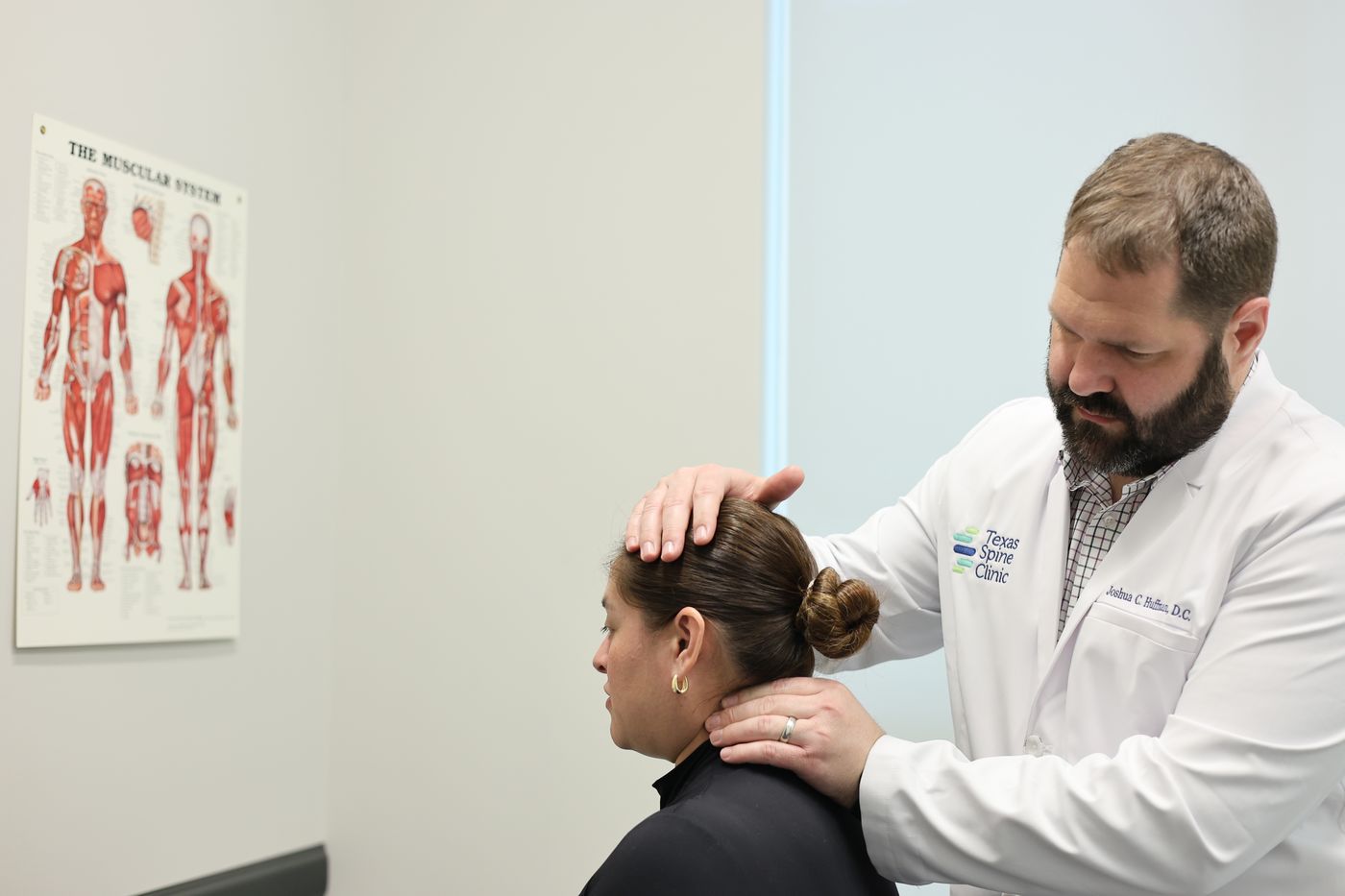
The cervical exam: range of motion, the nerve tension tests, and what your arm does when we load the neck.
The name is a cervicogenic headache: a headache generated by the neck.
If you've been treating headaches for years and nobody has ever examined your neck, that's a
conversation worth having. We can't promise yours are coming from your neck — plenty aren't,
and we'll say so if the pattern doesn't fit. But the neck is the first thing we check, and it's
the thing most often skipped.
Know the warning signs
When neck symptoms are an emergency
Most neck problems are not urgent. A few are, and you should be able to tell them
apart.
Everything above involves a nerve root — a branch heading out to your arm. But your
spinal cord also runs through your neck, and a small number of neck problems press on the cord
instead of a branch. Different situation, different urgency.
See a doctor promptly — not in a few weeks — if you notice:
Weakness in an arm or hand that keeps getting worse, especially if it's
spreading
Clumsiness with small tasks — buttons, zippers, keys in a lock, picking a
coin off a counter, handwriting that's changed
A change in how you walk — unsteady, wide-based, catching your feet,
reaching for the handrail on stairs you used to take two at a time
New shock-like feelings down your spine when you bend your head forward
Those can mean pressure on the spinal cord itself, which doctors call
myelopathy. It needs proper imaging and a specialist opinion, and it isn't
something to work through slowly. Not an emergency siren — an appointment you make this week,
with the right kind of doctor. If that's what your exam suggests, we'll tell you plainly and
help you get to the right person. That's a referral, not a treatment plan.
And go to an emergency room today, not to an appointment, if you have: new loss
of bladder or bowel control, rapidly worsening weakness, or numbness in the groin, the inner
thighs, or the area you sit on — what doctors call saddle anesthesia.
We're telling you this on the same page where we ask for your business. That's deliberate.
The straight answer
Will it settle down on its own?
Often, yes. And we're not going to bury that.
The best population study we have followed 561 people with a pinched nerve in
the neck for a median of nearly five years. At last check, about 90% were symptom-free
or only mildly limited.13 That was measured
in an ordinary community, not a surgical clinic, which is what makes it worth knowing — though
it's an older study, and the care those people got along the way wasn't today's care.
Reflexes and grip strength are how we tell a nerve that's irritated from a nerve that's losing function — and the second one changes the timeline.
A later review of the same question found most of the improvement usually arrives in the
first four to six months, and that roughly 83% were fully recovered
somewhere between two and three years.14
That's a review of what happened to people over time, not a trial — so it describes the natural
course of the condition, not the result of any treatment.
The question that matters is how long you're willing to wait for "usually" — and what the waiting costs you.
Here's the rest of it. All of it is also true.
Four to six months is a long time to live inside. That's a season of 4am
wake-ups, a season of driving with your whole body, a season of not sleeping next to your
spouse because you're propped on the couch. "It usually gets better eventually" is a statistic.
The waiting is a life.
It comes back more often than people expect. In that same 561-person group,
31.7% had a recurrence, and 26% ended up having
surgery.13 Which also means the encouraging 90% figure
includes people who got there by way of an operating room — it is not a picture of 561 people
quietly recovering on their own. "Gets better" and "stays better" are not the same sentence.
A nerve that's going quiet is a different situation from a nerve that's
shouting. Pain means the nerve is still talking. Numbness that's spreading, a grip that
keeps fading, buttons that got harder this month — that's function being lost, and function is
slower to come back than pain is. Waiting is a much more reasonable bet for a loud arm than for
a fading one.
And nobody can tell you in advance which group you're in. Not us, not a
surgeon, not the radiologist. There's no test that sorts "this one resolves by Christmas" from
"this one is still here in two years." Two people walk in with the same MRI and the same story
and get different answers from their own bodies.
So here's the choice in front of you:
Wait, and you might get better for free. You might also spend a year of
your life on the couch and arrive at the same decision point with a stiffer neck and a weaker
hand.
Treat it, and you stop waiting. The pressure comes off the nerve now, and you know by week two whether your neck is responding.
What we can do is take pressure off the nerve while your body does whatever it was going to
do, and tell you early whether your neck is responding instead of asking you to keep paying and
hoping. There's a checkpoint built into that, at the two-week mark, and it's spelled out
further down this page.
Where we start
Conservative care first — decompression when the
neck tells us it's needed
Most neck pain does not need a machine. It needs the joints in your neck moving again and the
muscles around them to stop guarding, and that is what conservative care does.
Start with hands-on care.
Cervical adjustments, hands-on therapy and targeted exercise. For neck pain on its own —
no arm symptoms — the adjustment is highly effective, and for a lot of
patients it is the whole treatment. If you'd rather not have your neck adjusted, say so;
it is never required here, and we have other ways to treat you.
If it isn't responding — or the arm is involved — we image it.
Pain, numbness or tingling travelling into the shoulder, arm or fingers points past the
joints to the disc, and that earns an MRI up front. So does a neck that isn't improving
the way it should with good conservative care. The MRI answers the question the exam
can't: why aren't you getting better.
The answer is usually the disc — or the joints behind it.
Then decompression, aimed at what the imaging found.
When the problem is the disc, that's when the DRX9000 enters the plan — set to the level
on the film, while the hands-on care and the strengthening keep going alongside it.
How we treat it
"Are you going to crack my neck?"
This one goes first, because it's the question behind half the hesitation on this page and
most people are too polite to ask it. The answer starts with a different question:
where is your neck pain coming from?
If it's the joints — stiff, achy, worse in certain positions, nothing
running into the arm — then cervical manipulation is often exactly the right treatment, and
we'll offer it if you're comfortable with it.
If it's the disc, with symptoms running into your arm, that changes the
plan. We do not adjust a neck with active radiculopathy until those symptoms have settled,
and in some cases we don't adjust it at all. The exam and the imaging decide which of those
two situations you're in — that's the whole reason we look before we treat.
And as for the machine: spinal decompression is not a manipulation. No
thrust. No twist. No rotation. No popping sound. Nobody's hands are on your neck applying
force.
You lie on your back. Your head rests in a padded cradle. A computer applies a slow, steady
pull along the line of your spine, holds it, and eases off — over and over, for about half an
hour. The force is measured in real time and never exceeds what was set for you. You hold a
switch that stops the machine instantly. Most patients describe it as a stretch. A fair
number fall asleep.
And here's the part we can state as policy, not accommodation: an adjustment
is never required for any care we provide. Not for decompression, neck or low back,
and not for anything else. We have plenty of other ways to treat you, and we adjust only when
a case calls for it and you agree to it. If you've
never seen a chiropractor and you're not comfortable having your neck adjusted, you're
completely fine here. Nobody will argue with you or make you justify it.
When the exam says the joints are the problem, this is the adjustment — face up,
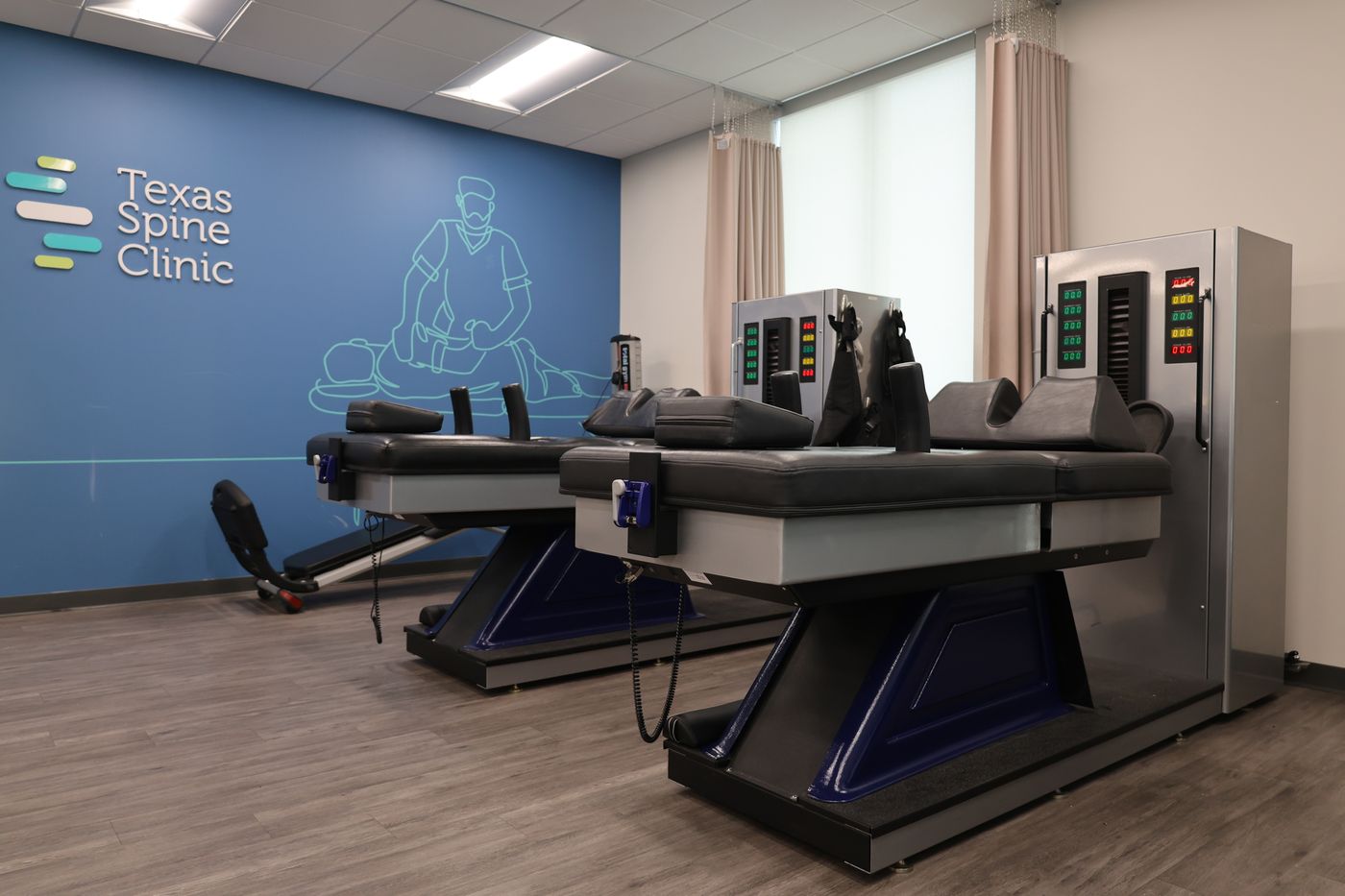
your head cradled and supported, a precise contact rather than a wrench.Where it happens. The decompression room. The cervical setup is its
own harness, its own angle, and a fraction of the lumbar force.
"Isn't this just traction?"
Traction is the ancestor, and we'll admit that freely. The difference is control. Old
traction pulls with a fixed weight and holds it. The DRX9000 builds force gradually along a
set curve, holds, releases, repeats. That matters because neck muscles fight a sudden pull —
and that guarding is exactly what stops a straight yank from ever reaching the disc.
Easing into it gets past the guarding, so the pull reaches the disc instead of stopping at
the muscles. Inside the disc that creates negative pressure — a vacuum effect, measured
directly inside human discs.1 The vacuum draws fluid
back toward the center, which is how a bulge can retract off the nerve rather than just being
stretched around.
"Why does the whole neck feel better, not just the disc?"
Because four tissues carry that load, not one: the muscles, the small facet joints at every
level, the nerves, and the discs. When the disc loses height, the joints take more load, the
nerves lose space, and the muscles never stop guarding. Everything you've tried treated one
of those at a time. Decompression unloads all four at once — which is why range of motion
often returns faster than people expect, and why the grip at the base of your skull can start
to let go. The DRX9000 page — the full four-tissues explanation and Dr. Barton's
own MRI series.
"Why does it take so many visits?"
Because that's how discs behave. The disc is avascular, meaning it has no blood vessels of its
own, which is why it's one of the slowest-healing structures in your body. It feeds by being
loaded and unloaded, like a sponge. One session is a good stretch. Repetition over
weeks is what changes tissue. Sessions run about 25–30 minutes, several times a week, and
most programs land around 20–25 sessions over 6–8 weeks. Anyone who tells you a neck disc can
be fixed in three visits is selling something.
Two reasons this works when other things haven't
The first is the machine — and knowing how to run it. The DRX9000 is
genuinely effective at what it does, but owning one and knowing how to use it are different
things. Every protocol is set by hand: the angle of pull, the force curve, the specific level
being treated, adjusted as your spine responds week to week. We've been doing that for
21 years. That experience is the difference between
a table and a treatment.
The second matters just as much, and almost nobody in this industry will
tell you about it:
We screen patients the way a spine surgeon screens surgical
candidates.
Weigh it against the alternative
The case for trying this first
Whatever else you decide about this program, weigh what it asks of you. No incision.
No anesthesia. No hardware in your spine. No fusion. No narcotics and nothing to wean off. No
recovery period, and no time off work — sessions run about half an hour and you drive
yourself home afterward.
And nothing about it closes a door. Whatever options you
have today — an injection, a surgical consult, a second opinion — you'll still have every one of
them when you're done here. That isn't true in the other direction. A fused segment doesn't come
back, and scar tissue doesn't unform. Trying the reversible thing first isn't a compromise; it's
the order that makes sense.
Why this works
Why this works — and who we won't treat
Not everyone should be on this machine, and we don't put everyone on
it.
We have turned away more patients than we can count —
including people who pushed, pleaded and offered to pay in full. Saying no costs us
money every time. It's also the only reason we've been able to do this for
21 years and still have the reputation we
have.
The exam and your imaging — not the machine, and not your credit card —
decide whether someone is treated here.
Who we generally will not treat, for the neck:
You've had a fusion, or you have plates, screws, or an artificial disc
replacement at the level we'd be treating. Hardware changes how force travels,
and a level that can't move can't be decompressed — and a disc replacement counts exactly
like fusion hardware here. That level is excluded — no exceptions. The levels above
and below are a different question: Kevin's observation after two decades is that
the problem is "generally never the fusion level — it's always above or below," and those
levels are evaluated case-by-case, depending on how stable the fusion is. Never a phone
answer.
Your stenosis is severe and bony — the opening narrowed by bone
growth rather than by a disc. Decompression can help a disc. It cannot move bone. That's
a surgeon's conversation and we'll say so.
You have severe osteoporosis, a fracture, a
tumor, or an infection in the spine.
A story circulates in patient forums about a man who did forty cervical decompression
sessions and finished no better than he started. He'd had a previous fusion. He should
never have been on the table. That isn't a story about a machine failing — it's a story
about a clinic that didn't screen, and it's the exact outcome our screening exists to
prevent.
What to watch for at any decompression clinic, including this
one: a price quoted before anyone has reviewed your MRI; discs "diagnosed" from an
X-ray, which cannot show a disc; a same-day signing push after a frightening speech about
your spine.
The first weeks can stir things up
Some patients get sorer before they get better — neck soreness, sometimes a temporary echo
of the arm symptoms — usually in the first week or two. We're telling you now instead of
after. Patients who respond often describe the arm symptoms receding upward: out of
the fingers, then the forearm, then the shoulder. That's a pattern we watch for, not a
promise we make.
What we stand behind
We don't publish a success rate and we don't predict what your next MRI will look like —
sometimes the pictures change, and sometimes people feel dramatically better while the pictures
look much the same. What we stand behind is the process: your imaging reviewed with you,
candidacy decided by the exam, your number in writing before you commit, and a real checkpoint
at week two.
And we bring some mileage to that judgement. Dr. Barton has been in
practice since 2003 and has run this machine since 2005 —
21 years and more than
2,000 patients on the DRX9000. That's long enough to know which spines
respond to it and which ones don't, and to tell you which one you are early instead of
late.
We assess whether your spine is responding around the second week,
after eight to ten sessions. If it isn't, we say so then — not after another month of visits —
and you don't pay for the rest.
What it costs
What insurance covers, and what to expect
You'll have your figure in writing before you
commit to anything.
If your care is chiropractic — adjustments, hands-on therapy and rehab —
most insurance plans cover it, and it's some of the most affordable care you can get for a
neck. We verify your benefits at no charge and tell you what your visits will run before you
start.
Spinal decompression isn't a covered benefit. No plan covers the
decompression program. If you carry a commercial health plan, we can usually generate an
insurance credit through it, which we apply against your cost. How big that credit is depends
on your specific benefits. So expect an out-of-pocket investment, and expect to know exactly
what it is before you commit. We verify
your benefits at no charge, paying at time of service earns a discount, and CareCredit,
Affirm and in-office payment plans are available. You only ever pay for care you
actually receive — if you paid ahead and the program stops being right for you, the
unused portion comes back to you. Cost & Insurance — how the investment
works.
The research
What it looks like in numbers
For necks, the research support is stronger than most people assume — and it starts with the guidelines.
The one place the guidelines are actually on our side
Is there a real clinical guideline behind any of this — for necks specifically?
Yes. And it is the strongest guideline support anywhere on this website.
The neck is the best-supported part of what we do — the opposite of what almost everybody assumes.
And the symptom that brought you here held up the longest. Followed out to five to eight years, arm pain — the defining symptom of a pinched nerve — showed no statistically significant difference between surgery and structured non-surgical care at any timepoint, in either paper, and both groups remained significantly better than when they started.19
The vacuum effect was measured, not imagined. Researchers publishing in the Journal of Neurosurgery put pressure sensors inside human lumbar discs during decompression and recorded the pressure dropping to −100 to −160 mm Hg1 — a true vacuum, measured inside a living disc.
Herniations shrank more than with a sham treatment. In a randomized trial of real decompression against a sham — so patients couldn't tell which they got — the herniation index fell 27.6% with real treatment against 7.1% with sham, with better leg pain and disability scores at follow-up.3
Discs measurably gained height. Thirty patients scanned before and after a six-week DRX9000 program showed average disc height rising 7.5 mm → 8.8 mm, with pain falling 6.2 → 1.6 out of 10 — and the two changes tracked together.2
Leg pain responded most. In 73 patients compared against physiotherapy plus conventional traction, radiating leg pain and disc height improved far more with decompression.5
Across working clinics. The largest recent series followed 267 patients across multiple clinics: average pain fell from 6.9 to 2.5, with measurable improvement in reflexes and daily function.4
What the change looks like on MRI
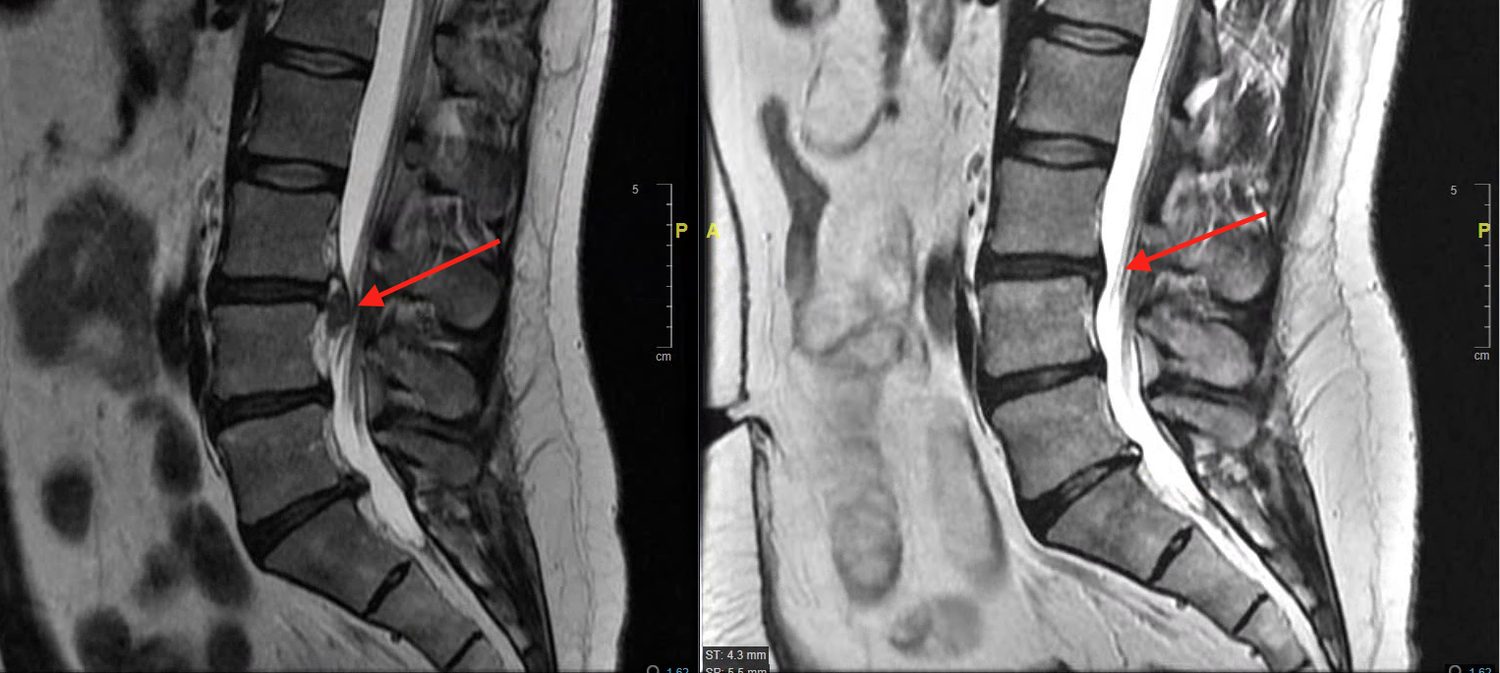
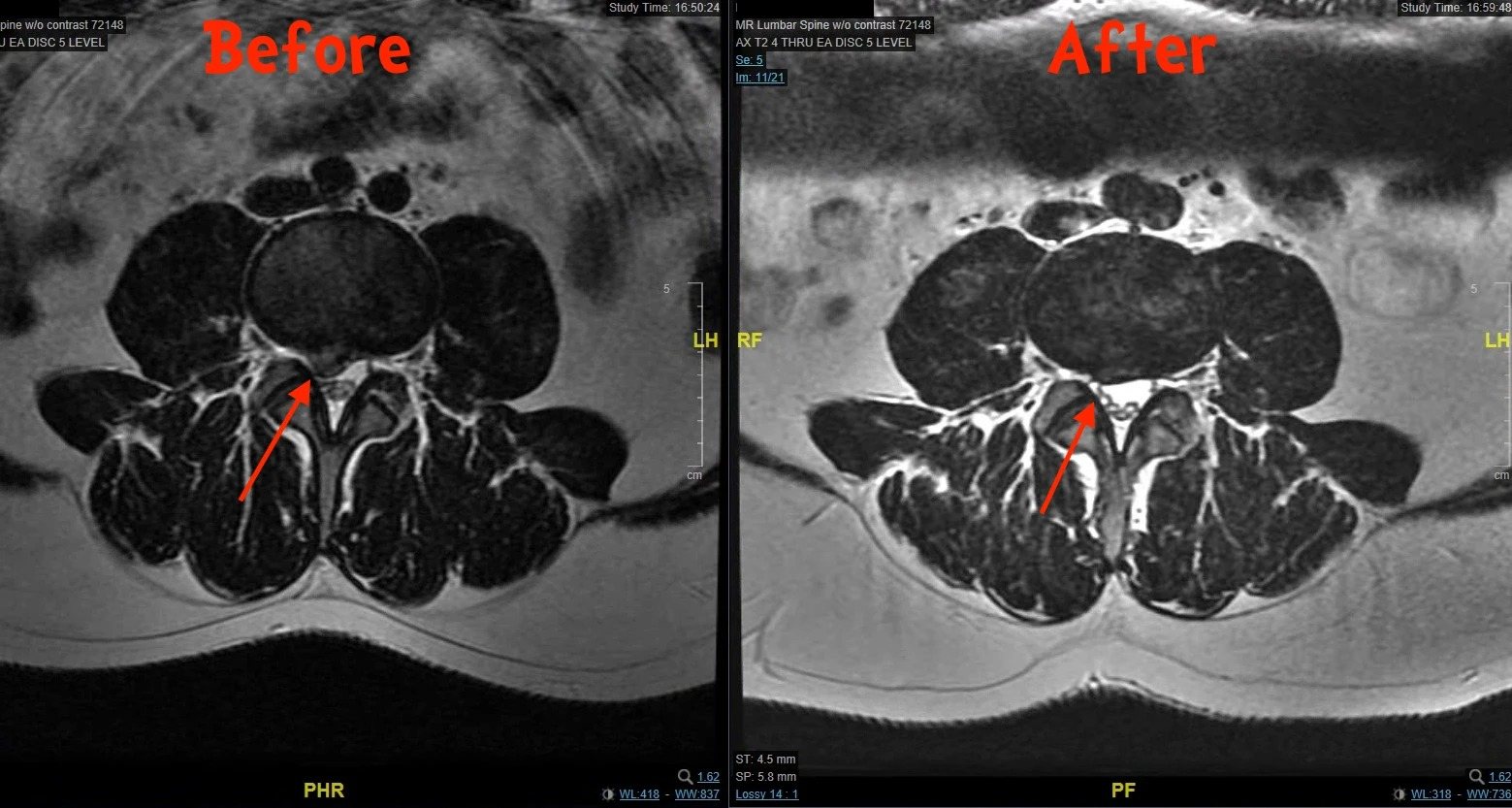
Before and after, side-on. Imaging is how disc change is measured in the
studies on this page — and how your own progress gets shown to you rather than described
to you.The same disc from above — the arrow marks the same spot on both scans, before
and after a course on the DRX9000.
Who you'll see
Your care team
We work as a team. Dr. Barton and Dr. Huffman have practiced side by side for
more than 18 years, and your care is a team effort from your first visit.
Kevin S. Barton, D.C.
Chiropractor · In practice since 2003
Dr. Barton has been in practice since 2003 and has used the DRX9000 since 2005, with more
than 2,000 patients treated on it. He's the author of the treatment philosophy here: find
the source of the pain and treat it there, without surgery and without narcotics. He
completed advanced scrambler therapy training in Rome with Dr. Giuseppe Marineo, the
inventor of the treatment.
In 2025 he went through the DRX9000 program himself, for one of the worst herniated discs he'd
seen in his career, and filmed the whole course of treatment, MRIs included.
Watch his nine-part series.
Joshua C. Huffman, D.C.
Chiropractor · In practice since 2007
Dr. Huffman earned his Doctor of Chiropractic degree from Texas Chiropractic College in
Pasadena, Texas, and completed his internship at Moody Health Center, with a rotation at
the Michael E. DeBakey VA Medical Center in Houston. He has advanced training in
myofascial release technique and is certified as a designated doctor for the State of
Texas.
A Texas native, he was born and raised in Matagorda County. When he isn't getting
patients well, he's hunting, fishing, kayaking and hiking with his wife, Kendra, and their
two children, Titus and Alley.
How the program runs
Decompression and strengthening, together
Taking pressure off the disc is one part of it. If nothing else changes, your neck goes
back to holding that bowling ball exactly the way it did before.
So alongside decompression, as the pain settles, we rebuild what Dr. Barton calls your structural
margin. In a neck, that means the deep stabilising muscles at the front and base of
the neck — the ones that hold your head over your shoulders instead of in front of
them. Almost nobody has ever trained these. They're small and unglamorous, and they're the
part of your neck most likely to still be working for you a year from now. We work on how
your shoulder blades sit, and we go through your actual setup: desk, monitor height, car,
phone, pillow.
Why we build the strengthening phase in: the research on rehabilitation
for a pinched nerve in the neck is still young, and the mechanics are the reason we do
it.15 Your neck holds a ten-pound head up all day, and what
keeps a treated level unloaded afterwards is the strength and the positioning around it.
That's the answer to "what do I do about my desk on Monday" — and we'd rather send you home
with it than without it.
We re-examine you along the way, not just at the end, and we tell you what's changed and
what hasn't.
And about "maintenance." The rehab half is part of the
program, and what follows it is plain aftercare: periodic maintenance treatments that take
the pressure off the disc from time to time. A neck that carries a bowling ball all day
earns them, the way teeth earn cleanings — we'll recommend a schedule and tell you why.
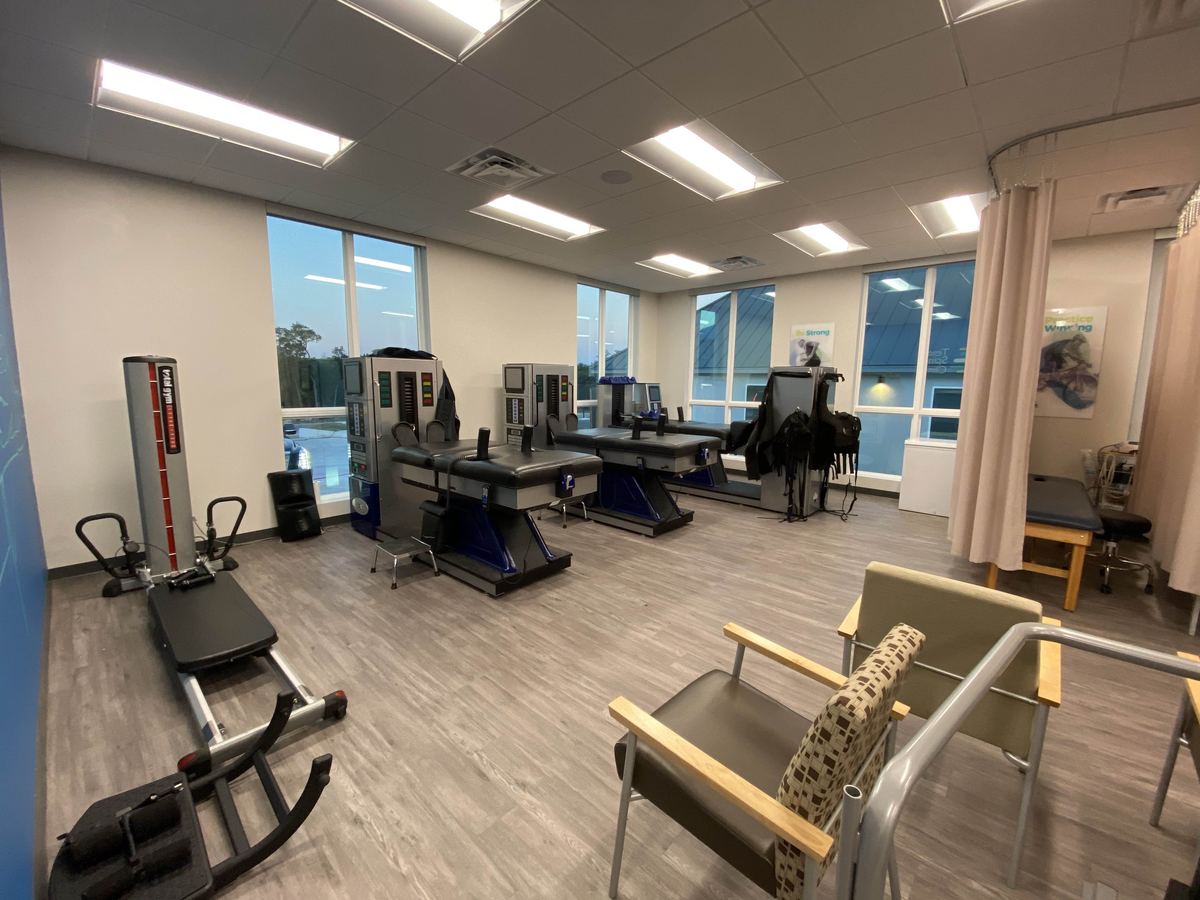
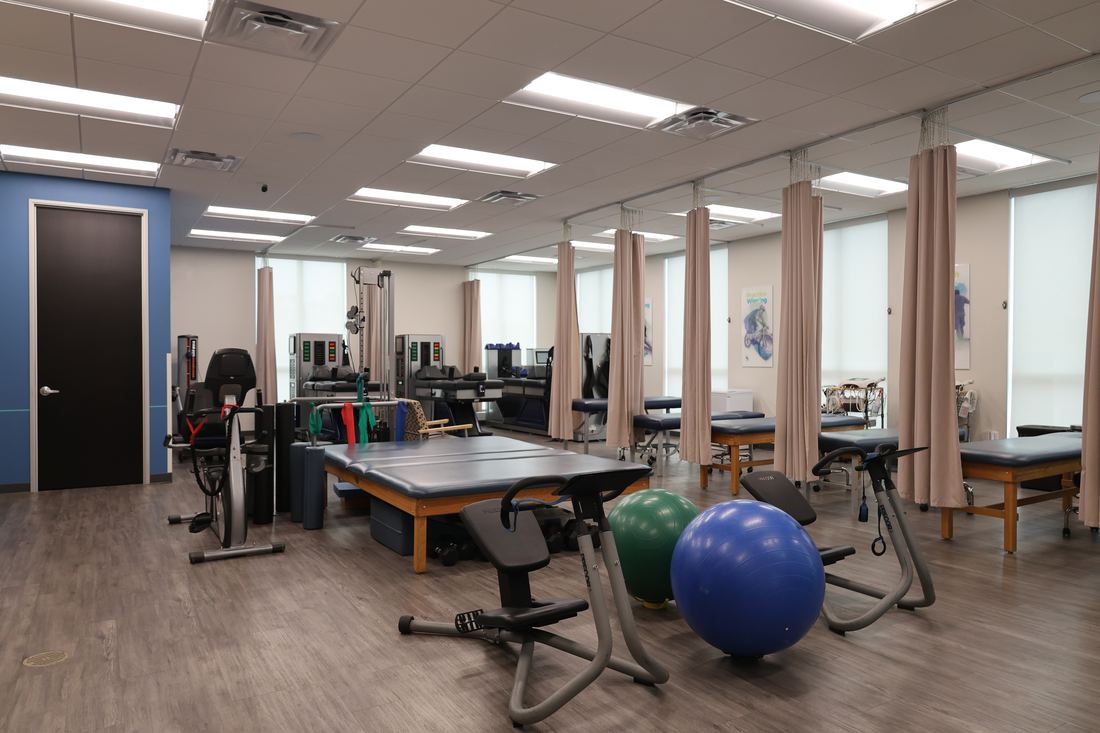
The decompression tables. Where the pressure comes off the
disc.The rehab room. Where the strength that holds the result gets
built — the two run together, not one after the other.
Every patient's story is their own. Results vary.
Andrea is a real Texas Spine Clinic patient, telling it in her own words.
Questions patients actually ask
Before you call
Can a disc in my neck really make my hand go numb?
Yes — and it's one of the most commonly missed connections in spine
care. The nerves that run to your hand start at your neck. Compress one where it exits the
spine and the symptom shows up at the far end, where the nerve ends. That's why
people get treated for a wrist or a shoulder for months with no change. What the numb
fingers don't tell you is which level of your neck is involved — the internet
charts that promise that don't hold up against MRI, and the level has to be worked out by
examination and imaging.
Is this safe? I've read scary things about neck treatment.
You're thinking of manipulation — a quick thrust, usually with
rotation. Decompression is not that. No thrust, no twist, and nobody's hands on your neck
applying force. You lie on your back with your head in a padded cradle while a computer
applies a gentle, measured pull along the line of your spine, and you hold a switch that
stops it instantly. Whether you ever want your neck adjusted is a separate decision, and
it's yours.
How is this different from the traction they tried in physical therapy?
Force control, mostly. A fixed-weight pull makes neck muscles guard,
and guarded muscles absorb the pull before it reaches the disc. The DRX9000 ramps force
gradually along a set curve, holds, and releases — which gets past the guarding. It also
targets a specific level rather than the whole neck.
Will this help my headaches?
Sometimes, and it depends entirely on where they come from. Headaches
generated by the upper neck — usually one-sided, starting at the base of the skull, worse
after driving or desk work — often improve as the neck does. Migraine and other headache
types are a different problem. We examine your neck and tell
you which pattern yours looks like.
Do I need an MRI before you'll see me?
No — but we need to see one before anyone treats you. An MRI is
required, or a CT if you can't have an MRI; those are the only two kinds of imaging that
show the disc, and we need to see the disc one way or the other. An X-ray shows bone; it
cannot show a disc — and no clinic should qualify you for this program off an X-ray alone.
If you have imaging, bring it and we'll put it on the screen and go through the pictures
with you — not just the report — which patients tell us has never happened to them
before. If you don't, we'll refer you for it.
Nobody here quotes you a price for a program before your imaging has been reviewed.
I had a neck fusion years ago. Can I still do this?
Not at the fused level — that's an absolute rule here. Hardware changes
how force moves through the spine, and a level that can't move can't be decompressed. But
come in anyway if you want a straight answer, because in our experience the problem is
generally never the fusion level — it's the level above or below, and whether that
level can be treated is a case-by-case call that depends on how stable your fusion is. It's
never a phone answer. If the exam and your imaging say this isn't the right treatment for
you, we'll tell you that at the consultation, and point you toward what is.
How long before I know if it's working?
Patients generally see gradual improvement over eight to ten
sessions — about two to three weeks of treatment. That's also when we reassess: a neck
that's going to respond has usually started to show it by then, and if yours hasn't, we
say so at that point rather than after another month.
What does it cost, and will insurance cover it?
If chiropractic care is all you need, most insurance plans cover it,
and it's among the more affordable treatment there is for a neck.
Decompression is the exception. The decompression program isn't a covered benefit
under any plan. If you carry a commercial health plan, we can usually generate an insurance
credit through it, which we apply against your cost. How big that credit is depends on your
specific benefits. So expect an out-of-pocket investment, and expect to know
exactly what it is, in writing, before you commit. We verify your benefits free. Payment in
full earns a time-of-service discount, and CareCredit, Affirm and in-office payment plans
are available. Full detail on the
Cost & Insurance page.
Am I too old for this?
Age by itself isn't the deciding factor — bone quality and what your
imaging shows are. We've treated patients well into their seventies and turned away people
in their forties. Your imaging is what tells us which one you are.
Footnotes
Decompression evidence — the five
approved sources, numbered the same on every page in this site's spine section.
Apfel et al., BMC Musculoskeletal Disorders 2010 — disc height and pain
through a DRX9000 program. ↩
Choi et al., Int J Clinical Practice 2022 — randomised sham-controlled
trial. ↩
Schueren et al., Military Medicine 2025 — 267-patient multi-clinic
series. ↩
El-Zayat et al., Egyptian Rheumatology & Rehabilitation 2019 —
decompression vs. physiotherapy with traction.
↩
Cervical radiculopathy:
diagnosis, natural history and rehabilitation — these are not decompression studies
and say nothing about the DRX9000. They are the sources for the dermatome correction, the
natural-history section, and the straight ceiling on rehab.
Rainville et al., Spine 2017 — 30 MRI-confirmed C6 and 39 C7 patients;
arm pain and sensory symptoms diffuse and not distinctly different between levels.
↩
Rainville et al., Spine Journal 2016 — nearly complete overlap in
locations of impaired sensation for C6 vs. C7.
↩
Redebrandt et al., Health Science Reports 2022 — 83 patients; clinicians
blinded to MRI named the involved root: exact match 31%, adjacent level a further 28%;
agreement between examiners 58%.
↩
Murphy et al., Chiropractic & Osteopathy 2009 — 226 nerve roots in
169 patients; cervical pain non-dermatomal in 69.7% of cases.
↩
Hong & Nam, Neurospine 2022 — 227 surgically verified patients;
62.6% had a standard dermatomal pattern.
↩
Lee et al., Clinical Anatomy 2008 — current dermatome maps are
inaccurate and based on flawed original studies.
↩
Downs & Laporte, J Orthop Sports Phys Ther 2011 — dermatome maps in
textbooks are inconsistent with each other and with the original evidence.
↩
Radhakrishnan et al., Brain 1994 — population-based natural history,
561 patients, median follow-up 4.9 years; ~90% asymptomatic or mildly limited at last
follow-up; 31.7% recurrence; 26% underwent surgery.
↩
Wong et al. 2014 — natural-course review; substantial improvement usually within
4–6 months; complete recovery in about 83% by 24–36 months.
↩
Mallard, Wong, Lemeunier & Côté, J Rehabil Med 2022 — systematic
review of multimodal rehabilitation for cervical radiculopathy. ↩
Wainner et al., Spine 2003 — diagnostic accuracy of the clinical
examination for cervical radiculopathy, 82 patients, against electrodiagnostic testing.
↩
Guideline support, and
surgery versus structured non-operative care — none of these studied the DRX9000, and
none of them studied chiropractic care. They are cited only to show that a structured
non-operative program is a reasonable first thing to try.
Blanpied et al., "Neck Pain: Revision 2017," J Orthop Sports Phys Ther
2017 — clinical practice guideline of the Orthopaedic Section, American Physical Therapy
Association. No industry or device funding.
↩
Engquist et al., Spine 2013 — randomised trial, 63 patients, surgery
plus physiotherapy vs. structured physiotherapy alone, two-year follow-up.
↩
Engquist et al., J Neurosurg Spine 2017 — five-to-eight-year follow-up
of the same trial, 59 patients.
↩
Persson et al. 1997 — randomised trial, 81 patients, surgery vs. physiotherapy
vs. cervical collar. ↩
Full citations on the evidence page.
The ask
Find out whether that arm is coming from your
neck — and whether we can take the pressure off it.
Call (210) 741-9166 or request
your consultation below. The consultation is $49 — and it isn't a sales
pitch. Here's exactly what happens:
You call, or send the form. Tell us what's going on. If your
fingers are numb, tell us which fingers — not because that names the level, but
because it's one of the pieces the exam puts together.
You come in and get examined. The doctor tests your strength,
reflexes and sensation, checks how far your neck turns, puts the nerve gently on
stretch, and reviews your imaging with you — the pictures on
the screen, not just the report, which most patients tell us nobody has ever
done. Those tests mean much more together than any one of them does
alone16 — which is why the answer comes from the
whole examination and your scan read side by side, not from a single manoeuvre.
You get one of three straight answers. You're a good candidate.
You're not. Or here's the option that fits you better — including the ones we don't
provide.
If the answer is yes, your first treatment is included. The $49
covers the examination, the imaging review and your first session on the table. If the
answer is no, it's no.
Two of those three answers earn us nothing. We give them out constantly.
P.S.
The neck pain isn't the part that worries us. Loud symptoms mean the nerve is still talking.
What deserves attention faster is the quiet version: the numb patch that spreads, the grip that
keeps fading, the buttons that got harder this month. A nerve under pressure for a long time
can be slower to recover even after the pressure comes off. If your arm is just loud, you have
time to choose carefully. If it's going quiet, choose sooner. Either way, one visit tells you
what you're actually dealing with — and you keep every option you walked in with.