1. The same disc, again
This is the most common story we hear.
A discectomy removes the piece of disc that broke loose and pressed on your nerve. It's very
good at that, and it's why so many people wake up with their leg pain gone. But understand
what the operation is: the surgeon takes out the fragment. Nobody rebuilds
the disc.
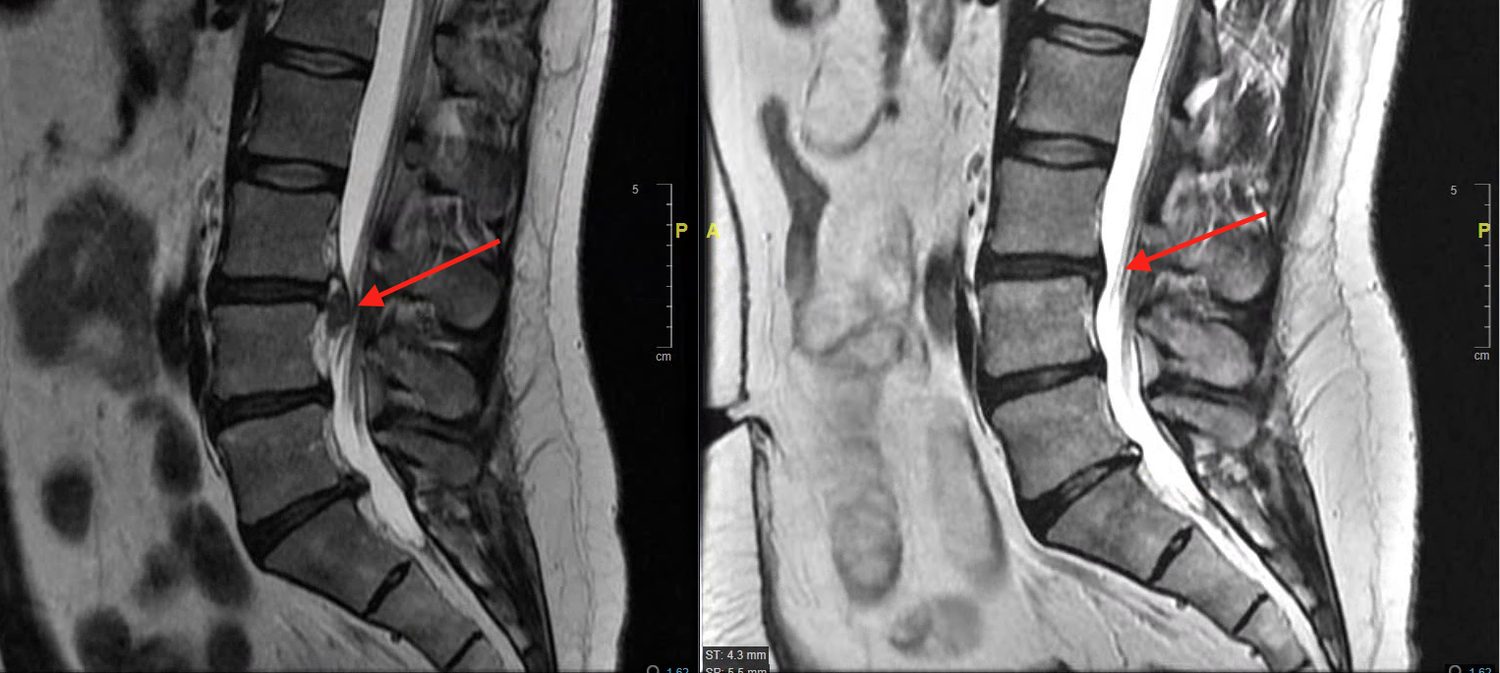
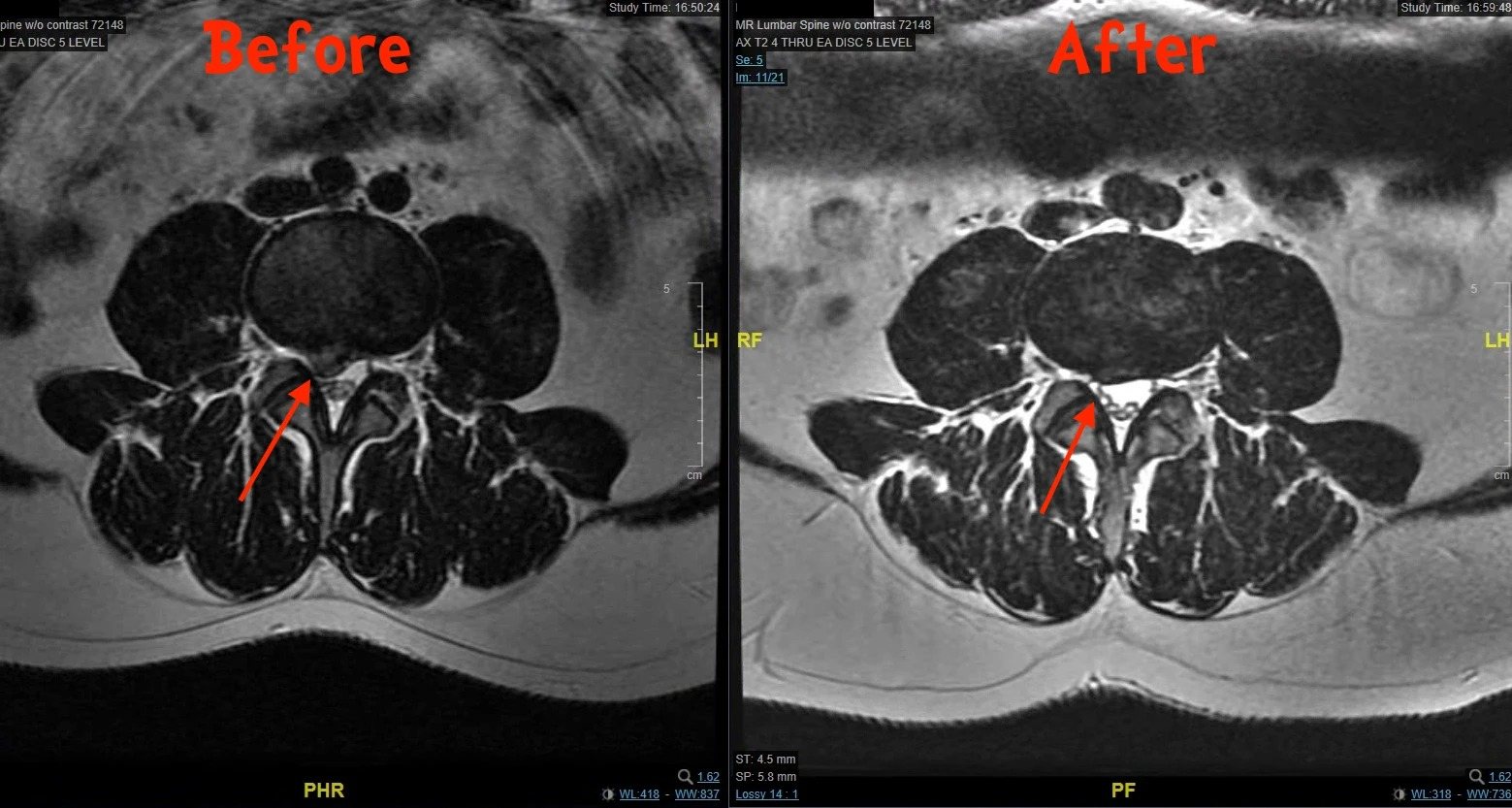
What's left is a disc that's thinner than it was, with a weak spot in its outer wall where
the material escaped, sitting between the same two bones, under the same load it lost to the
first time. The desk hasn't changed. Gravity hasn't changed. So the disc keeps losing
height — or a piece pushes out through that same weak spot, often during something completely
ordinary. That's the pop, and the flood of recognizable leg pain right behind it.
The straight answer here: this is the version of failed
back surgery most likely to have a non-surgical option left, because the problem is still
mechanical — pressure on a disc that never got unloaded. If there's no hardware at that
level, decompression is genuinely on the table — we treat post-discectomy patients all the
time. Your exam and your current imaging still make the final call, and we'll come back to
what that involves.
2. The level next door
A fusion welds two vertebrae into one bone. Done right, that segment stops moving — which is
the entire point, because its movement was what hurt.
But your back still has to bend the same amount to tie your shoes. That motion has to come
from somewhere. So the levels above and below the fusion take over the share the fused level
used to carry — more work, every day, for years. Eventually those neighbors wear faster than
they should have. The disc above the fusion flattens. The joints behind it get arthritic and
thick. Surgeons call this adjacent segment disease, and it usually shows up
years later: new pain, often slightly higher up your back, in a spot the first surgery never
touched.
This is not a mistake anybody made. It's physics, your surgeon knew about it, and it was
part of the trade they weighed before recommending the fusion in the first place.
The straight answer here: this is the hardest call we make,
and it is never made over the phone. Treating a level that sits right beside welded bone and metal is not the same as treating a normal spine. It's
possible — but very case-by-case, and the deciding question is the stability of your fusion,
read from your imaging and your exam together. Sometimes there's something safe and useful to
do. Sometimes the straight answer is that this belongs back with a surgeon — or with nobody,
for now.
3. Scar tissue with a nerve caught in it
Everything you heal makes scar. Skin, muscle, and the tissue around your nerve roots too.
That's normal healing, not a complication.
The trouble is what scar does to a nerve. A healthy nerve root isn't fixed in place — it
slides a little every time you lift your leg or bend forward, the way a rope runs through a
pulley. When scar forms around it, the nerve gets tethered. Now movement that used to be free
tugs on a nerve that can't move, and you get pain with position and activity that no pill
quite reaches.
Here's the part nobody explains: cutting scar out makes more scar. That's
why surgeons are cautious about reoperating when scar is the main finding. A second operation
to free the nerve creates a fresh healing site — and fresh healing is exactly what made the
scar.
The straight answer here: nobody can remove scar tissue
from around your nerve without surgery, and surgery is a poor trade for scar alone. Be
extremely careful with anyone selling you something that "dissolves scar tissue" or "releases
adhesions" — that's a marketing claim, not a mechanism. What can change is
the load on that segment, the inflammation around the nerve, and how well the nerve moves in
the space it has. That's a real conversation. "We'll melt the scar" is not.
4. A nerve that learned the pain
This is the one that gets missed most, and the one that makes patients feel crazy.
A nerve that's been squeezed for a long time doesn't just report pain — it changes. The
pathway gets more sensitive, the volume gets turned up in the spinal cord and the brain, and
after a while the alarm keeps ringing whether or not there's still a fire. Doctors call it
central sensitization. Patients describe it better: burning, electric, constant, there when
you wake at 4am, there when you're sitting still, there in a leg where the pressure came off
two years ago.
A few signs give it away. The pain stops following position and activity the way it used to.
Light touch — a sock, a bedsheet, the seam of your jeans — can set it off. And your imaging
looks better than you feel, which is why somebody has probably already told you your
scan is fine.
The straight answer here: no amount of structural fixing
quiets this. Not decompression. Not another operation. Not injections aimed at a disc that's
no longer the problem. When the signal itself is the disease, the treatment has to aim at the
signal — and that's a different lane, which we'll get to below.
Most people have more than one of these.
A re-herniated disc with a sensitized nerve on top of it is an
extremely common combination — and the reason people get half-better and then stall. Sorting
takes an exam and your imaging together. It cannot be done from a form, a phone call, or this
page.