

Free patient guide · From Texas Spine Clinic
When Back Pain Won't Go AwayBack pain, neck pain and sciatica: what's causing it, what your MRI shows, and how to treat it without surgery.
How to use this guide
01Why it hasn't gone away
Everything you've tried worked for a while. Here's why nothing held.
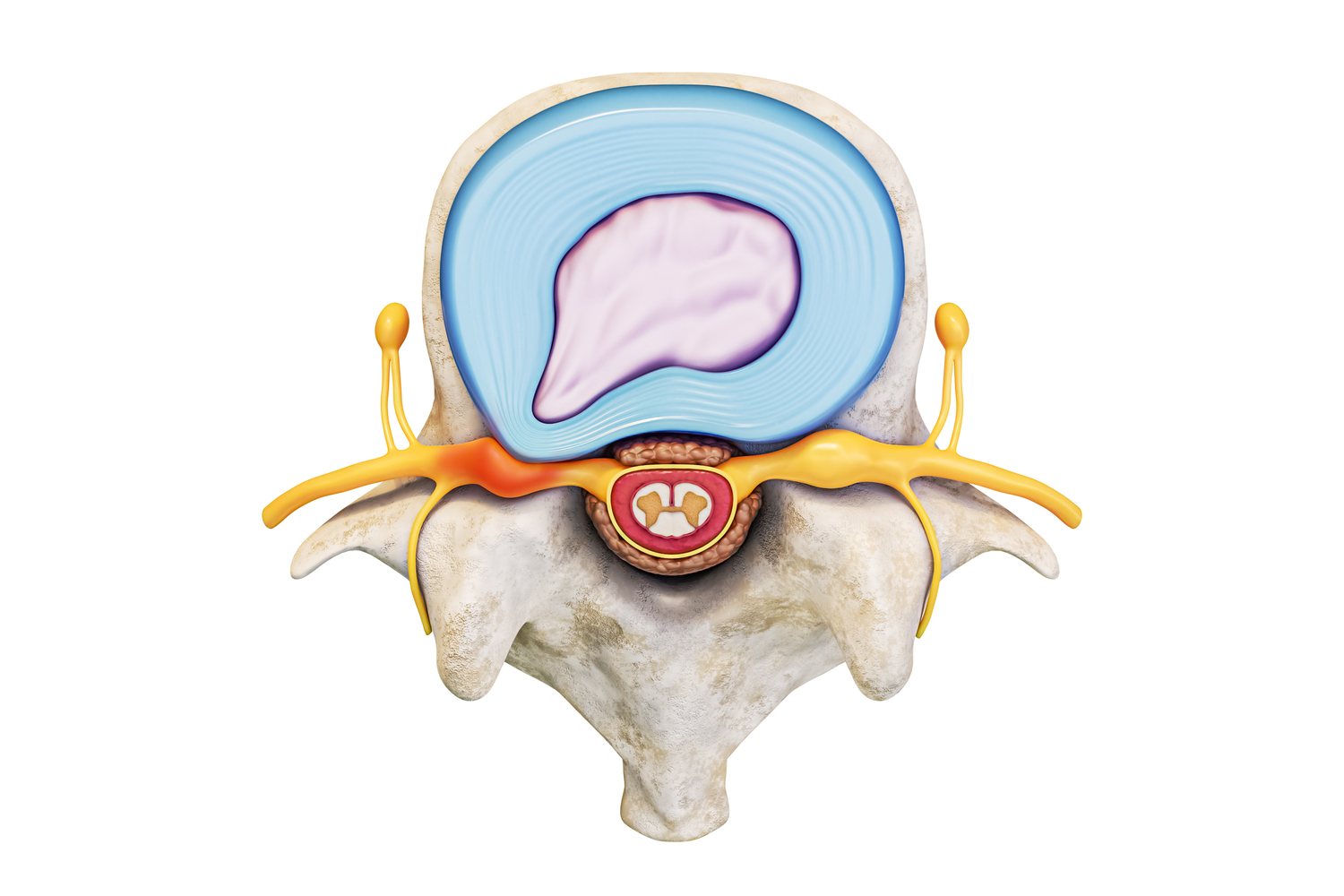
Four tissues carry the load of your spine: the discs, your shock absorbers; the facet joints, the small joints at every level; the nerves that run out between them; and the muscles that tighten to guard an injury.
When a disc is overloaded, it bulges or ruptures and presses on the tissues around it. The joints get jammed and inflamed. The nerve gets pinched, and that's the electric pain, the burning and the numb toes. The muscles lock down in spasm.
Now look at what you've tried. Pills calm the inflammation, for a while. Adjustments move the joints, for a while. An injection quiets the nerve, for a while. Each one treats a single tissue, and none of them takes the pressure off the disc.
The pressure that caused the problem is still there. That's why the relief keeps wearing off.
02Where your pain is coming from
Where the pain goes tells us where to look.
Find the line that sounds most like you. Many people see themselves in more than one.
Pain that runs down the back of your leg, past the knee, sometimes with numbness or tingling in your foot
A nerve in your low back is being pressed on, most often by a disc. That's sciatica.
Pain, tingling or numbness that runs from your neck into your shoulder blade, arm or hand
A nerve in your neck is being pressed on, often by a disc.
A deep ache in your low back that's worse bending forward, lifting, or after a long drive
Usually the disc itself: bulging, or dried out and flattened over the years.
Pain that's worse leaning back or twisting, and stiffness first thing in the morning
Often the facet joints, the small joints at the back of your spine.
Legs that feel heavy, tired or tingly when you stand or walk, and better when you sit or lean forward
Often spinal stenosis: less room for the nerves in the spinal canal.
Pain that came back, or never left, after back surgery
The same disc again, or the level next to it. Often still treatable without another operation.
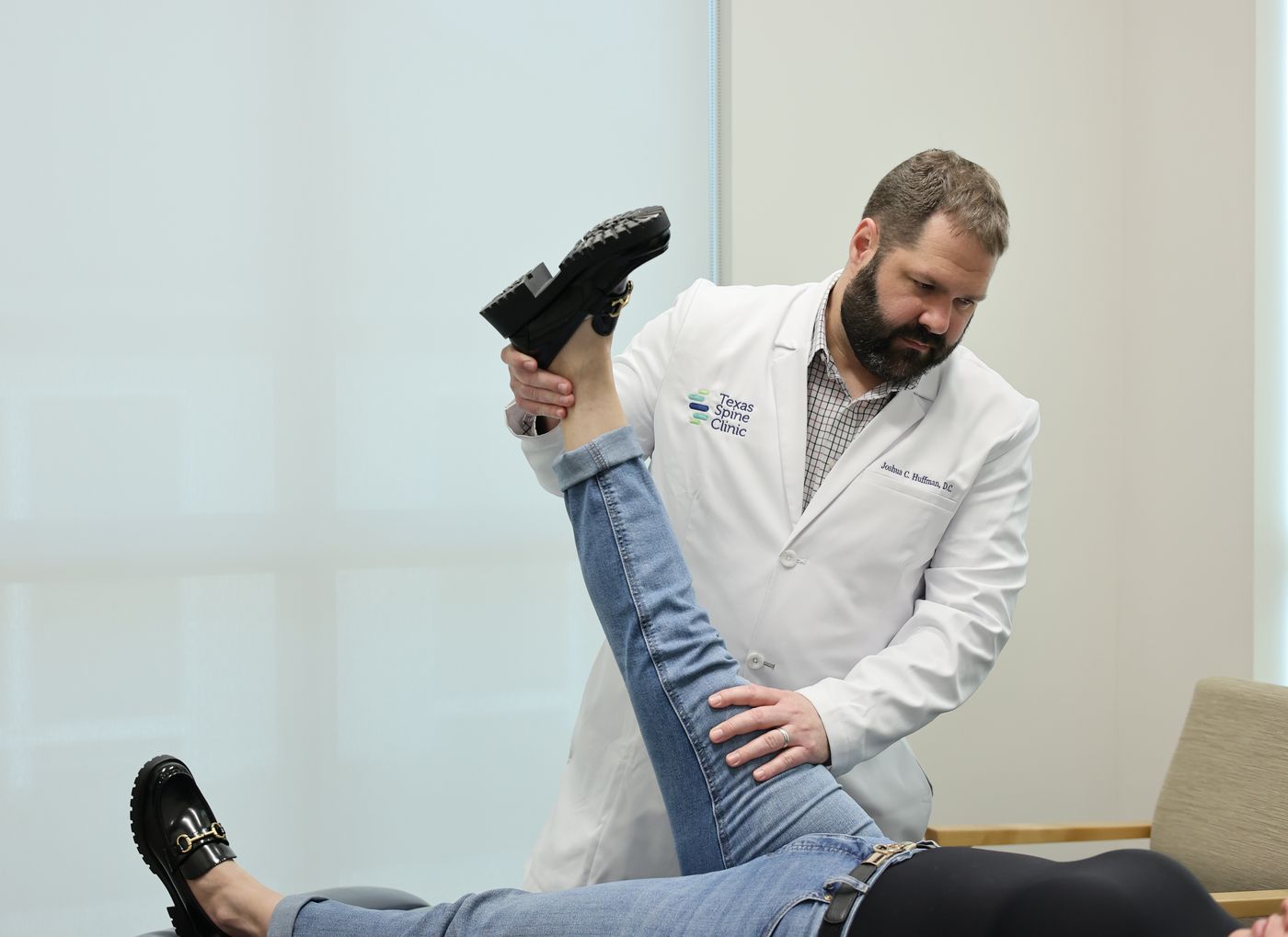
Where it goes is a clue, not a diagnosis.
Your exam and your imaging together tell us what's causing your pain. The exam tests your movement, strength, reflexes and the nerves involved. The MRI shows the disc. Put together, they show which tissue is the problem and which treatment fits it.
03Your starting line
Write down where you are today. It's how you'll know how far you've come.
We measure progress by three things: how bad the pain is, how often it comes, and what you can do. Standing for 10 minutes before care and 30 minutes now is real progress you can measure. Fill this in once. It saves on this phone.
Your numbers today
Where does it go?
0 of 6 checkedWhat have you tried?
0 of 6 checked
Not an appointment — today
Go to an emergency room today if you have any of these.
If it's happening right now, call 911.
04Your MRI
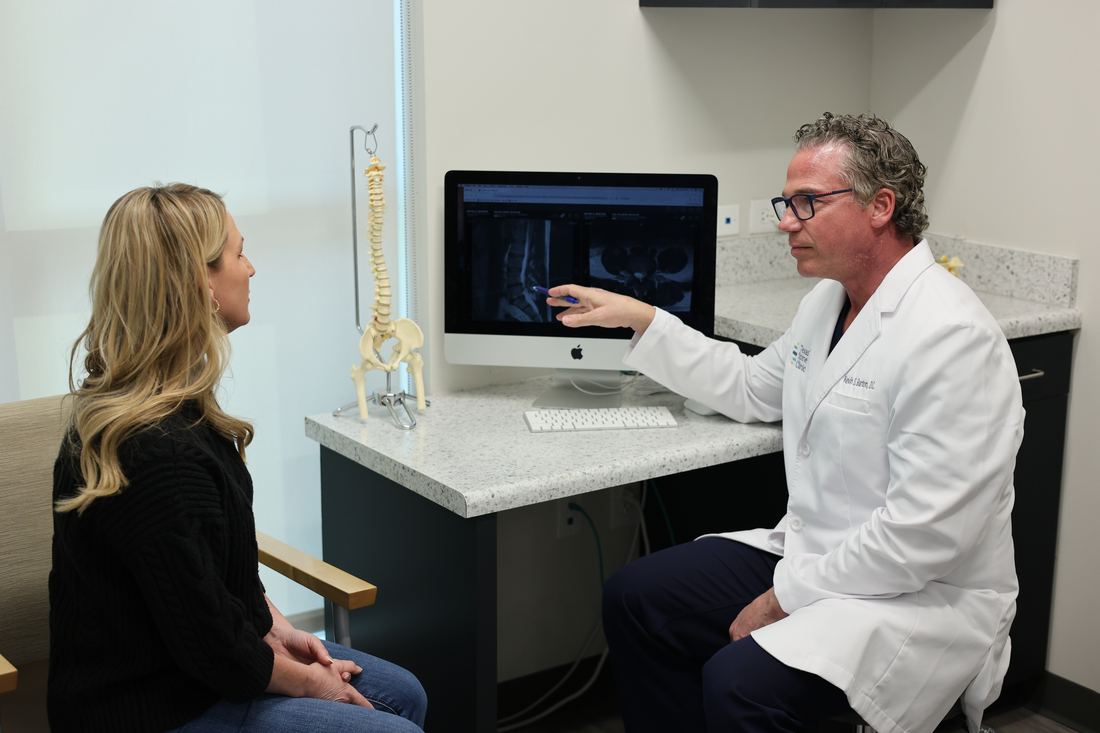
Ask to see the pictures, not just the report.
Patients tell us the same thing all the time: nobody ever showed them the pictures. The radiologist who reads your MRI writes the report and never meets you. The doctors who do meet you usually work from that report, and a busy schedule rarely has room to walk through the images with you.
An MRI, or a CT if you can't have an MRI, is the only imaging that shows a disc. An X-ray shows bone. It can't show a herniated or bulging disc.
Words you'll see on your report:
- Bulge
- The whole disc spreads past its normal edge, like a tire low on air. The outer shell is intact.
- Protrusion
- The gel inside the disc pushes out in one broad lump.
- Extrusion
- Disc material has squeezed through the outer shell. Large ones are often the most likely to shrink.
- Desiccation
- The disc has lost water. That's all it means.
- Stenosis
- Narrowing. Less room for the nerves, in the central canal or the side exits.
- Impinging
- The disc is pressing on a nerve.
05Your options
What each option does to the disc.
Discs can shrink on their own. The question is how long it takes.
Often months, sometimes longer. Meanwhile a nerve that stays under pressure can lose function, and the longer it's pressed on, the slower it comes back.
Calm the inflammation and the spasm.
They help you get through a bad stretch. They don't take the pressure off the disc.
Move the joints and build support.
Both are part of care here. Neither one takes the pressure off a disc that's pressing on a nerve.
Calms the inflamed nerve.
It doesn't change what's pressing on the nerve, which is why the relief can fade.
Cuts away or fuses what's pressing.
Some of what it changes can't be undone. A fused segment doesn't come back, and scar tissue doesn't unform.
Takes the pressure off the disc itself.
No incision, no injection, no medication, no downtime. You drive yourself home and go back to work.
06How DRX9000 decompression works
Take the weight off the disc, and it can soak fluid back in.
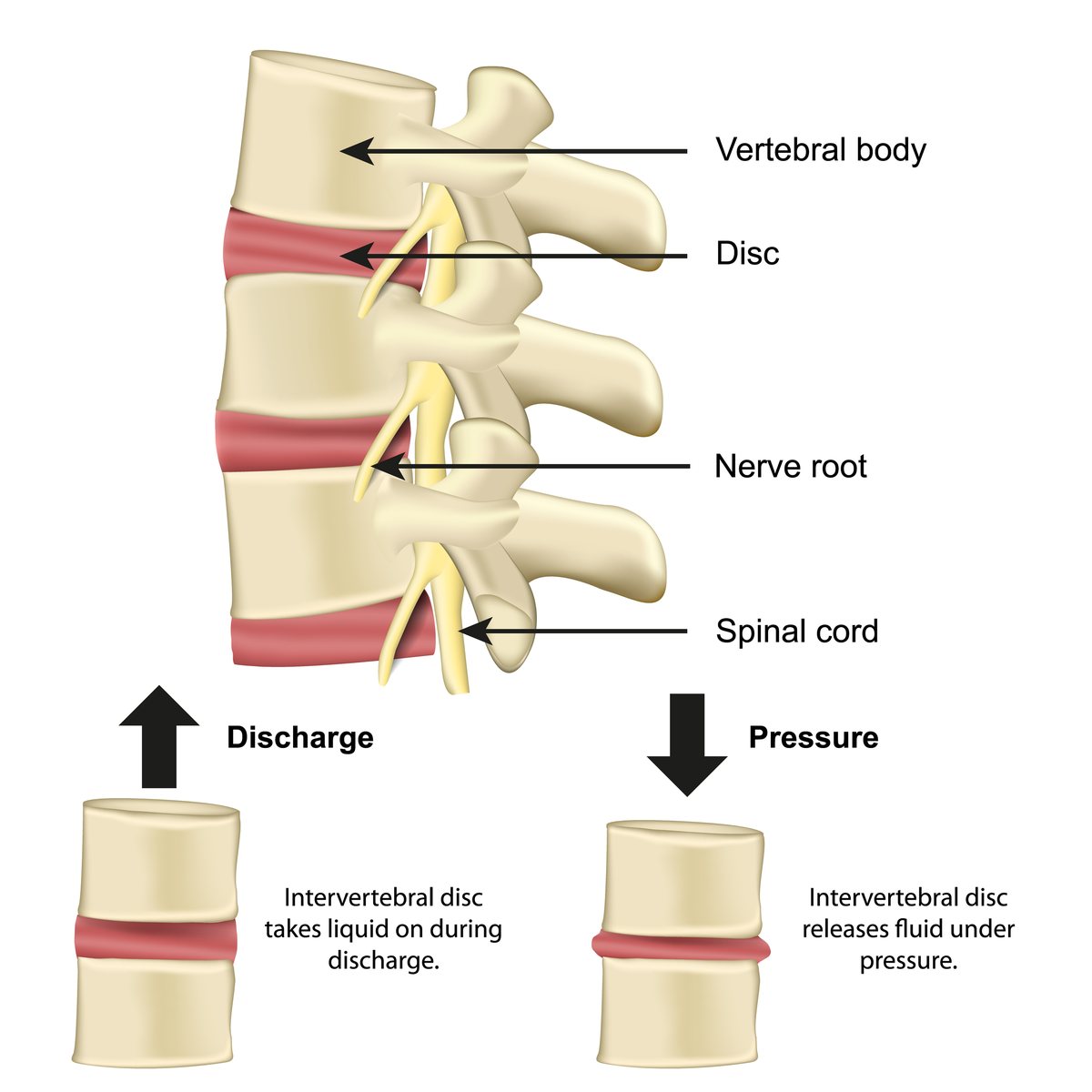
Your discs have almost no blood supply of their own. They feed by pressure. When weight presses down on a disc, fluid is squeezed out of it. When the weight comes off, the disc soaks fluid, oxygen and nutrients back in. A herniated disc is squeezed all day, sitting, standing, bending and lifting, and rarely gets a break long enough to recover.
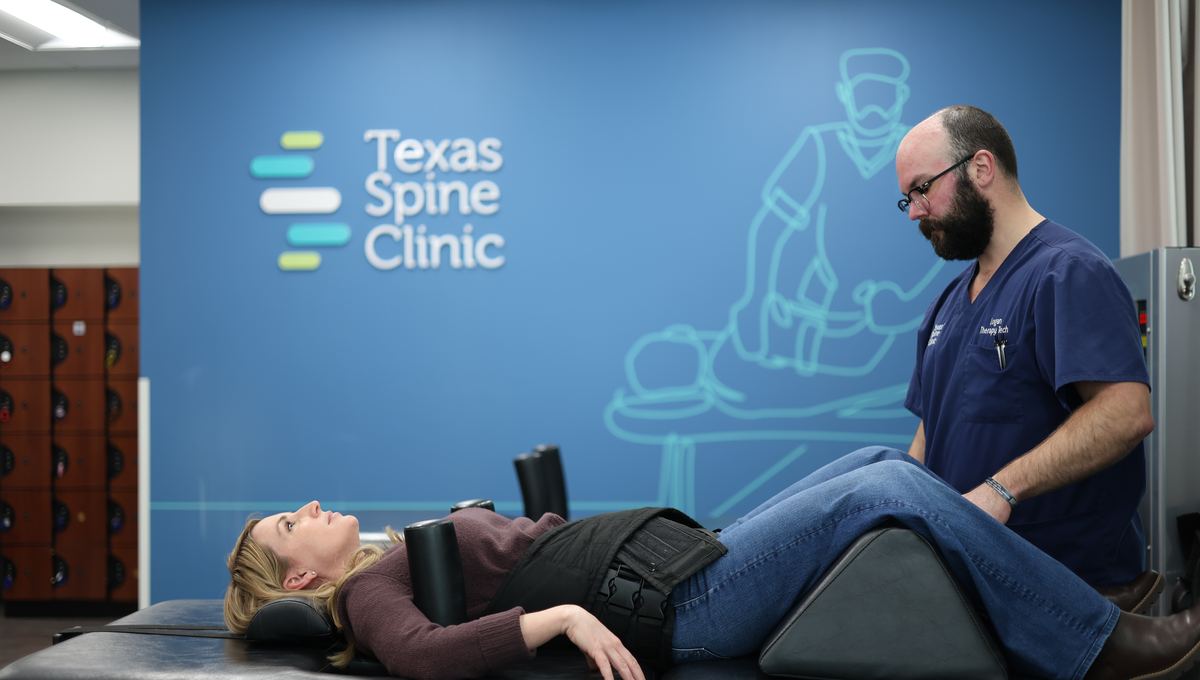
The DRX9000 is an FDA-cleared, computer-controlled decompression system. You lie on it fully clothed, fitted into a harness, for about 25 to 30 minutes. It applies a slow, precise pull, aimed at the level of your disc, and stays below the point where your muscles tense up and fight it. Most people find it comfortable. A lot of them fall asleep.
That takes the weight off the disc, so it can rehydrate and take in nutrients again, and it helps a herniation shrink faster, which takes pressure off the nerve.
For your neck, the pull starts at 5% of your body weight and builds about 1% a visit. And you never have to have your neck adjusted to have decompression.
What the research found
The doctor has been on that table himself.
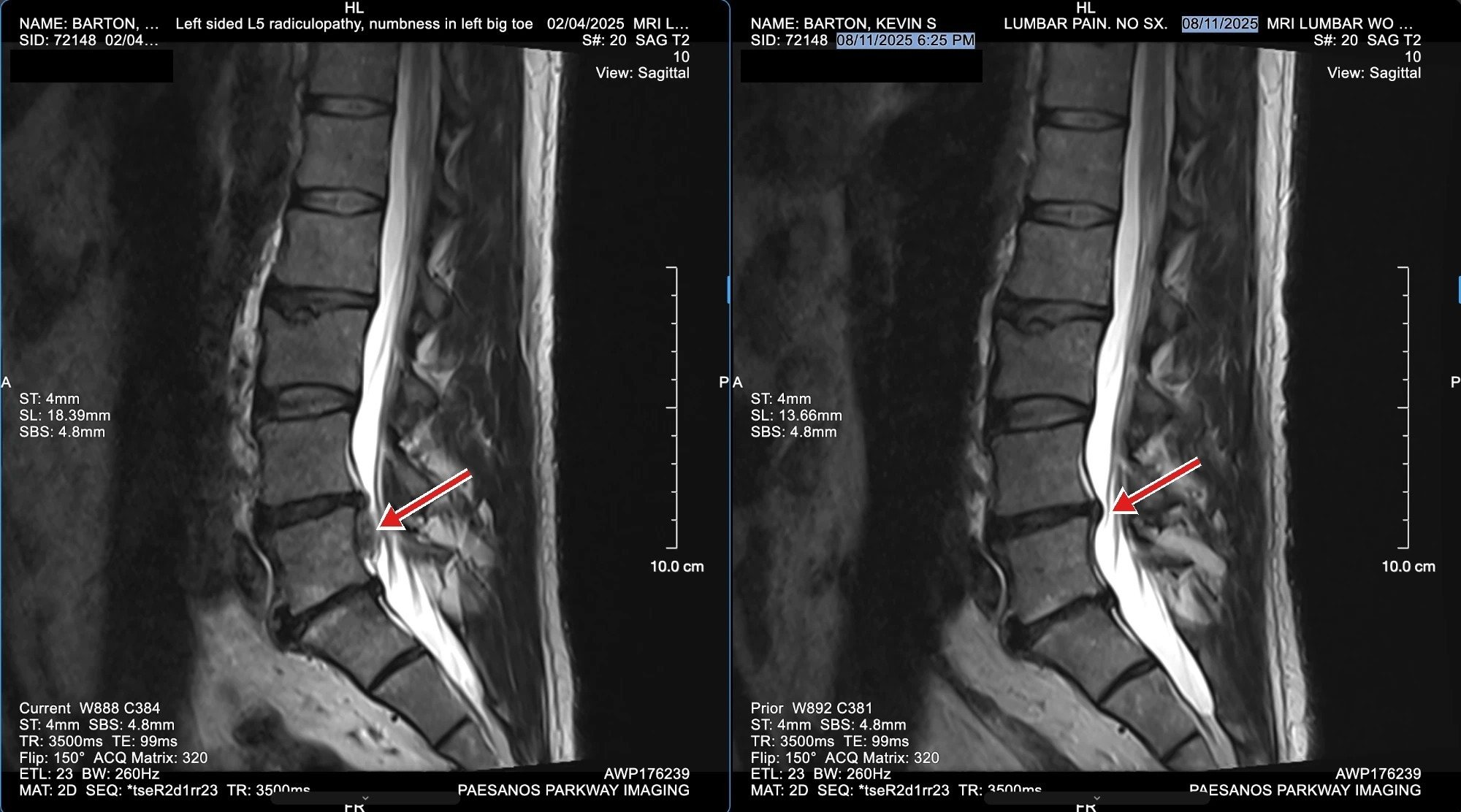
In February 2025, Dr. Barton's own MRI showed one of the worst herniated discs he had seen in more than 20 years of practice. It pressed on the nerve that runs to his left foot, and his big toe went dead. He treated it on the DRX9000. Within two weeks he had control of the toe back. By August, his MRI looked like the picture on the right.
"I wasn't going to live with a dead foot. But I knew there was a non-surgical treatment I'd watched work for twenty years, and its biggest risk was a few weeks of my time. So I tried that first."Kevin S. Barton, D.C.
07The program
20 to 25 sessions over six to eight weeks.
25 to 30 minutes on the DRX9000.
The force is set for your body and your level, and built up gradually. Your first visit is the gentlest of the whole program.
The early sessions can stir things up.
Some patients get sore before things turn. We tell you before you start, not after.
The checkpoint.
Around the second week, we measure whether your spine is responding, against your starting line. If it isn't, we tell you then.
When patients who respond usually feel the change.
Standing longer, walking farther, sleeping through the night.
Core strengthening.
As the pain calms, we strengthen the muscles that support your spine, so you finish stronger.
Maintenance.
A decompression treatment from time to time takes pressure off the spine and protects your result, the way a dental cleaning protects your teeth.
The investment
The decompression program isn't a covered benefit under any insurance plan. If you carry a commercial health plan, we can usually generate an insurance credit through it, which we apply against your cost. How big that credit is depends on your specific benefits. With Medicare, the program isn't covered, but if you also carry a secondary health plan, we can usually generate a credit through it.
You'll have your number in writing at your MRI review. Paying at the start earns a time-of-service discount, and CareCredit, Affirm and in-office payment plans are available. Your program is prorated: you pay only for the treatment you receive.
08Who it's for
We screen you the way a spine surgeon would.
A good surgeon doesn't operate on everyone who asks. We hold decompression to the same standard. Your exam and your imaging decide whether you're treated here.
Decompression is likely the right conversation if…
- Your MRI shows a herniated disc, a bulging disc or degenerative disc disease
- You have sciatica, or arm pain, from a disc pressing on a nerve
- You have facet syndrome, or stenosis from discs that have lost height
- Pills, exercises, adjustments or an injection helped for a while, then stopped helping
- A surgeon has recommended an operation, and you want to try this first
- You've had a discectomy or laminectomy, with no hardware, and the same disc is acting up again
We generally won't treat you if…
- You have a fusion or hardware at the level we'd treat
- You have severe osteoporosis, a spinal fracture, a tumor or an infection
- Your stenosis is severe and caused by bone rather than disc
- Your spondylolisthesis is unstable: it shifts more than 5 mm on the X-rays we take to check
- You have any of the emergency warning signs on page 3
- You're pregnant



09The next step
Your $49 DRX9000 consultation.
It takes two visits. At the first, your exam and your first time on the DRX9000. If you don't have an MRI or CT, we send you for one. At the second, we go through your MRI with you, put your number in writing, and if you're a candidate, your care continues that same day.
Bring with you
0 of 4 packedTexas Spine Clinic · 3212 Napier Park, San Antonio, TX 78231
Monday–Thursday, 8 a.m.–5 p.m. · Same-day appointments · No referral needed
This guide is general information, not medical advice. If you have a medical emergency, call 911.
Book your $49 DRX9000 consultation
Your exam, a review of your imaging, and your first treatment when the exam and imaging confirm you're a candidate.
Calendar not showing? Open it in a new tab.
Rather book by phone? Call (210) 741-9166.