← Blog
Spine & Discs
Astronauts grow up to two inches taller in space. Your discs are why.
Take the weight off a spinal disc and it draws fluid back in and gains height. What that means for a disc that has been squeezed for years, what CT scans showed after a DRX9000 program, and how one treatment reaches four tissues at once.
Send someone to the International Space Station for a few months and they come back to Earth taller. NASA’s researchers have watched crew members grow by as much as three percent on long missions.1 For a six-foot astronaut, that is about two inches.
Nobody grows new bone in orbit. What changes is the pressure on the discs. And if a disc in your back has been flattening for years, that is the most hopeful thing you will read about it this week.
What happens to a spine when gravity lets go
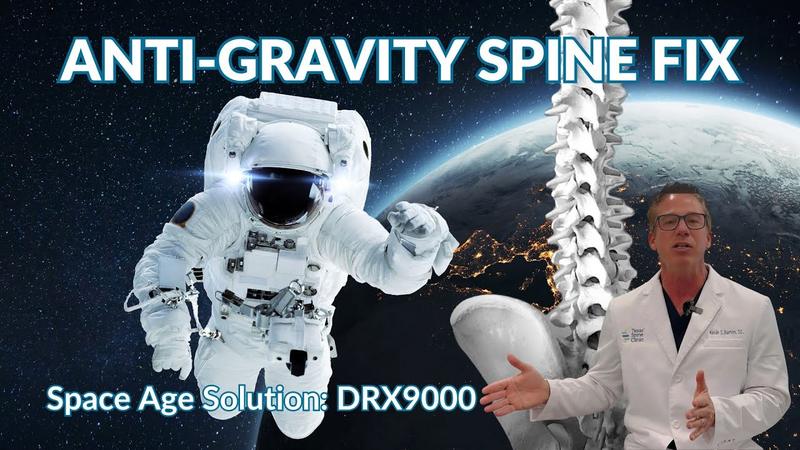
On Earth, gravity presses down on your spine every minute you are upright. The discs, the cushions between your vertebrae, take most of that weight. In space, the weight is gone. The discs stop being squeezed. They take on fluid and expand, the curves of the spine relax, and the whole column lengthens.
When the astronauts come home, gravity loads the spine again and their height settles back to normal. The discs were never broken. They were responding to pressure, the same way they do in every person, every day.
 Watch
You do a small version of this every night
You don’t have to leave the planet to see it. You are a little taller when you wake up than when you go to bed. Researchers have measured it on MRI: after a night lying down, the lumbar discs hold more fluid and more volume than they did the evening before.2,3 By the end of a day on your feet, that fluid has been pressed back out.
Longer stretches without load do more. In bed-rest studies, which space agencies use to mimic spaceflight on the ground, the lumbar discs gained measurable height.4
That rhythm is how a healthy disc lives. Here is why it matters so much when a disc is not healthy.
Why a disc can’t heal while it’s being squeezed
A spinal disc has almost no blood supply of its own. It can’t get fresh water and nutrients the way a muscle can. It feeds by pressure instead, like a sponge:
- Weight on: fluid is squeezed out.
- Weight off: the disc soaks fluid back in, along with what it needs to repair itself.
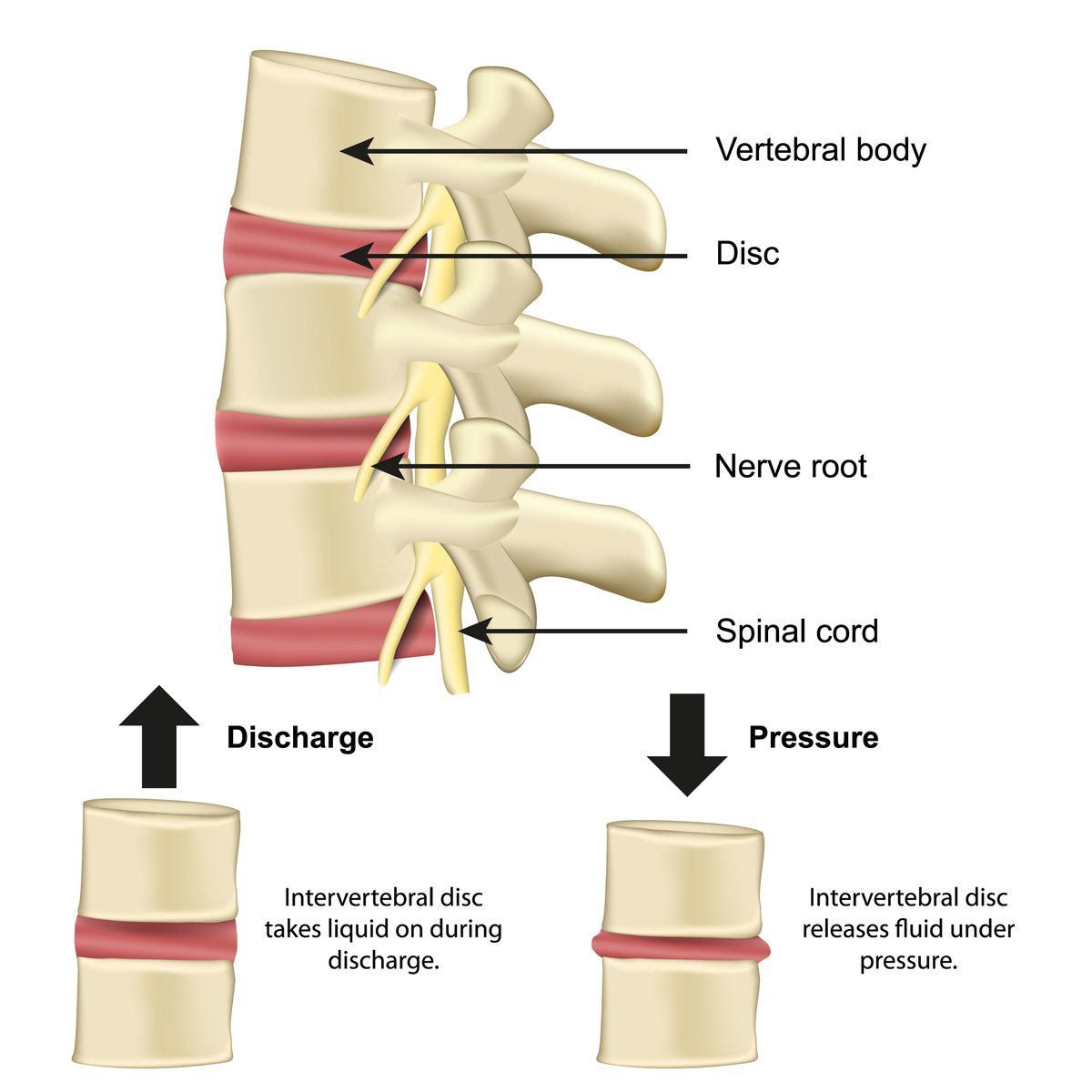
Years of sitting, lifting, bending and old injuries tip that balance. The disc loses more fluid than it gets back. It dries out and flattens. As it loses height, the openings the nerves pass through get smaller, the joints behind the disc carry weight they weren’t built for, and the muscles around them tighten to protect the area. On an MRI report, this shows up as words like desiccation, loss of disc height and bulge.
Think of a bruise that someone presses on all day. It can’t heal while the pressure stays on. A compressed disc is the same. To help it, you have to take the pressure off.
What your other treatments were working on
Most people reading this have already tried something. Each of those treatments has a job, and none of those jobs is unloading the disc:
- Pain pills and muscle relaxers change how much you feel. The disc stays under the same pressure.
- A steroid injection calms the inflamed nerve. It doesn’t change what is pressing on it, which is why the relief so often fades.
- Rest helps, a little. Lying flat lowers the pressure inside a lumbar disc, but researchers who measured it found it stays above zero.5
Spinal decompression is built to do the one thing those can’t: take the pressure inside the disc below zero. Researchers publishing in the Journal of Neurosurgery put pressure sensors inside human lumbar discs during decompression and recorded negative pressure, a true vacuum.6 That pull is what draws fluid and nutrients back into the disc, and helps draw bulging material back toward the center, away from the nerve.
It is the astronaut’s unloading, brought down to Earth and aimed at one disc, about thirty minutes at a time.
Measured on CT: discs gained height
A spine that grows two inches in orbit is a striking picture. The question that matters to you is whether a decompression program changes the disc on a scan. Researchers checked.
In a study published in BMC Musculoskeletal Disorders, 30 patients had CT scans of their discs before and after a six-week program on the DRX9000.7 Average disc height went from 7.5 mm to 8.8 mm. Average pain fell from 6.2 out of 10 to 1.6. Patients whose discs gained more height tended to report more relief.
A second study compared decompression with physical therapy plus conventional traction and measured the discs on MRI. Disc height improved in 27 of 37 decompression patients, against 4 of 34 in the therapy-and-traction group.8
A millimeter or so sounds small. In discs that averaged 7.5 mm to begin with, it is about a sixth more height, and it is the kind of change pills and injections are not designed to make.
 Watch
Four tissues, unloaded at the same time
The disc is usually at the center of the problem, but it is rarely the only thing hurting. By the time most people come to us, four tissues are involved, and each one is part of the pain:
- The disc has lost fluid and height, and may be bulging or herniated.
- The facet joints, the small joints at the back of each level, are carrying extra load. They get stiff, irritated and locked down.
- The nerve has less room than it needs. That is the shooting pain, tingling or burning down the leg or arm.
- The muscles have tightened and gone into spasm to guard everything underneath them.
Most treatments reach one of these at a time. A shot targets the nerve. A massage targets the muscle. An adjustment targets a joint. When the DRX9000 unloads a spinal level, all four respond together. The disc draws fluid back in. The facet joints open up and start to move. The pressure on the nerve eases. And once the joints are moving and the nerve calms down, the muscles have no reason to keep guarding, so the spasm lets go.
We are going after every part of the pain at once. That is why patients so often notice their flexibility coming back before they expect it. Motion was lost for several reasons at the same time, and all of them are being treated at the same time.
 Watch
What the program looks like
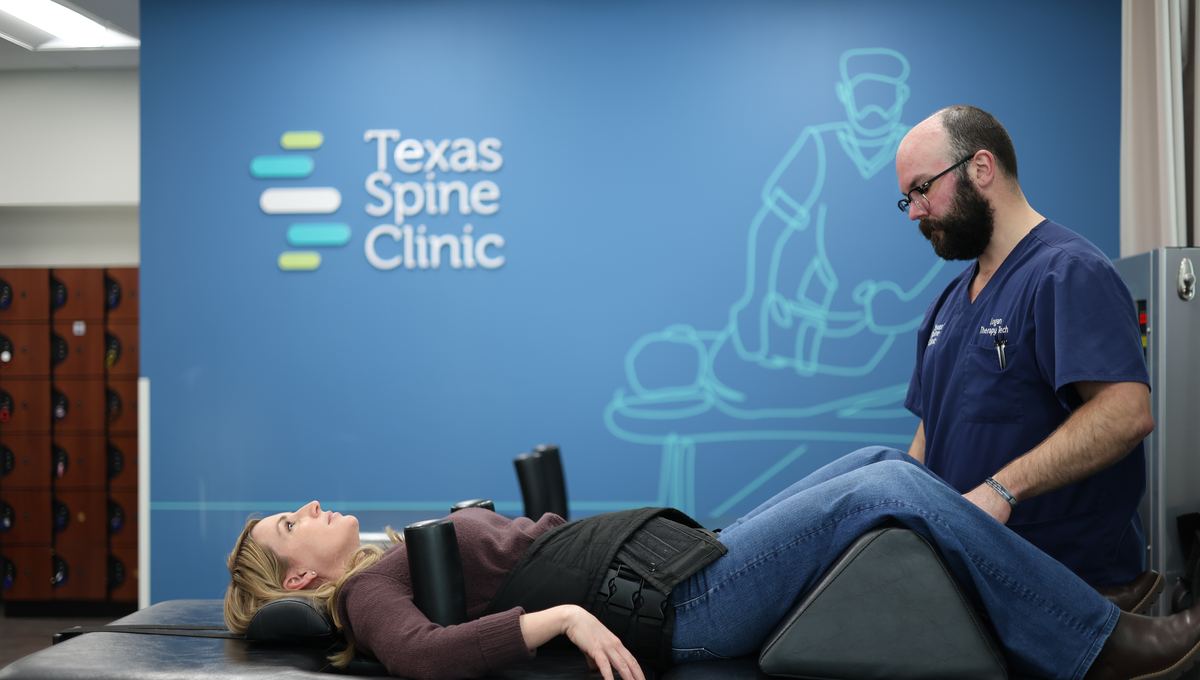
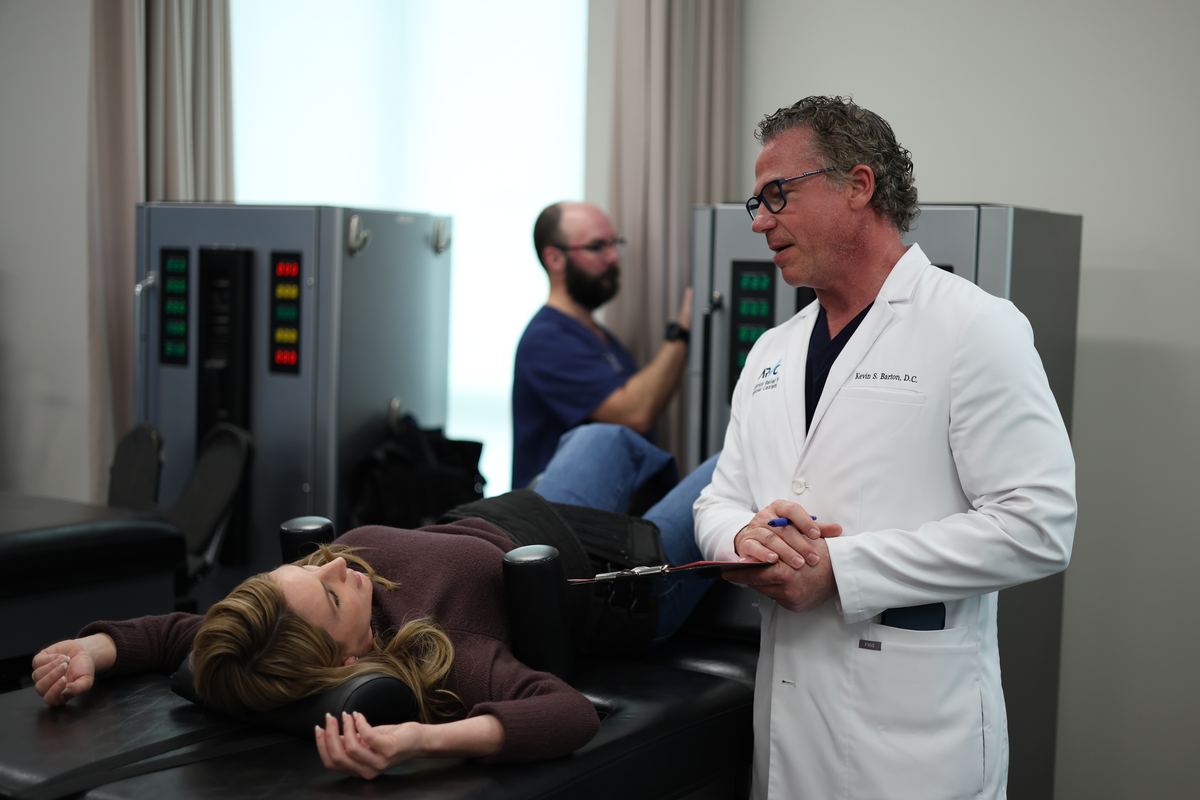
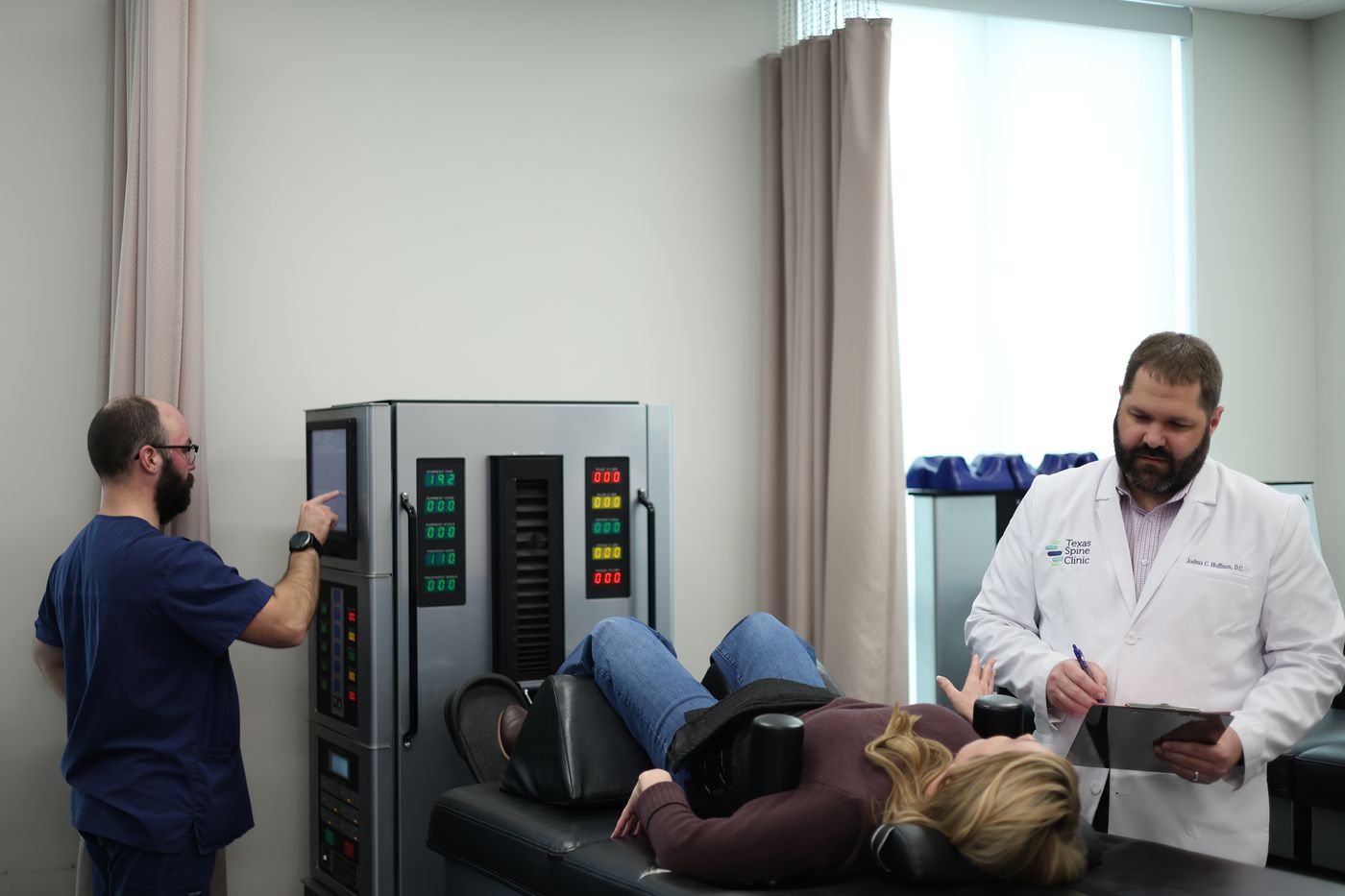
You lie on a padded table, fully clothed, with a harness around your pelvis (or a cradle under your head, for a neck). The DRX9000 applies a measured pull at the angle set for your disc, ramping up and easing off in cycles so the muscles don’t fight it.
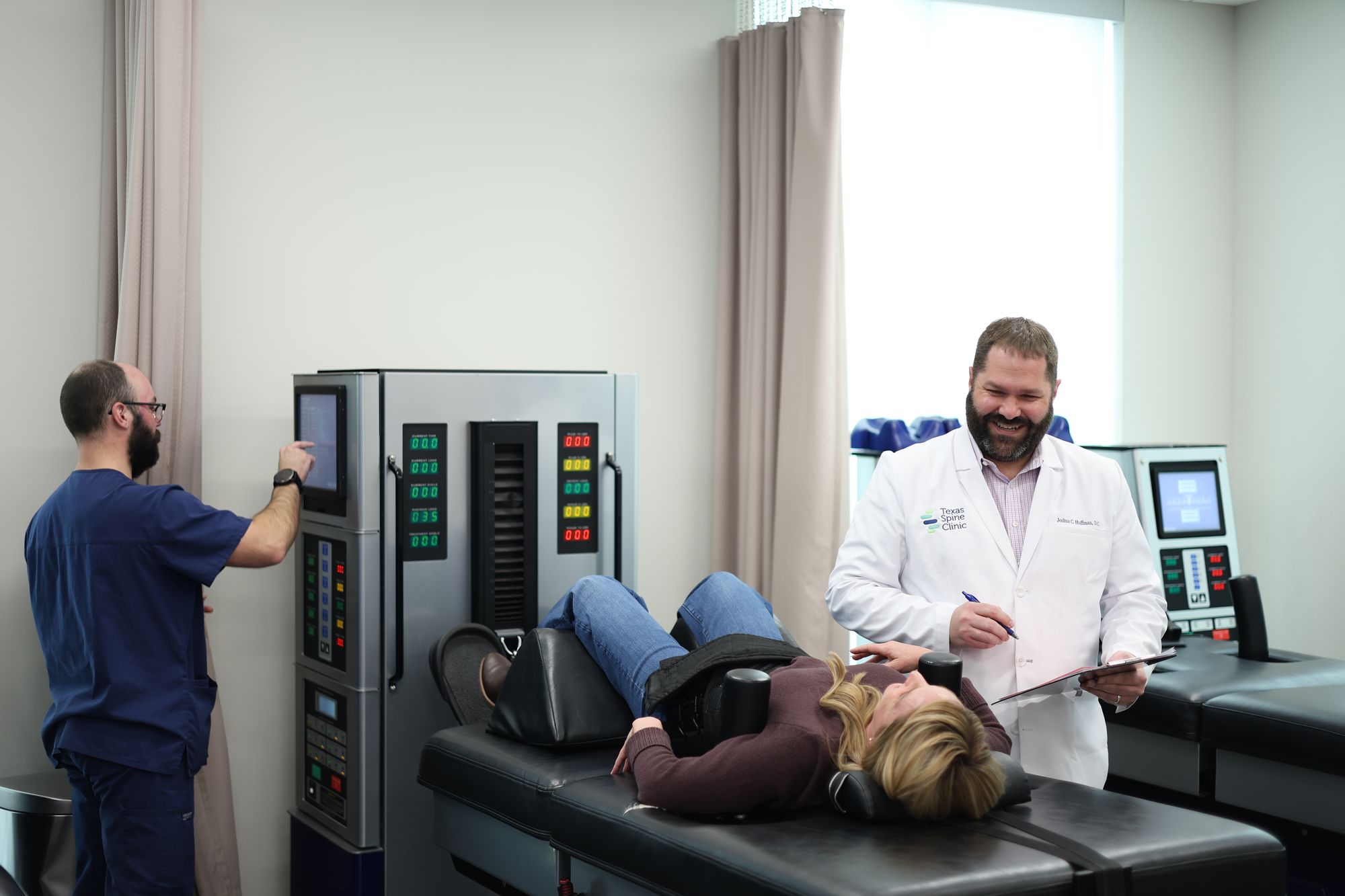
A course runs about 20 to 25 sessions over six to eight weeks. Core strengthening runs alongside decompression, so that when your disc has had its chance to recover, the muscles around it can carry the load. You know by the second week whether your body is responding.
And because nothing is cut, fused or injected, you keep every option you have today. No anesthesia, no hospital stay, no time off work to recover, no medication to wean off of.
Is your disc a candidate?
Not every spine is. The exam decides, not the calendar. We look at your history, test your strength, reflexes and motion, and put your MRI on the screen with you. If something on it says decompression isn’t right for you, we will tell you so.
Find out at a $49 DRX9000 consultation: an exam, your imaging reviewed with you, and if you qualify, your first session the same day.
Book the $49 DRX9000 consultation
Sources
- NASA. Spinal Ultrasound investigation, International Space Station: crew members grow up to three percent taller during long-duration missions and return to their normal height on Earth.
- Botsford DJ, Esses SI, Ogilvie-Harris DJ. In vivo diurnal variation in intervertebral disc volume and morphology. Spine. 1994.
- Hutton WC, et al. Lumbar disc volume measured by MRI: effects of bed rest, horizontal exercise, and vertical loading. Aviation, Space, and Environmental Medicine. 2003.
- Kordi M, Belavý DL, Armbrecht G, Sheikh A, Felsenberg D, Trudel G. Loss and re-adaptation of lumbar intervertebral disc water signal intensity after prolonged bedrest. Journal of Musculoskeletal and Neuronal Interactions. 2015;15(3):294–300.
- Wilke HJ, Neef P, Caimi M, Hoogland T, Claes LE. New in vivo measurements of pressures in the intervertebral disc in daily life. Spine. 1999;24(8):755–762.
- Ramos G, Martin W. Effects of vertebral axial decompression on intradiscal pressure. Journal of Neurosurgery. 1994;81(3):350–353.
- Apfel CC, Cakmakkaya OS, Martin W, et al. Restoration of disk height through non-surgical spinal decompression is associated with decreased discogenic low back pain: a retrospective cohort study. BMC Musculoskeletal Disorders. 2010;11:155.
- El-Zayat RS, et al. Non-surgical spinal decompression versus physiotherapy and traction for lumbar disc herniation. Egyptian Rheumatology and Rehabilitation. 2019.
Full methodology for every study we cite: the evidence page.
This article is educational and is not a substitute for an examination and diagnosis. Individual results vary and no outcome is guaranteed.