← Blog
Nerve Pain
Why is the scrambler therapy machine so big?
Dr. Barton asked its inventor, Dr. Giuseppe Marineo, in Rome. His answer, “it’s the smallest the technology allows,” explains why this is nothing like the TENS unit in your drawer.
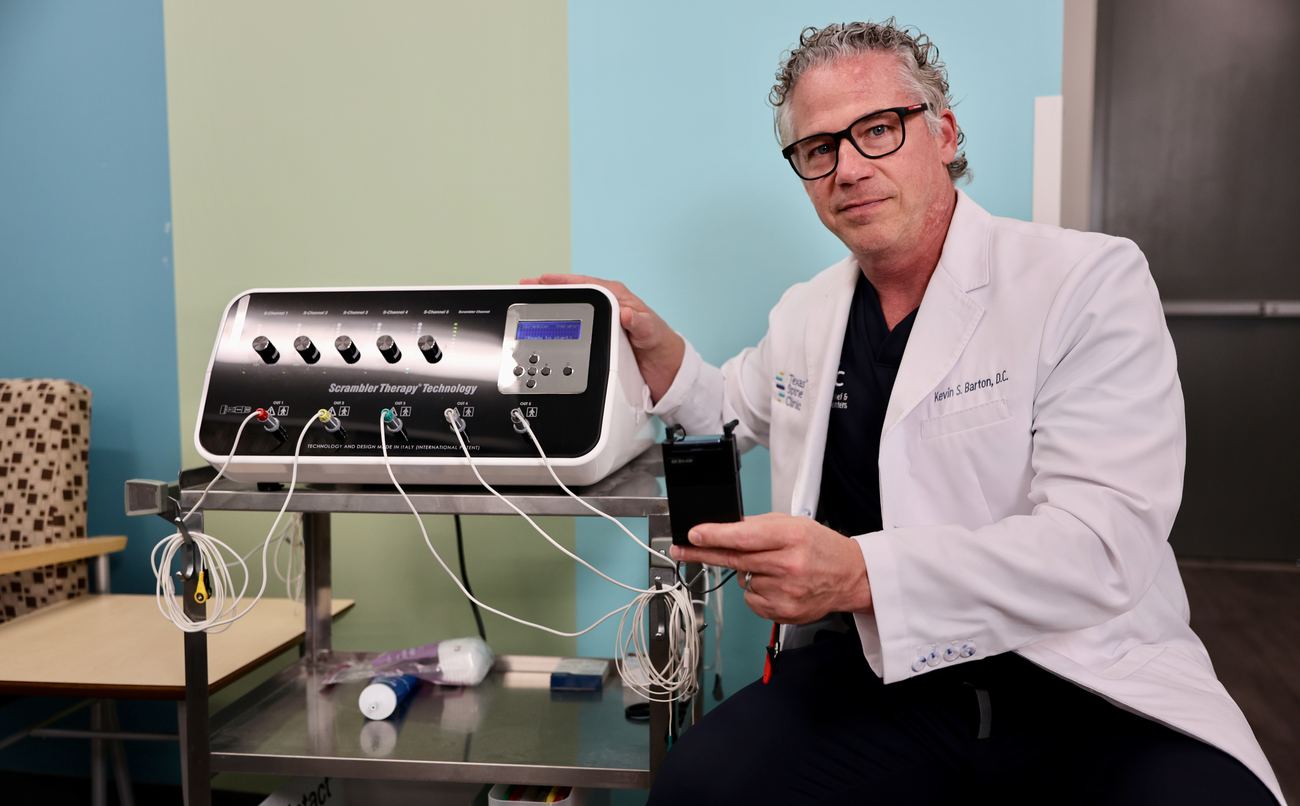
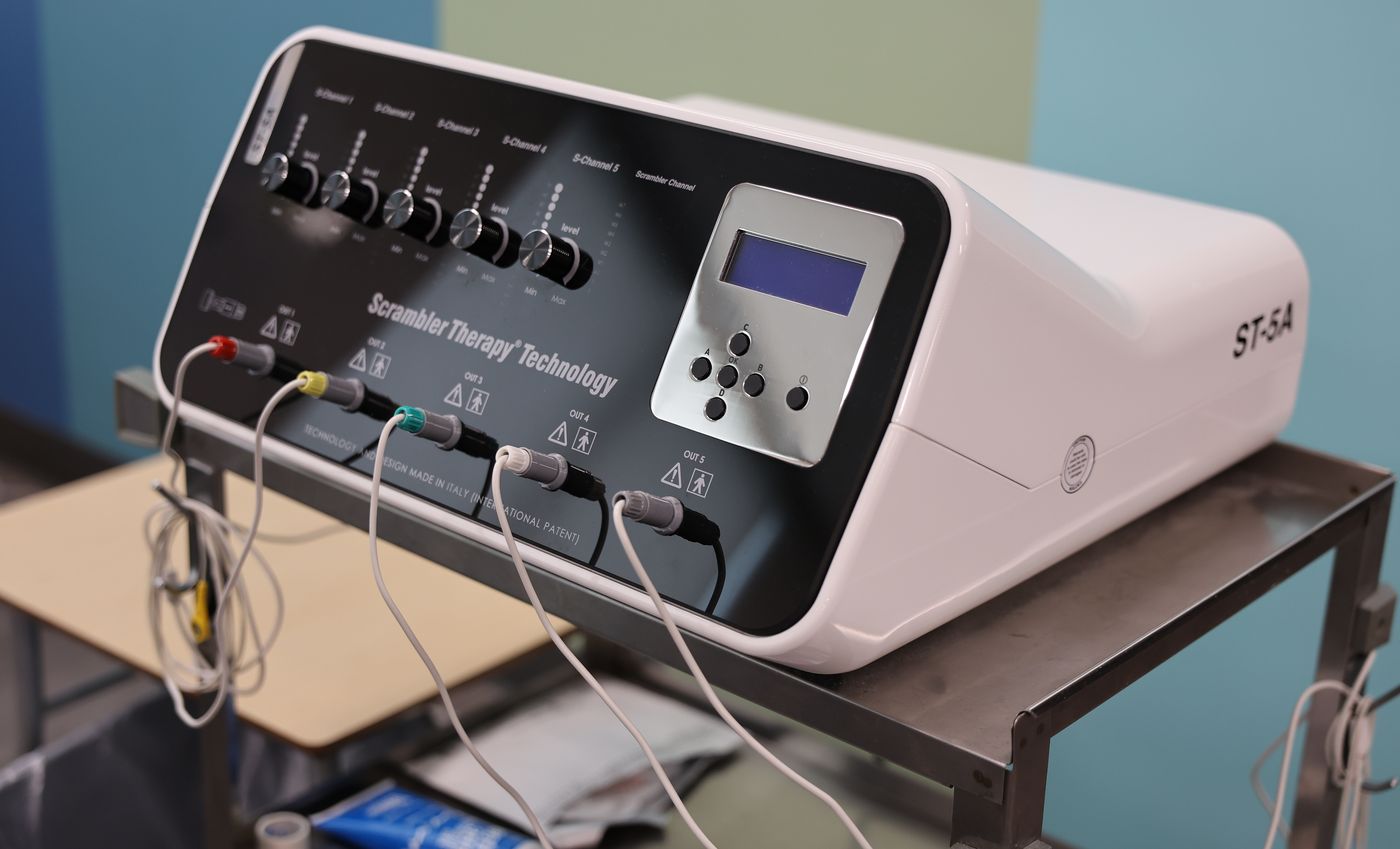
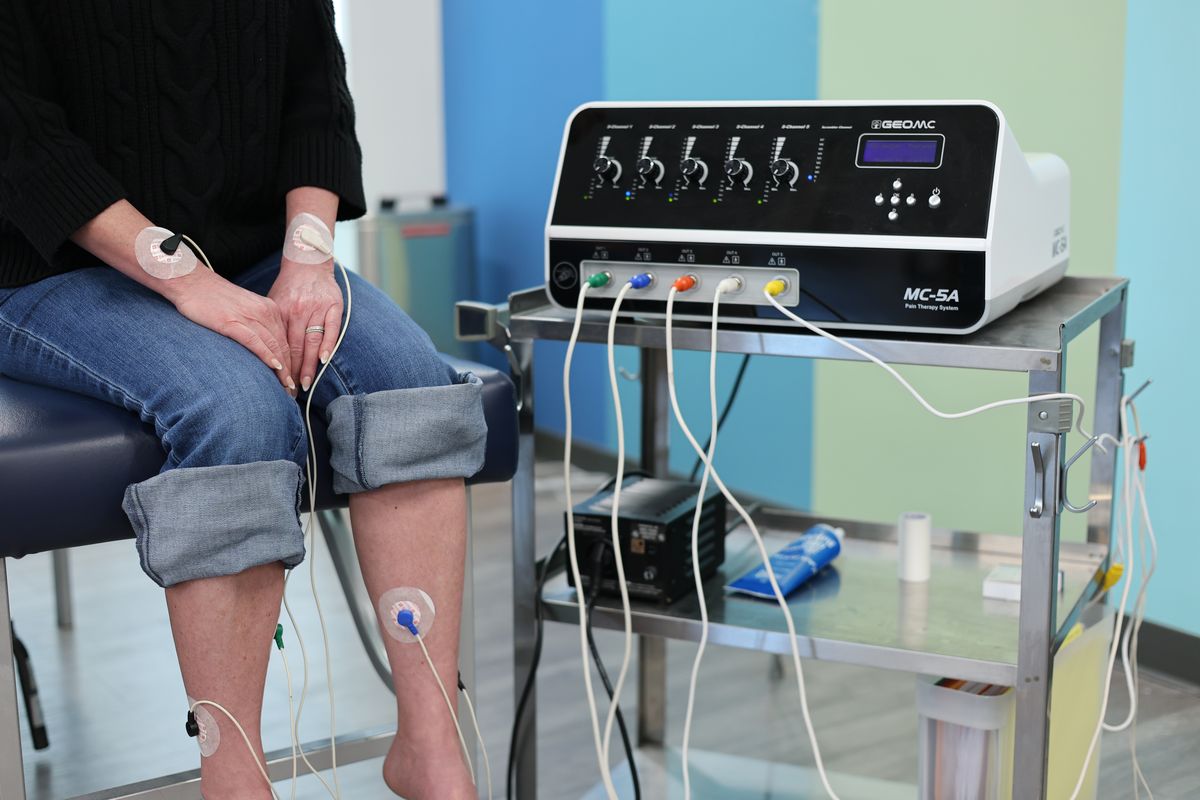
People notice it the moment they walk into the room. The scrambler therapy device is not a gadget. It sits on its own cart, with a panel of color-coded channels and a bundle of cables, and it looks like something that belongs in a hospital, because it does.
Dr. Barton wondered the same thing when he trained on it in Rome with Dr. Giuseppe Marineo, the biophysicist who invented the treatment. So he asked. Why is it so big?
Marineo’s answer: that is the smallest the technology allows them to make it.

That one sentence says a lot, because the question people are really asking is the next one. Isn’t this just a TENS unit? The electrodes look identical. A TENS unit fits in a pocket and sells for forty dollars online. If the two machines did the same thing, one of them would not need a cart.
What the size is for
A TENS unit produces a simple, repeating pulse. You feel a buzz, the buzz competes with the pain for your attention, and when you switch it off the pain is where you left it.
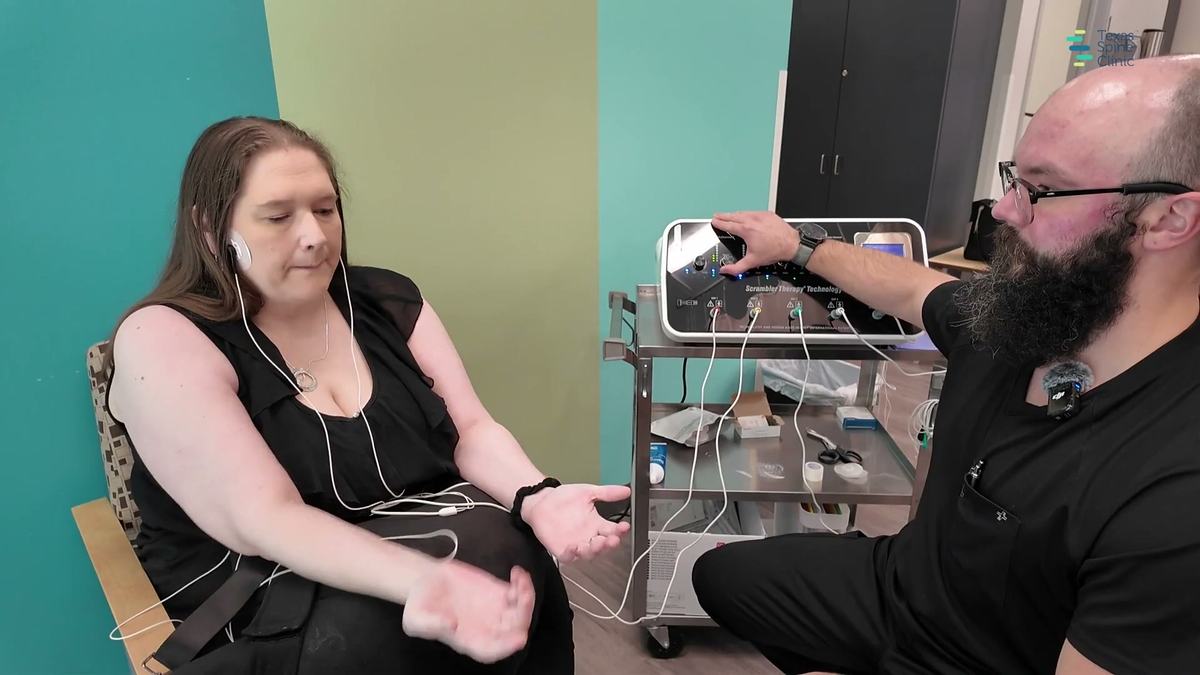
Scrambler therapy is doing something different, and it is the difference that takes the hardware. The device builds sequences of waveforms, changing constantly, shaped to imitate the traffic a healthy nerve sends when nothing is wrong.1 It sends that information up the nerve pathways that serve the painful area, over several independent channels, each with its own pair of electrodes, each set by hand. The goal is not to distract the nervous system from the pain message. It is to hand the nervous system a different message on the same line, for about forty minutes, until the circuit starts to hold on to it.
Dr. Thomas Smith of Johns Hopkins, one of the authors of the New England Journal of Medicine review of the treatment, describes it as pressing Control-Alt-Delete on the pain signal. It is a good picture. You are not being numbed. You are not being drugged. The nerve is being given a new message to carry.
Three differences that matter to you
The NEJM review is explicit that scrambler therapy is not a version or a subcategory of TENS.1 They are different treatments that happen to share a sticker.
- A TENS unit is designed to be adjusted by you, at home, for as long as you like. This machine is not adjustable in that way. Its output is generated by the device’s own program; the settings that shape the signal can’t be turned up or invented by the operator. What the operator controls is where the electrodes go and how strong the sensation is, guided by what you say you feel.
- TENS relief is designed to work while it’s on. For most people it fades within minutes to hours of switching it off. Scrambler therapy is given as a course of sessions, on consecutive weekdays, specifically because it is aiming at relief that outlasts the session.
- You can’t do it at home. The device is restricted to use by physicians, or by trained personnel under a physician’s supervision.1 Here, Dr. Barton performs the treatments, and the program is medically supervised by Lisa D. Persyn, M.D.
If you tried a TENS unit and got nothing, that is not evidence about this. It is the single most common reason people rule themselves out of scrambler therapy, and it tells you nothing about how you will respond.
What it feels like
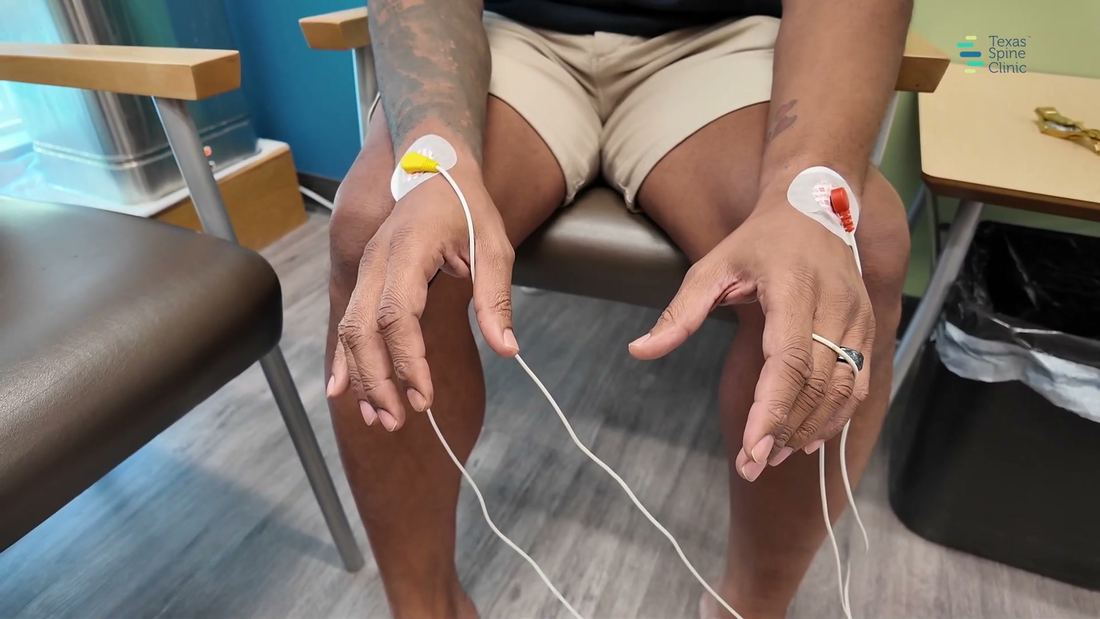
The level comes up slowly, one channel at a time, and the only thing you have to do is tell the truth about what you feel. First tell me when you feel something, then tell me when it’s enough. The target is a clear tingle that is completely comfortable. People describe it as fizzing, or a light buzz, or, in the phrase from the published description, like being bitten by tiny electrical ants.1 It should never hurt. If anything we do makes the pain go up, we stop and change something.
 Watch
Watch Watch
WatchScrambler therapy on PBSDr. Thomas Smith of Johns Hopkins explains how it works.
 Watch
WatchCRPS: what's really driving your painWhy the usual tools fall short, and the treatment most patients have never heard of.
Where to try it, at a price that makes the question answerable
A $19 consultation first: your diagnosis, what you have already tried, and the short list of reasons someone can’t have this treatment. Then a $99 first session, done properly, so you and we can see how your nerves respond, with the $99 credited toward your course if you continue. The machine is big. The first step isn’t.
About scrambler therapy at Texas Spine Clinic
Source
- Scrambler therapy for chronic pain. New England Journal of Medicine, 2023, a review written by physicians at Johns Hopkins and the Mayo Clinic. The description of the signal, the distinction from TENS, and the restriction to physicians or supervised personnel are from this review.
This article is educational and is not a substitute for an examination and diagnosis. Individual results vary and no outcome is guaranteed.